Home
Department Of Physics text logo
  • Research
    • Our research
    • Our research groups
    • Our research in action
    • Research funding support
    • Summer internships for undergraduates
  • Study
    • Undergraduates
    • Postgraduates
  • Engage
    • For alumni
    • For business
    • For schools
    • For the public
Menu
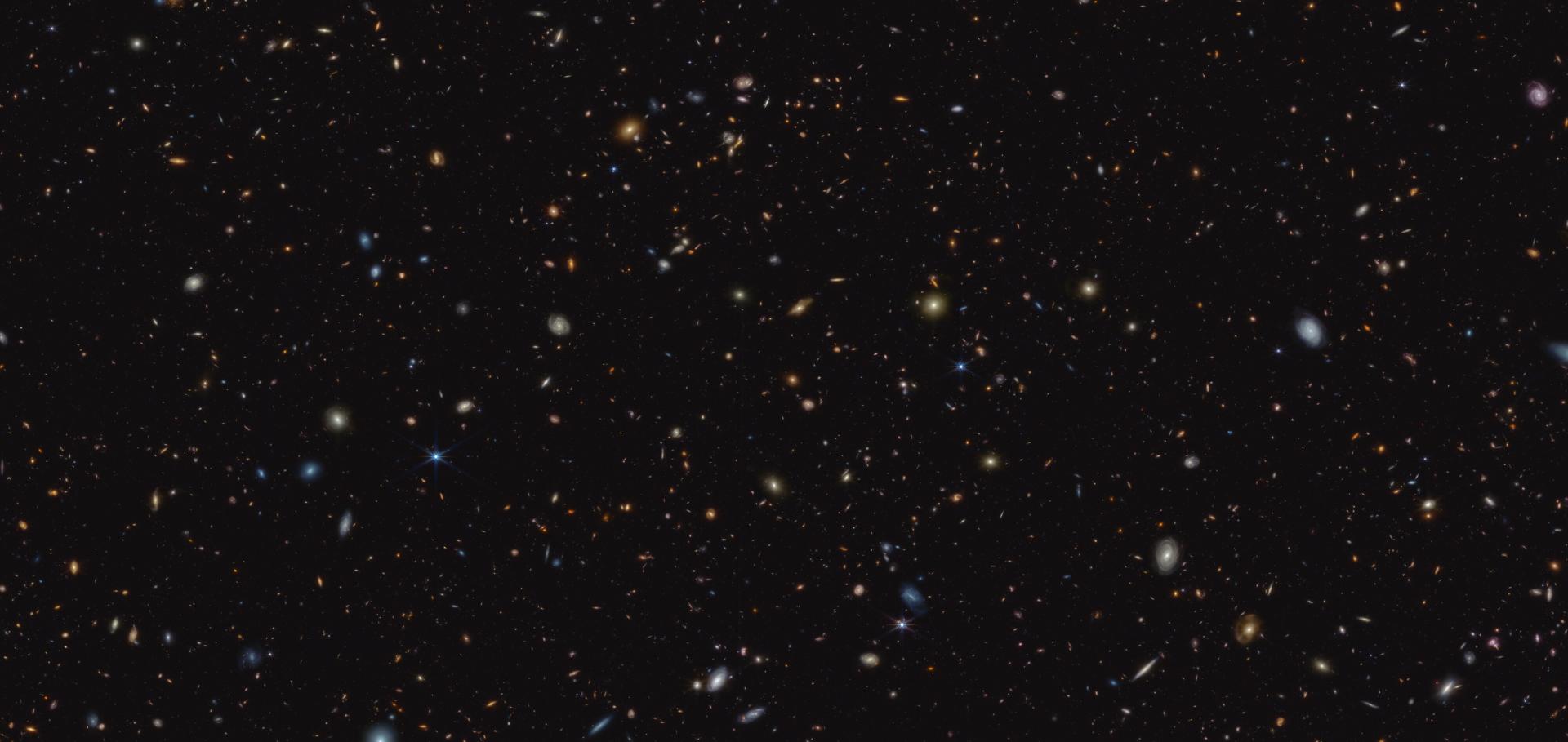
An image of the GOODS-South field as observed by JWST. More than 45,000 galaxies are visible here.

An image of the GOODS-South field as observed by JWST. More than 45,000 galaxies are visible here. In this image, blue, green, and red were assigned to Webb’s NIRCam (Near-Infrared Camera) data at 0.9, 1.15, and 1.5 microns; 2.0, 2.77, and 3.55 microns; and 3.56, 4.1, and 4.44 microns (F090W, F115W, and F150W; F200W, F277W, and F335M; and F356W, F410M, and F444W), respectively.

Credit: NASA, ESA, CSA, B. Robertson (UC Santa Cruz), B. Johnson (Center for Astrophysics, Harvard & Smithsonian), S. Tacchella (Univers

Dr Jacopo Chevallard

Postdoctoral Research Assistant

Research theme

  • Astronomy and astrophysics

Sub department

  • Astrophysics

Research groups

  • Galaxy formation and evolution
jacopo.chevallard@physics.ox.ac.uk
Telephone: 01865 273467
Denys Wilkinson Building, room 463
  • About
  • Publications

Encoding the infrared excess (IRX) in the NUVrK color diagram for star-forming galaxies

ArXiv 1309.0008 (2013)

Authors:

Stephane Arnouts, Emeric Le Floc'h, Jacopo Chevallard, Benjamin D Johnson, Olivier Ilbert, Marie Treyer, Herve Aussel, Peter Capak, Dave B Sanders, Nick Scoville, Henry J McCracken, Bruno Milliard, Lucia Pozzetti, Mara Salvato

Abstract:

We present an empirical method of assessing the star formation rate (SFR) of star-forming galaxies based on their locations in the rest-frame color-color diagram (NUV-r) vs (r-K). By using the Spitzer 24 micron sample in the COSMOS field (~16400 galaxies with 0.2 < z < 1.3) and a local GALEX-SDSS-SWIRE sample (~700 galaxies with z < 0.2), we show that the mean infrared excess = < L_IR / L_UV > can be described by a single vector, NRK, that combines the two colors. The calibration between and NRK allows us to recover the IR luminosity, L_IR, with an accuracy of ~0.21 dex for the COSMOS sample and ~0.27 dex for the local one. The SFRs derived with this method agree with the ones based on the observed (UV+IR) luminosities and on the spectral energy distribution fitting for the vast majority (~85 %) of the star-forming population. Thanks to a library of model galaxy SEDs with realistic prescriptions for the star formation history, we show that we need to include a two-component dust model (i.e., birth clouds and diffuse ISM) and a full distribution of galaxy inclinations in order to reproduce the behavior of the stripes in the NUVrK diagram. In conclusion, the NRK method, based only on rest-frame UV and optical colors available in most of the extragalactic fields, offers a simple alternative of assessing the SFR of star-forming galaxies in the absence of far-IR or spectral diagnostic observations.
Details from ArXiV

Insights into the content and spatial distribution of dust from the integrated spectral properties of galaxies

ArXiv 1303.6631 (2013)

Authors:

Jacopo Chevallard, Stephane Charlot, Benjamin Wandelt, Vivienne Wild

Abstract:

[Abridged] We present a new approach to investigate the content and spatial distribution of dust in structurally unresolved star-forming galaxies from the observed dependence of integrated spectral properties on galaxy inclination. We develop an innovative combination of generic models of radiative transfer (RT) in dusty media with a prescription for the spectral evolution of galaxies, via the association of different geometric components of galaxies with stars in different age ranges. We show that a wide range of RT models all predict a quasi-universal relation between slope of the attenuation curve at any wavelength and V-band attenuation optical depth in the diffuse interstellar medium (ISM), at all galaxy inclinations. This relation predicts steeper (shallower) dust attenuation curves than both the Calzetti and MW curves at small (large) attenuation optical depths, which implies that geometry and orientation effects have a stronger influence on the shape of the attenuation curve than changes in the optical properties of dust grains. We use our combined RT and spectral evolution model to interpret the observed dependence of the H\alpha/H\beta\ ratio and ugrizYJH attenuation curve on inclination in a sample of ~23 000 nearby star-forming galaxies. From a Bayesian MCMC fit, we measure the central face-on B-band optical depth of this sample to be tau_B\perp~1.8\pm0.2. We also quantify the enhanced optical depth towards newly formed stars in their birth clouds, finding this to be significantly larger in galaxies with bulges than in disc-dominated galaxies, while tau_B\perp is roughly similar in both cases. Finally, we show that neglecting the effect of geometry and orientation on attenuation can severely bias the interpretation of galaxy spectral energy distributions, as the impact on broadband colours can reach up to 0.3-0.4 mag at optical wavelengths and 0.1 mag at near-infrared ones.
Details from ArXiV

Pagination

  • First page First
  • Previous page Prev
  • …
  • Page 5
  • Page 6
  • Page 7
  • Page 8
  • Page 9
  • Page 10
  • Page 11
  • Page 12
  • Current page 13

Footer Menu

  • Contact us
  • Giving to the Dept of Physics
  • Work with us
  • Media

User account menu

  • Log in

Follow us

FIND US

Clarendon Laboratory,

Parks Road,

Oxford,

OX1 3PU

CONTACT US

Tel: +44(0)1865272200

University of Oxfrod logo Department Of Physics text logo
IOP Juno Champion logo Athena Swan Silver Award logo

© University of Oxford - Department of Physics

Cookies | Privacy policy | Accessibility statement

Built by: Versantus

  • Home
  • Research
  • Study
  • Engage
  • Our people
  • News & Comment
  • Events
  • Our facilities & services
  • About us
  • Giving to Physics
  • Current students
  • Staff intranet