Home
Department Of Physics text logo
  • Research
    • Our research
    • Our research groups
    • Our research in action
    • Research funding support
    • Summer internships for undergraduates
  • Study
    • Undergraduates
    • Postgraduates
  • Engage
    • For alumni
    • For business
    • For schools
    • For the public
  • Support
Menu
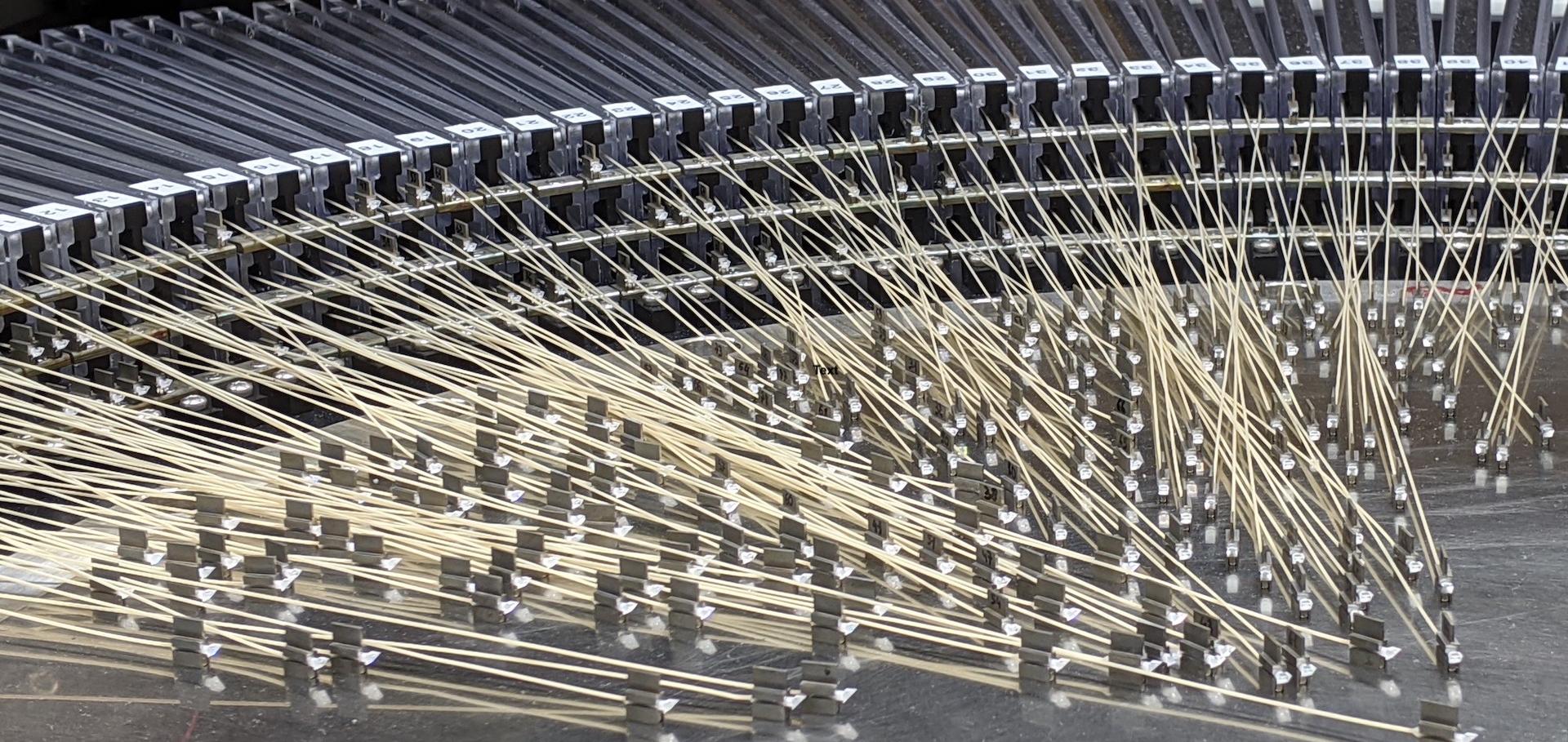
Part of a WEAVE fibre configuration

Part of the WEAVE focal plane showing optical fibres positioned on a set of targets in the telescope focal plane.

Prof Gavin Dalton

Professor of Astrophysics

Research theme

  • Astronomy and astrophysics

Sub department

  • Astrophysics

Research groups

  • Astronomical instrumentation
  • Extremely Large Telescope
Gavin.Dalton@physics.ox.ac.uk
  • About
  • Research
  • Publications

Black hole mass and eddington ratio distribution functions of X-ray-selected broad-line AGNs at z ∼ 1.4 in the Subaru XMM-Newton Deep Field

Astrophysical Journal 761:2 (2012)

Authors:

K Nobuta, M Akiyama, Y Ueda, MG Watson, J Silverman, K Hiroi, K Ohta, F Iwamuro, K Yabe, N Tamura, Y Moritani, M Sumiyoshi, N Takato, M Kimura, T Maihara, G Dalton, I Lewis, D Bonfield, H Lee, E Curtis-Lake, E MacAulay, F Clarke, K Sekiguchi, C Simpson, S Croom, M Ouchi, H Hanami, T Yamada

Abstract:

In order to investigate the growth of supermassive black holes (SMBHs), we construct the black hole mass function (BHMF) and Eddington ratio distribution function (ERDF) of X-ray-selected broad-line active galactic nuclei (AGNs) at z ∼ 1.4 in the Subaru XMM-Newton Deep Survey (SXDS) field. A significant part of the accretion growth of SMBHs is thought to take place in this redshift range. Black hole masses of X-ray-selected broad-line AGNs are estimated using the width of the broad Mg II line and 3000 Å monochromatic luminosity. We supplement the Mg II FWHM values with the Hα FWHM obtained from our NIR spectroscopic survey. Using the black hole masses of broad-line AGNs at redshifts between 1.18 and 1.68, the binned broad-line AGN BHMFs and ERDFs are calculated using the V maxmethod. To properly account for selection effects that impact the binned estimates, we derive the corrected broad-line AGN BHMFs and ERDFs by applying the maximum likelihood method, assuming that the ERDF is constant regardless of the black hole mass. We do not correct for the non-negligible uncertainties in virial BH mass estimates. If we compare the corrected broad-line AGN BHMF with that in the local universe, then the corrected BHMF at z = 1.4 has a higher number density above 108 M⊙but a lower number density below that mass range. The evolution may be indicative of a downsizing trend of accretion activity among the SMBH population. The evolution of broad-line AGN ERDFs from z = 1.4 to 0 indicates that the fraction of broad-line AGNs with accretion rates close to the Eddington limit is higher at higher redshifts. © 2012. The American Astronomical Society. All rights reserved..
More details from the publisher
More details

Development of the single fibres and IFUs of WEAVE

Proceedings of SPIE - The International Society for Optical Engineering 8450 (2012)

Authors:

I Guinouard, P Bonifacio, SC Trager, MAW Verheijen, I Lewis, G Dalton

Abstract:

WEAVE is a new wide-field spectroscopy facility proposed for the prime focus of the 4.2m William Herschel telescope. The facility comprises a new 2 degree field of view prime focus corrector with a 1000-multiplex fibre positioner, a small number of individually deployable IFUs, and a large single IFU. The IFUs and the MOS fibres can be used to feed a dual-beam spectrograph that will provide full coverage of the majority of the visible spectrum in a single exposure at a resolution ∼5000 or two 50nm-wide regions at a resolution of ∼20000. This paper sums up the design of these two modes and describes the specific developments required to optimise the performances of the fibre system. © 2012 SPIE.
More details from the publisher
More details

Multi-object spectroscopy with the European ELT: Scientific synergies between EAGLE & EVE

Proceedings of SPIE - The International Society for Optical Engineering 8446 (2012)

Authors:

CJ Evans, B Barbuy, P Bonifacio, F Chemla, JG Cuby, GB Dalton, B Davies, K Disseau, K Dohlen, H Flores, E Gendron, I Guinouard, F Hammer, P Hastings, D Horville, P Jagourel, L Kaper, P Laporte, D Lee, SL Morris, T Morris, R Myers, R Navarro, P Parr-Burman, P Petitjean, M Puech, E Rollinde, G Rousset, H Schnetler, N Welikala, M Wells, Y Yang

Abstract:

The EAGLE and EVE Phase A studies for instruments for the European Extremely Large Telescope (E-ELT) originated from related top-level scientific questions, but employed different (yet complementary) methods to deliver the required observations. We re-examine the motivations for a multi-object spectrograph (MOS) on the E-ELT and present a unified set of requirements for a versatile instrument. Such a MOS would exploit the excellent spatial resolution in the near-infrared envisaged for EAGLE, combined with aspects of the spectral coverage and large multiplex of EVE. We briefly discuss the top-level systems which could satisfy these requirements in a single instrument at one of the Nasmyth foci of the E-ELT. © 2012 SPIE.
More details from the publisher
More details
Details from ArXiV

Subaru FMOS now and future

Proceedings of SPIE - The International Society for Optical Engineering 8446 (2012)

Authors:

N Tamura, N Takato, F Iwamuro, M Akiyama, M Kimura, P Tait, GB Dalton, GJ Murray, S Smedley, T Maihara, K Ohta, Y Moritani, K Yabe, M Sumiyoshi, T Totani, H Sugai, H Karoji, SY Wang, Y Ohyama

Abstract:

Fiber Multi Object Spectrograph "FMOS" on Subaru Telescope is capable of configuring 400 fibers on the 30-arcmin diameter field of view at the prime focus for near-infrared (0.9-1.8 μm) spectroscopy, and this instrument has been open as a common-use instrument since May 2010. In this article, an overview of the instrument is given first, and then the typical operational sequence in science observation and a few notable features of the instrument are explained. In §§ 5, the instrument performance in terms of fiber positioning, auto guiding, and sensitivity to emission lines are highlighted. Recently (since March 2012) a Subaru Strategic Program (SSP) has started with FMOS to conduct a wide-field galaxy survey for a cosmological experiment. Upgrading fiber configuration by using a "metrology camera" has also been under discussion, which will enable to measure the positions of the 400 fibers quickly and shorten the fiber configuration time significantly. We will also report the status of these recent activities. © 2012 SPIE.
More details from the publisher
More details

VIRUS: Production of a massively replicated 33k fiber integral field spectrograph for the upgraded Hobby-Eberly Telescope

Proceedings of SPIE - The International Society for Optical Engineering 8446 (2012)

Authors:

GJ Hill, SE Tuttle, H Lee, BL Vattiat, ME Cornell, DL DePoy, N Drory, MH Fabricius, A Kelz, JL Marshall, JD Murphy, T Prochaska, RD Allen, R Bender, G Blanc, T Chonis, G Dalton, K Gebhardt, J Good, D Haynes, T Jahn, PJ MacQueen, MD Rafal, MM Roth, RD Savage, J Snigula

Abstract:

The Visible Integral-field Replicable Unit Spectrograph (VIRUS) consists of a baseline build of 150 identical spectrographs (arrayed as 75 units, each with a pair of spectrographs) fed by 33,600 fibers, each 1.5 arcsec diameter, deployed over the 22 arcminute field of the upgraded 10 m Hobby-Eberly Telescope (HET). The goal is to deploy 82 units. VIRUS has a fixed bandpass of 350-550 nm and resolving power R∼700. VIRUS is the first example of industrial-scale replication applied to optical astronomy and is capable of spectral surveys of large areas of sky. This approach, in which a relatively simple, inexpensive, unit spectrograph is copied in large numbers, offers significant savings of engineering effort, cost, and schedule when compared to traditional instruments. The main motivator for VIRUS is to map the evolution of dark energy for the Hobby-Eberly Telescope Dark Energy Experiment (HETDEX‡) using 0.8M Lyman-α emitting galaxies as tracers. The full VIRUS array is due to be deployed by early 2014 and will provide a powerful new facility instrument for the HET, well suited to the survey niche of the telescope. VIRUS and HET will open up wide-field surveys of the emission-line universe for the first time. We present the production design and current status of VIRUS. © 2012 SPIE.
More details from the publisher
More details

Pagination

  • First page First
  • Previous page Prev
  • …
  • Page 29
  • Page 30
  • Page 31
  • Page 32
  • Current page 33
  • Page 34
  • Page 35
  • Page 36
  • Page 37
  • …
  • Next page Next
  • Last page Last

Footer Menu

  • Contact us
  • Giving to the Dept of Physics
  • Work with us
  • Media

User account menu

  • Log in

Follow us

FIND US

Clarendon Laboratory,

Parks Road,

Oxford,

OX1 3PU

CONTACT US

Tel: +44(0)1865272200

University of Oxfrod logo Department Of Physics text logo
IOP Juno Champion logo Athena Swan Silver Award logo

© University of Oxford - Department of Physics

Cookies | Privacy policy | Accessibility statement

Built by: Versantus

  • Home
  • Research
  • Study
  • Engage
  • Our people
  • News & Comment
  • Events
  • Our facilities & services
  • About us
  • Giving to Physics
  • Current students
  • Staff intranet