Home
Department Of Physics text logo
  • Research
    • Our research
    • Our research groups
    • Our research in action
    • Research funding support
    • Summer internships for undergraduates
  • Study
    • Undergraduates
    • Postgraduates
  • Engage
    • For alumni
    • For business
    • For schools
    • For the public
  • Support
Menu
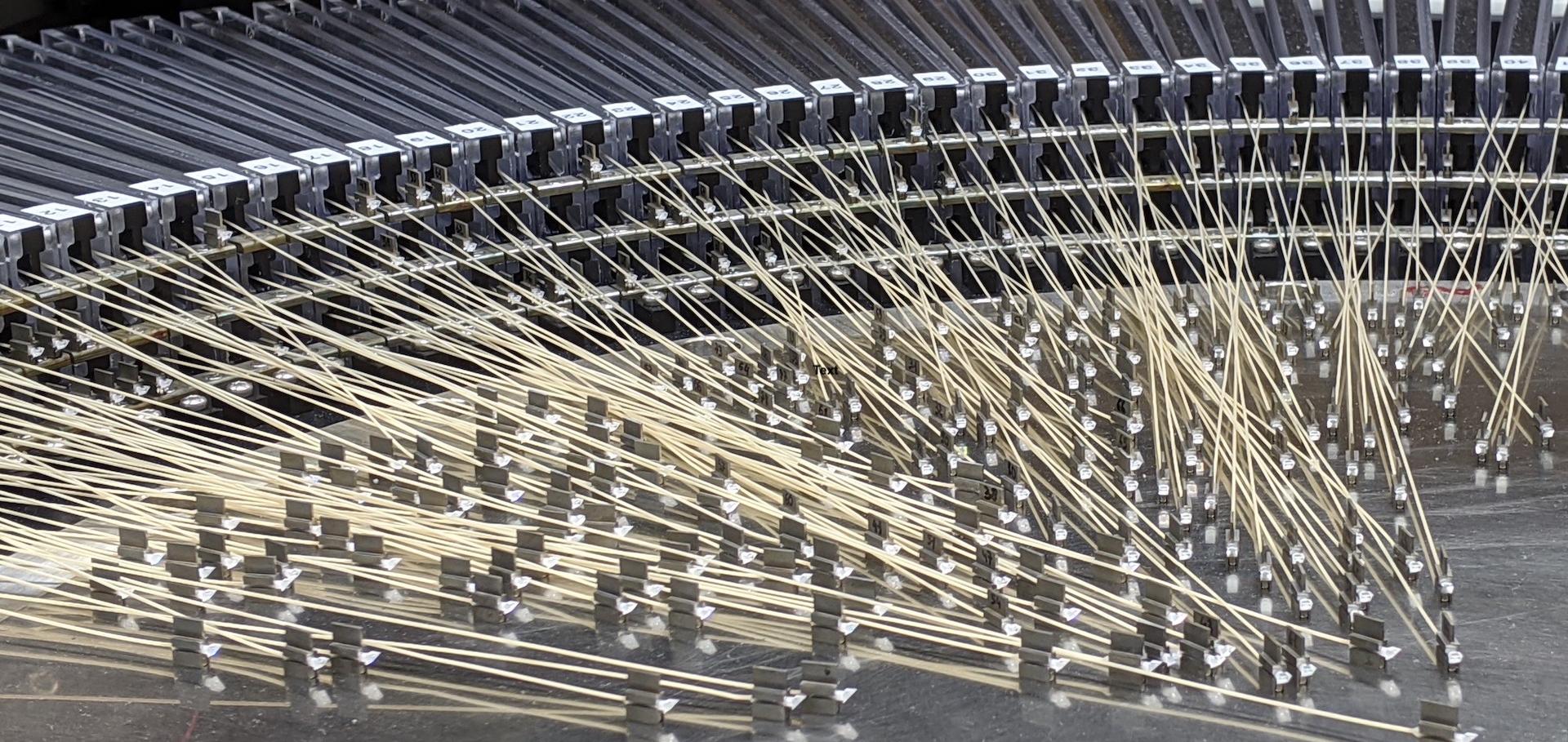
Part of a WEAVE fibre configuration

Part of the WEAVE focal plane showing optical fibres positioned on a set of targets in the telescope focal plane.

Prof Gavin Dalton

Professor of Astrophysics

Research theme

  • Astronomy and astrophysics

Sub department

  • Astrophysics

Research groups

  • Astronomical instrumentation
  • Extremely Large Telescope
Gavin.Dalton@physics.ox.ac.uk
  • About
  • Research
  • Publications

WEAVE: The next generation wide-field spectroscopy facility for the William Herschel Telescope

Proceedings of SPIE - The International Society for Optical Engineering 8446 (2012)

Authors:

G Dalton, S Trager, DC Abrams, D Carter, P Bonifacio, JAL Aguerri, M MacIntosh, C Evans, I Lewis, R Navarro, T Agocs, K Dee, S Rousset, I Tosh, K Middleton, J Pragt, D Terrett, M Brock, C Benn, M Verheijen, D Cano, C Bevil, I Steele, C Mottram, S Bates, F Gribbin, J Rey, LF Rodriguez, JM Delgado, I Guinouard, N Walton, M Irwin, P Jagourel, R Stuik, G Gerlofsma, R Roelfsma, I Skillen, A Ridings, M Balcells, JB Daban, C Gouvret, L Venema, P Girard

Abstract:

We present the preliminary design of the WEAVE next generation spectroscopy facility for the William Herschel Telescope (WHT), principally targeting optical ground-based follow up of upcoming ground-based (LOFAR) and space-based (Gaia) surveys. WEAVE is a multi-object and multi-IFU facility utilizing a new 2 degree prime focus field of view at the WHT, with a buffered pick and place positioner system hosting 1000 multi-object (MOS) fibres or up to 30 integral field units for each observation. The fibres are fed to a single spectrograph, with a pair of 8k(spectral) x 6k (spatial) pixel cameras, located within the WHT GHRIL enclosure on the telescope Nasmyth platform, supporting observations at R-5000 over the full 370-1000nm wavelength range in a single exposure, or a high resolution mode with limited coverage in each arm at R-20000. © 2012 SPIE.
More details from the publisher
More details

FMOS near-IR spectroscopy of herschel-selected galaxies: Star formation rates, metallicity and dust attenuation at z ~ 1

Monthly Notices of the Royal Astronomical Society 426:3 (2012) 1782-1792

Authors:

IG Roseboom, A Bunker, M Sumiyoshi, L Wang, G Dalton, M Akiyama, J Bock, D Bonfield, V Buat, C Casey, E Chapin, DL Clements, A Conley, E Curtis-Lake, A Cooray, JS Dunlop, D Farrah, SJ Ham, E Ibar, F Iwamuro, M Kimura, I Lewis, E Macaulay, G Magdis, T Maihara, G Marsden, T Mauch, Y Moritani, K Ohta, SJ Oliver, MJ Page, B Schulz, D Scott, M Symeonidis, N Takato, N Tamura, T Totani, K Yabe, M Zemcov

Abstract:

We investigate the properties (e.g. star formation rate, dust attenuation, stellar mass and metallicity) of a sample of infrared (IR) luminous galaxies at z ~ 1 via near-IR spectroscopy with Subaru-FMOS. Our sample consists of Herschel SPIRE and Spitzer MIPS selected sources in the COSMOS field with photometric redshifts in the range of 0.7 < zphot < 1.8, which have been targeted in two pointings (0.5 deg2) with FMOS. We find a modest success rate for emission-line detections, with candidate Hα emission lines detected for 57 of 168 SPIRE sources (34 per cent). By stacking the near-IR spectra we directly measure the mean Balmer decrement for the Hα and Hβ lines, finding a value of 〈E(B - V)〉 = 0.51 ± 0.27 for 〈LIR〉 = 1012 L⊙ sources at 〈z〉 = 1.36. By comparing star formation rates estimated from the IR and from the dust-uncorrected Ha line we find a strong relationship between dust attenuation and star formation rate. This relation is broadly consistent with that previously seen in star-forming galaxies at z ~ 0.1. Finally, we investigate the metallicity via the N2 ratio, finding that z ~ 1 IR-selected sources are indistinguishable from the local mass-metallicity relation. We also find a strong correlation between dust attenuation and metallicity, with the most metal-rich IR sources experiencing the largest levels of dust attenuation. © 2012 The Authors, Monthly Notices of the Royal Astronomical Society.
More details from the publisher
More details

Black hole mass and Eddington ratio distribution functions of X-ray selected broad-line AGNs at z~1.4 in the Subaru XMM-Newton Deep Field

(2012)

Authors:

K Nobuta, M Akiyama, Y Ueda, MG Watson, J Silverman, K Hiroi, K Ohta, F Iwamuro, K Yabe, N Tamura, Y Moritani, M Sumiyoshi, M Kimura, T Maihara, G Dalton, I Lewis, D Bonfield, H Lee, E Curtis Lake, E Macaulay, F Clarke, K Sekiguchi, C Simpson, S Croom, M Ouchi, H Hanami, T Yamada
More details from the publisher

The VISTA Deep Extragalactic Observations (VIDEO) Survey

Monthly Notices of the Royal Astronomical Society 428 (2012)

Authors:

MJ Jarvis, DG Bonfield, VA Bruce, JE Geach, K McAlpine, RJ McLure, E Gonzalez-Solares, M Irwin, J Lewis, A Kupcu Yoldas, S Andreon, NJG Cross, JP Emerson, G Dalton, JS Dunlop, ST Hodgkin, O Le Fevre, M Karouzos, K Meisenheimer, S Oliver, S Rawlings, C Simpson, I Smail, DJB Smith, M Sullivan, W Sutherland, SV White, JTL Zwart
More details from the publisher
More details
Details from ArXiV

Subaru FMOS now and future

Society of Photo-Optical Instrumentation Engineers (SPIE) 8446 (2012) 0-0

Authors:

N Tamura, N Takato, F Iwamuro, M Akiyama, M Kimura, P Tait, GB Dalton, GJ Murray, S Smedley, T Maihara, K Ohta, Y Moritani, K Yabe, M Sumiyoshi, T Totani, H Sugai, H Karoji, S-Y Wang, Y Ohyama

Pagination

  • First page First
  • Previous page Prev
  • …
  • Page 30
  • Page 31
  • Page 32
  • Page 33
  • Current page 34
  • Page 35
  • Page 36
  • Page 37
  • Page 38
  • …
  • Next page Next
  • Last page Last

Footer Menu

  • Contact us
  • Giving to the Dept of Physics
  • Work with us
  • Media

User account menu

  • Log in

Follow us

FIND US

Clarendon Laboratory,

Parks Road,

Oxford,

OX1 3PU

CONTACT US

Tel: +44(0)1865272200

University of Oxfrod logo Department Of Physics text logo
IOP Juno Champion logo Athena Swan Silver Award logo

© University of Oxford - Department of Physics

Cookies | Privacy policy | Accessibility statement

Built by: Versantus

  • Home
  • Research
  • Study
  • Engage
  • Our people
  • News & Comment
  • Events
  • Our facilities & services
  • About us
  • Giving to Physics
  • Current students
  • Staff intranet