Home
Department Of Physics text logo
  • Research
    • Our research
    • Our research groups
    • Our research in action
    • Research funding support
    • Summer internships for undergraduates
  • Study
    • Undergraduates
    • Postgraduates
  • Engage
    • For alumni
    • For business
    • For schools
    • For the public
  • Support
Menu
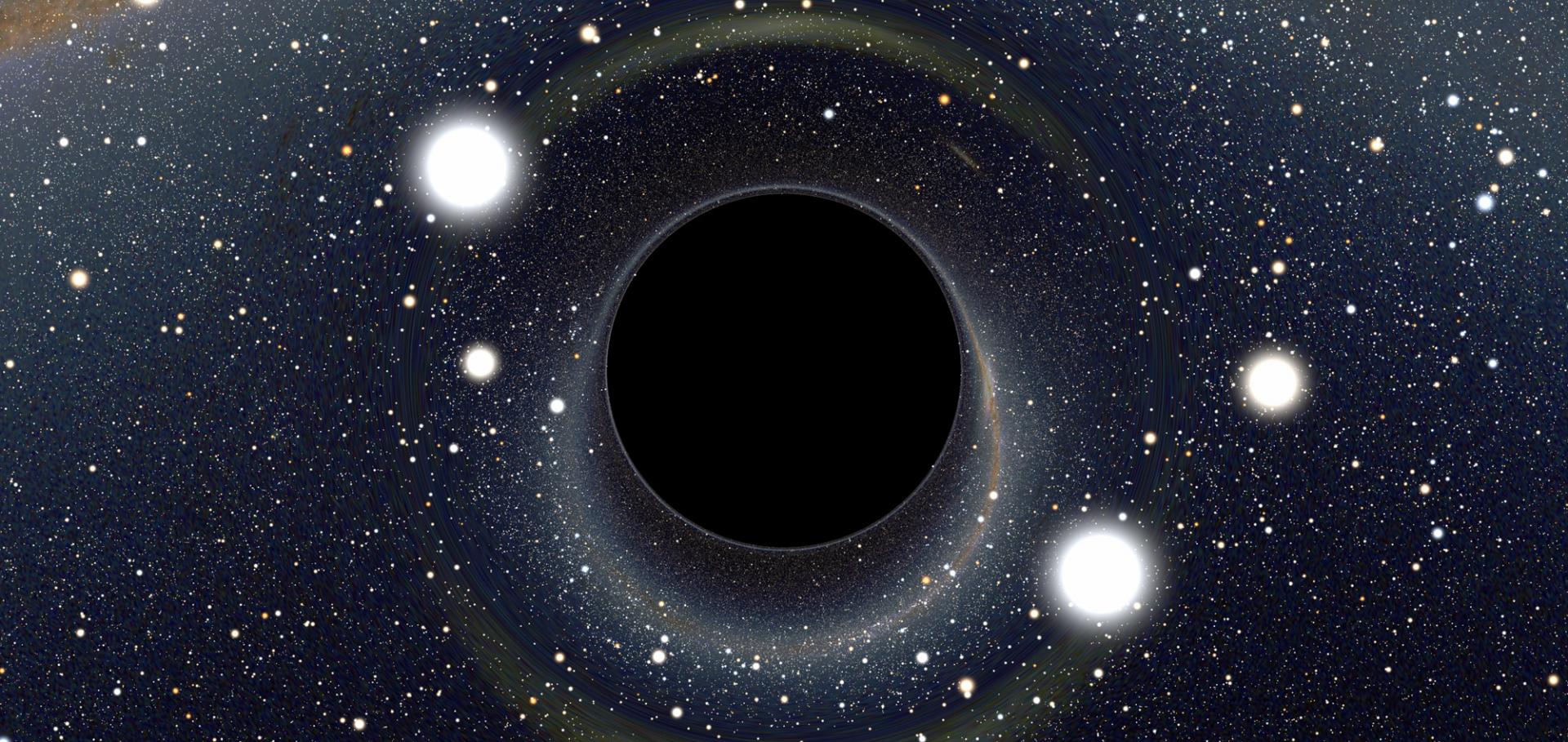
Black Hole

Lensing of space time around a black hole. At Oxford we study black holes observationally and theoretically on all size and time scales - it is some of our core work.

Credit: ALAIN RIAZUELO, IAP/UPMC/CNRS. CLICK HERE TO VIEW MORE IMAGES.

Professor Roger Davies

Emeritus Wetton Professor

Research theme

  • Astronomy and astrophysics
  • Instrumentation

Sub department

  • Astrophysics

Research groups

  • Astronomical instrumentation
  • Cosmology
  • Galaxy formation and evolution
  • Hintze Centre for Astrophysical Surveys
  • Rubin-LSST
  • Extremely Large Telescope
Roger.Davies@physics.ox.ac.uk
  • About
  • Publications

E-INSPIRE – I. Bridging the gap with the local Universe: stellar population of a statistical sample of ultra-compact massive galaxies at z < 0.3

Monthly Notices of the Royal Astronomical Society Oxford University Press 541:3 (2025) 2440-2458

Authors:

John Mills, Chiara Spiniello, Alexey Sergeyev, Crescenzo Tortora, Vladyslav Khramtsov, Giuseppe D’Ago, Michalina Maksymowicz-Maciata, João PV Benedetti, Anna Ferré-Mateu, Michele Cappellari, Roger Davies, Johanna Hartke, Charles Rosen

Abstract:

This paper presents the first effort to Extend the Investigation of Stellar Populations In RElics (E-INSPIRE). We present a catalogue of 430 spectroscopically confirmed ultra-compact massive galaxies (UCMGs) from the Sloan Digital Sky Survey at redshifts . This increases the original INSPIRE sample eightfold, bridging the gap with the local Universe. For each object, we compute integrated stellar velocity dispersion, age, metallicity, and [Mg/Fe] through spectroscopic stellar population analysis. We infer star formation histories (SFHs), metallicity evolution histories (MEHs) and compute the Degree of Relicness (DoR) of each object. The UCMGs, covering a wide range of DoR from 0.05 to 0.88, can be divided into three groups, according to how extreme their SFH was. The first group consists of 81 extreme relics () that have formed the totality of their stellar mass by and have super-solar metallicities at all cosmic epochs. The second group () contains 293 objects also characterized by peaked SFHs but with a small percentage of later-formed stars and with a variety of MEHs. The third group (), has 56 objects that cannot be considered relics since they have extended SFHs and formed a non-negligible fraction ( per cent) of their stellar mass at . We conclude that the most efficient method of finding relics is to select UCMGs with a combination of large velocity dispersion values (as already found by INSPIRE), super-solar metallicities and high [Mg/Fe].
More details from the publisher
Details from ORA
More details

The ALMA-CRISTAL survey

Astronomy & Astrophysics EDP Sciences 689 (2024) a145

Authors:

M Solimano, J González-López, M Aravena, R Herrera-Camus, I De Looze, NM Förster Schreiber, J Spilker, K Tadaki, RJ Assef, L Barcos-Muñoz, RL Davies, T Díaz-Santos, A Ferrara, DB Fisher, L Guaita, R Ikeda, EJ Johnston, D Lutz, I Mitsuhashi, C Moya-Sierralta, M Relaño, T Naab, AC Posses, K Telikova, H Übler, S van der Giessen, S Veilleux, V Villanueva
More details from the publisher

Using the motion of S2 to constrain vector clouds around Sgr A*

Monthly Notices of the Royal Astronomical Society Oxford University Press (OUP) 530:4 (2024) 3740-3751

Authors:

A Foschi, R Abuter, K Abd El Dayem, N Aimar, P Amaro Seoane, A Amorim, JP Berger, H Bonnet, G Bourdarot, W Brandner, R Davies, PT de Zeeuw, D Defrère, J Dexter, A Drescher, A Eckart, F Eisenhauer, NM Förster Schreiber, PJV Garcia, R Genzel, S Gillessen, T Gomes, X Haubois, G Heißel, Th Henning, L Jochum, L Jocou, A Kaufer, L Kreidberg, S Lacour, V Lapeyrère, J-B Le Bouquin, P Léna, D Lutz, F Mang, F Millour, T Ott, T Paumard, K Perraut, G Perrin, O Pfuhl, S Rabien, DC Ribeiro, M Sadun Bordoni, S Scheithauer, J Shangguan, T Shimizu, J Stadler, C Straubmeier, E Sturm, M Subroweit, LJ Tacconi, F Vincent, S von Fellenberg, J Woillez
More details from the publisher

An ∼600 pc View of the Strongly Lensed, Massive Main-sequence Galaxy J0901: A Baryon-dominated, Thick Turbulent Rotating Disk with a Clumpy Cold Gas Ring at z = 2.259

The Astrophysical Journal American Astronomical Society 942:2 (2023) 98

Authors:

Daizhong Liu, NM Förster Schreiber, R Genzel, D Lutz, SH Price, LL Lee, Andrew J Baker, A Burkert, RT Coogan, RI Davies, RL Davies, R Herrera-Camus, Tadayuki Kodama, Lee Minju M., A Nestor, C Pulsoni, A Renzini, Chelsea E Sharon, TT Shimizu, LJ Tacconi, Ken-ichi Tadaki, H Übler
More details from the publisher
More details

Kiloparsec view of a typical star-forming galaxy when the Universe was ∼1 Gyr old

Astronomy & Astrophysics EDP Sciences 665 (2022) L8-L8

Authors:

R Herrera-Camus, NM Förster Schreiber, SH Price, H Übler, AD Bolatto, RL Davies, D Fisher, R Genzel, D Lutz, T Naab, A Nestor, T Shimizu, A Sternberg, L Tacconi, K Tadaki

Abstract:

We present a kinematic analysis of the main-sequence galaxy HZ4 at z = 5.5. Our study is based on deep, spatially resolved observations of the [C II] 158 μm transition obtained with the Atacama Large Millimeter/Submillimeter Array (ALMA). From the combined analysis of the disk morphology, the 2D velocity structure, and forward modeling of the 1D velocity and velocity dispersion profiles, we conclude that HZ4 has a regular rotating disk in place. The intrinsic velocity dispersion in HZ4 is high (σ0 = 65.8−3.3+2.9 km s−1), and the ratio between the rotational velocity and the intrinsic velocity dispersion is Vrot/σ0 = 2.2. These values are consistent with the expectations from the trends of increasing σ0 and decreasing Vrot/σ0 as a function of the redshift observed in main-sequence galaxies up to z ≈ 4. Galaxy evolution models suggest that the high level of turbulence observed in HZ4 can only be achieved if, in addition to stellar feedback, there is radial transport of gas within the disk. Finally, we find that HZ4 is baryon-dominated on galactic scales (≲2 × Re), with a dark-matter fraction at one effective radius of fDM(Re) = 0.41−0.22+0.25. This value is comparable to the dark-matter fractions found in lower redshift galaxies that could be the descendants of HZ4: massive (M⋆ ≈ 1011 M⊙), star-forming galaxies at z ∼ 2, and passive, early-type galaxies at z ≈ 0.
More details from the publisher
Details from ORA
More details
More details

Pagination

  • Current page 1
  • Page 2
  • Page 3
  • Page 4
  • Page 5
  • Page 6
  • Page 7
  • Page 8
  • Page 9
  • …
  • Next page Next
  • Last page Last

Footer Menu

  • Contact us
  • Giving to the Dept of Physics
  • Work with us
  • Media

User account menu

  • Log in

Follow us

FIND US

Clarendon Laboratory,

Parks Road,

Oxford,

OX1 3PU

CONTACT US

Tel: +44(0)1865272200

University of Oxfrod logo Department Of Physics text logo
IOP Juno Champion logo Athena Swan Silver Award logo

© University of Oxford - Department of Physics

Cookies | Privacy policy | Accessibility statement

Built by: Versantus

  • Home
  • Research
  • Study
  • Engage
  • Our people
  • News & Comment
  • Events
  • Our facilities & services
  • About us
  • Giving to Physics
  • Current students
  • Staff intranet