Home
Department Of Physics text logo
  • Research
    • Our research
    • Our research groups
    • Our research in action
    • Research funding support
    • Summer internships for undergraduates
  • Study
    • Undergraduates
    • Postgraduates
  • Engage
    • For alumni
    • For business
    • For schools
    • For the public
  • Support
Menu
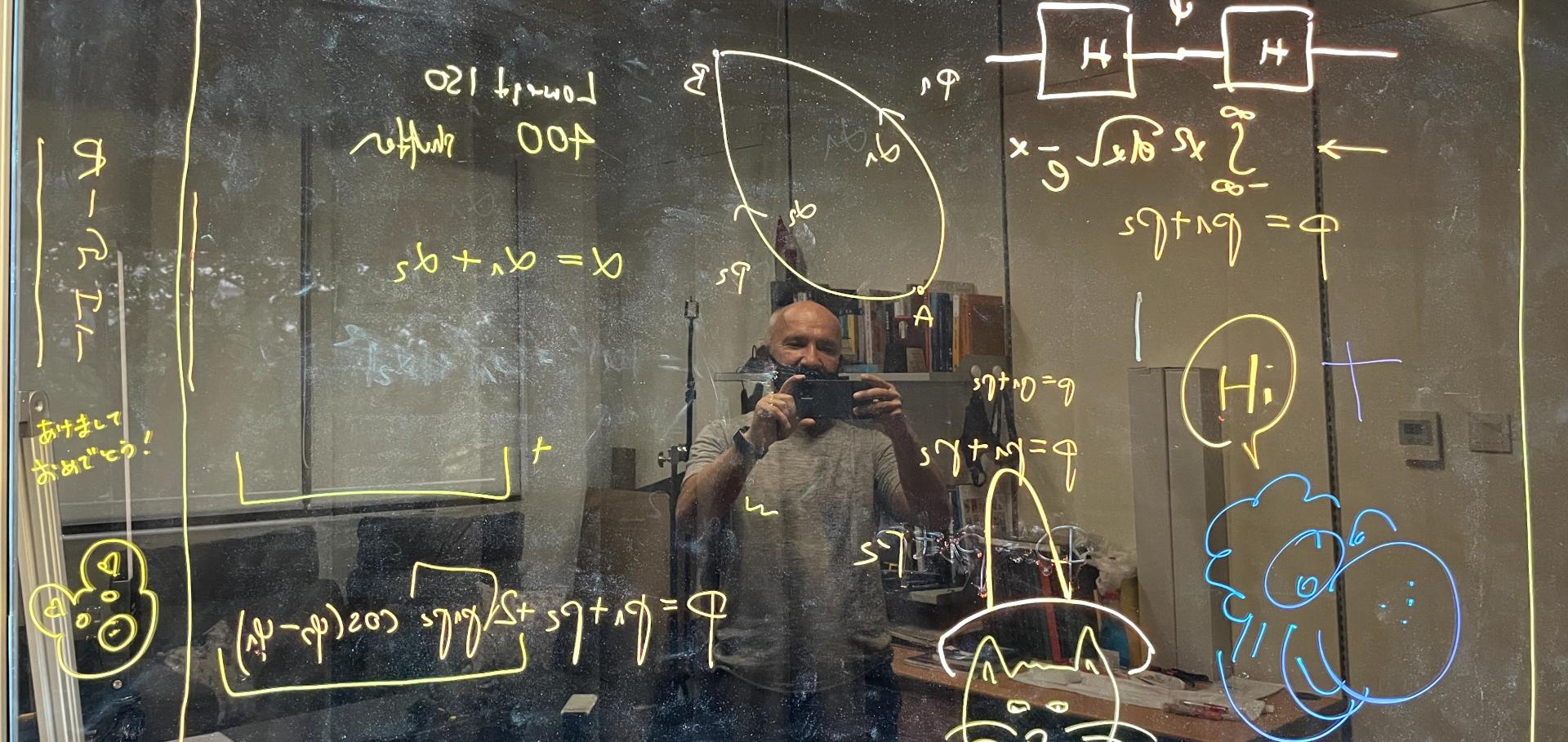
lightboard

Professor Artur Ekert FRS

Professor

Research theme

  • Quantum information and computation

Sub department

  • Atomic and Laser Physics
artur.ekert@physics.ox.ac.uk
Clarendon Laboratory
Wikipedia
Lecture: Introduction to Quantum Information Science
  • About
  • Publications

Mirror inversion of quantum states in linear registers.

Phys Rev Lett 93:23 (2004) 230502

Authors:

Claudio Albanese, Matthias Christandl, Nilanjana Datta, Artur Ekert

Abstract:

Transfer of data in linear quantum registers can be significantly simplified with preengineered but not dynamically controlled interqubit couplings. We show how to implement a mirror inversion of the state of the register in each excitation subspace with respect to the center of the register. Our construction is especially appealing as it requires no dynamical control over individual interqubit interactions. If, however, individual control of the interactions is available then the mirror inversion operation can be performed on any substring of qubits in the register. In this case, a sequence of mirror inversions can generate any permutation of a quantum state of the involved qubits.
More details from the publisher
More details

Improved algorithm for quantum separability and entanglement detection

Physical Review A - Atomic, Molecular, and Optical Physics 70:6 (2004)

Authors:

LM Ioannou, BC Travaglione, D Cheung, AK Ekert

Abstract:

The use of an algorithm for solving the quantum separability problem and for entanglement detection of quantum states was presented. The algorithm takes as input the density matrix for a quantum state ρ and either decides that ρ is separable, or returns an entanglement witness that detects ρ. The general technique of the algorithm is depend on the convexity of the set of separable states, and thus is used to test the multipartite entanglement. The algorithm is also used to determine if an unknown state is entangled by measuring only a subset of the expected values which describe the state.
More details from the publisher

Experimental Demonstration of Quantum State Multi-meter and One-qubit Fingerprinting in a Single Quantum Device

ArXiv quant-ph/0411180 (2004)

Authors:

Jiangfeng Du, Ping Zou, Daniel KL Oi, Xinhua Peng, LC Kwek, CH Oh, Artur Ekert

Abstract:

We experimentally demonstrate in NMR a quantum interferometric multi-meter for extracting certain properties of unknown quantum states without resource to quantum tomography. It can perform direct state determinations, eigenvalue/eigenvector estimations, purity tests of a quantum system, as well as the overlap of any two unknown quantum states. Using the same device, we also demonstrate one-qubit quantum fingerprinting.
Details from ArXiV
More details from the publisher

Multipartite entanglement in quantum spin chains

ArXiv quant-ph/0411080 (2004)

Authors:

D Bruss, N Datta, A Ekert, LC Kwek, C Macchiavello

Abstract:

We study the occurrence of multipartite entanglement in spin chains. We show that certain genuine multipartite entangled states, namely W states, can be obtained as ground states of simple XX type ferromagnetic spin chains in a transverse magnetic field, for any number of sites. Moreover, multipartite entanglement is proven to exist even at finite temperatures. A transition from a product state to a multipartite entangled state occurs when decreasing the magnetic field to a critical value. Adiabatic passage through this point can thus lead to the generation of multipartite entanglement.
Details from ArXiV
More details from the publisher

Multipartite entanglement in quantum spin chains

(2004)

Authors:

D Bruss, N Datta, A Ekert, LC Kwek, C Macchiavello
More details from the publisher

Pagination

  • First page First
  • Previous page Prev
  • …
  • Page 14
  • Page 15
  • Page 16
  • Page 17
  • Current page 18
  • Page 19
  • Page 20
  • Page 21
  • Page 22
  • …
  • Next page Next
  • Last page Last

Footer Menu

  • Contact us
  • Giving to the Dept of Physics
  • Work with us
  • Media

User account menu

  • Log in

Follow us

FIND US

Clarendon Laboratory,

Parks Road,

Oxford,

OX1 3PU

CONTACT US

Tel: +44(0)1865272200

University of Oxfrod logo Department Of Physics text logo
IOP Juno Champion logo Athena Swan Silver Award logo

© University of Oxford - Department of Physics

Cookies | Privacy policy | Accessibility statement

Built by: Versantus

  • Home
  • Research
  • Study
  • Engage
  • Our people
  • News & Comment
  • Events
  • Our facilities & services
  • About us
  • Giving to Physics
  • Current students
  • Staff intranet