Home
Department Of Physics text logo
  • Research
    • Our research
    • Our research groups
    • Our research in action
    • Research funding support
    • Summer internships for undergraduates
  • Study
    • Undergraduates
    • Postgraduates
  • Engage
    • For alumni
    • For business
    • For schools
    • For the public
  • Support
Menu
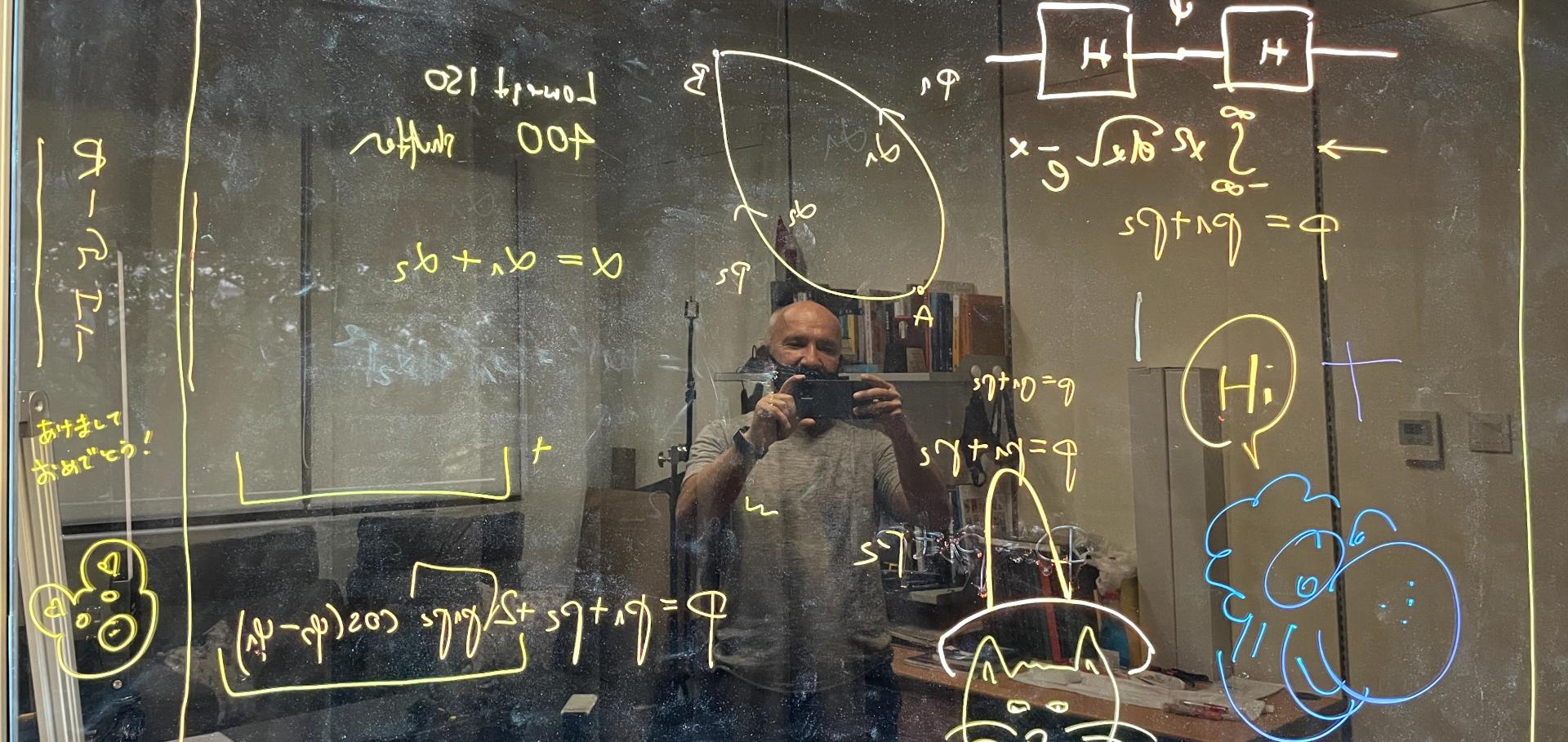
lightboard

Professor Artur Ekert FRS

Professor

Research theme

  • Quantum information and computation

Sub department

  • Atomic and Laser Physics
artur.ekert@physics.ox.ac.uk
Clarendon Laboratory
Wikipedia
Lecture: Introduction to Quantum Information Science
  • About
  • Publications

Perfect Transfer of Arbitrary States in Quantum Spin Networks

ArXiv quant-ph/0411020 (2004)

Authors:

Matthias Christandl, Nilanjana Datta, Tony C Dorlas, Artur Ekert, Alastair Kay, Andrew J Landahl

Abstract:

We propose a class of qubit networks that admit perfect state transfer of any two-dimensional quantum state in a fixed period of time. We further show that such networks can distribute arbitrary entangled states between two distant parties, and can, by using such systems in parallel, transmit the higher dimensional systems states across the network. Unlike many other schemes for quantum computation and communication, these networks do not require qubit couplings to be switched on and off. When restricted to $N$-qubit spin networks of identical qubit couplings, we show that $2\log_3 N$ is the maximal perfect communication distance for hypercube geometries. Moreover, if one allows fixed but different couplings between the qubits then perfect state transfer can be achieved over arbitrarily long distances in a linear chain. This paper expands and extends the work done in PRL 92, 187902.
Details from ArXiV
More details from the publisher

Perfect Transfer of Arbitrary States in Quantum Spin Networks

(2004)

Authors:

Matthias Christandl, Nilanjana Datta, Tony C Dorlas, Artur Ekert, Alastair Kay, Andrew J Landahl
More details from the publisher

Mirror Inversion of Quantum States in Linear Registers

Physical Review Letters 93:23 (2004) 230502

Authors:

AK Ekert, Claudio Albanese, Mattias Christandi, Nilanjana Datta
More details from the publisher
Details from ArXiV

A proposal for the implementation of quantum gates with photonic-crystal coupled cavity waveguides

ArXiv quant-ph/0410189 (2004)

Authors:

Dimitris G Angelakis, Marcelo Franca Santos, Vassilis Yannopapas, Artur Ekert

Abstract:

Quantum computers require technologies that offer both sufficient control over coherent quantum phenomena and minimal spurious interactions with the environment. We show, that photons confined to photonic crystals, and in particular to highly efficient waveguides formed from linear chains of defects doped with atoms can generate strong non-linear interactions which allow to implement both single and two qubit quantum gates. The simplicity of the gate switching mechanism, the experimental feasibility of fabricating two dimensional photonic crystal structures and integrability of this device with optoelectronics offers new interesting possibilities for optical quantum information processing networks.
Details from ArXiV
More details from the publisher

A proposal for the implementation of quantum gates with photonic-crystal coupled cavity waveguides

(2004)

Authors:

Dimitris G Angelakis, Marcelo Franca Santos, Vassilis Yannopapas, Artur Ekert
More details from the publisher

Pagination

  • First page First
  • Previous page Prev
  • …
  • Page 15
  • Page 16
  • Page 17
  • Page 18
  • Current page 19
  • Page 20
  • Page 21
  • Page 22
  • Page 23
  • …
  • Next page Next
  • Last page Last

Footer Menu

  • Contact us
  • Giving to the Dept of Physics
  • Work with us
  • Media

User account menu

  • Log in

Follow us

FIND US

Clarendon Laboratory,

Parks Road,

Oxford,

OX1 3PU

CONTACT US

Tel: +44(0)1865272200

University of Oxfrod logo Department Of Physics text logo
IOP Juno Champion logo Athena Swan Silver Award logo

© University of Oxford - Department of Physics

Cookies | Privacy policy | Accessibility statement

Built by: Versantus

  • Home
  • Research
  • Study
  • Engage
  • Our people
  • News & Comment
  • Events
  • Our facilities & services
  • About us
  • Giving to Physics
  • Current students
  • Staff intranet