Home
Department Of Physics text logo
  • Research
    • Our research
    • Our research groups
    • Our research in action
    • Research funding support
    • Summer internships for undergraduates
  • Study
    • Undergraduates
    • Postgraduates
  • Engage
    • For alumni
    • For business
    • For schools
    • For the public
  • Support
Menu
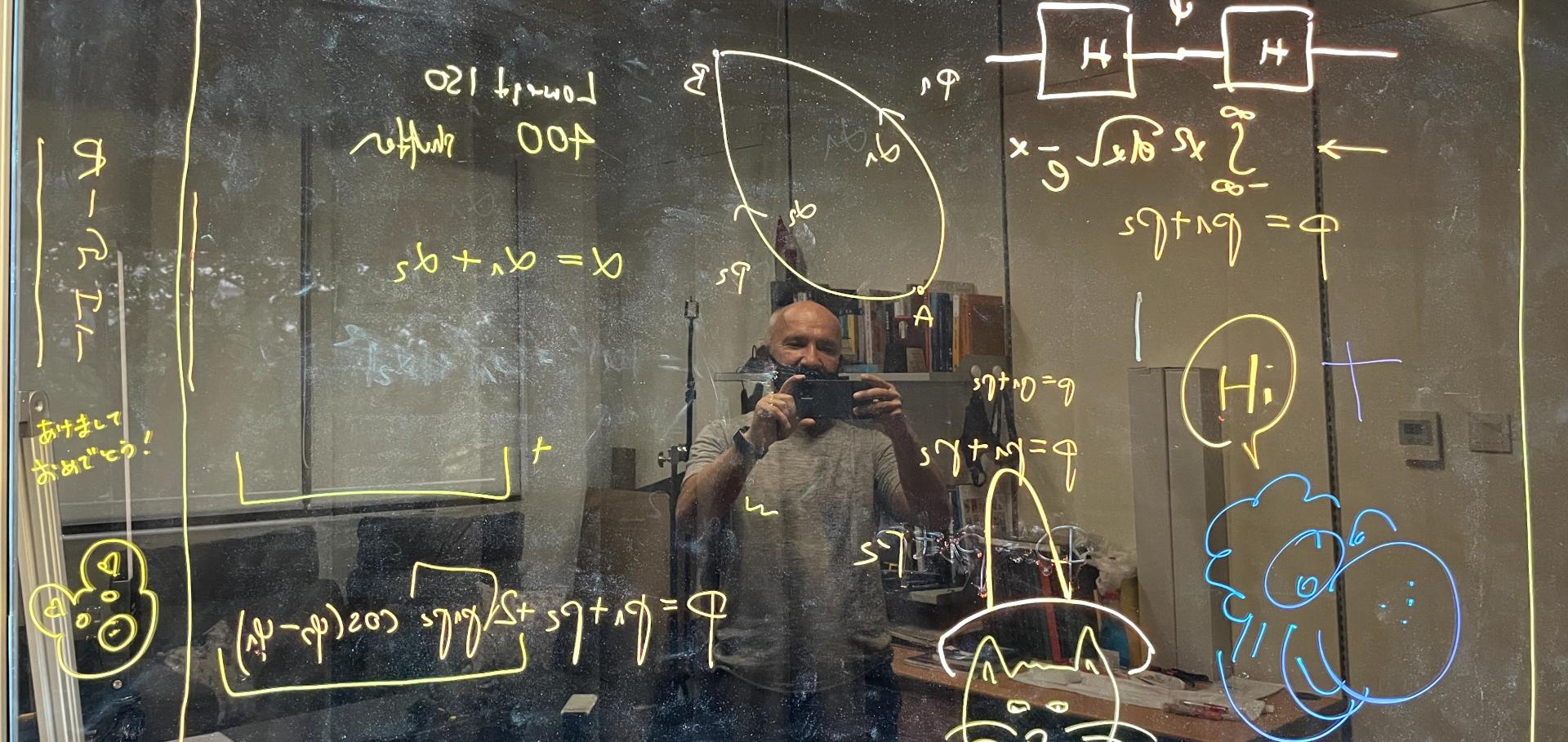
lightboard

Professor Artur Ekert FRS

Professor

Research theme

  • Quantum information and computation

Sub department

  • Atomic and Laser Physics
artur.ekert@physics.ox.ac.uk
Clarendon Laboratory
Wikipedia
Lecture: Introduction to Quantum Information Science
  • About
  • Publications

Old and new ideas in quantum cryptography

Optica Publishing Group (2004) jtua1
More details from the publisher

Experimental demonstration of an efficient quantum phase-covariant cloning and its possible applications to simulating eavesdropping in quantum cryptography

ArXiv quant-ph/0311010 (2003)

Authors:

Jiangfeng Du, Thomas Durt, Ping Zou, LC Kwek, CH Lai, CH Oh, Artur Ekert

Abstract:

We describe a nuclear magnetic resonance (NMR) experiment which implements an efficient one-to-two qubit phase-covariant cloning machine(QPCCM). In the experiment we have achieved remarkably high fidelities of cloning, 0.848 and 0.844 respectively for the original and the blank qubit. This experimental value is close to the optimal theoretical value of 0.854. We have also demonstrated how to use our phase-covariant cloning machine for quantum simulations of bit by bit eavesdropping in the four-state quantum key distribution protocol.
Details from ArXiV
More details from the publisher

Perfect state transfer in quantum spin networks

(2003)

Authors:

Matthias Christandl, Nilanjana Datta, Artur Ekert, Andrew J Landahl
More details from the publisher

Optimal State Discrimination Using Particle Statistics

ArXiv quant-ph/0309090 (2003)

Authors:

S Bose, A Ekert, Y Omar, N Paunkovic, V Vedral

Abstract:

We present an application of particle statistics to the problem of optimal ambiguous discrimination of quantum states. The states to be discriminated are encoded in the internal degrees of freedom of identical particles, and we use the bunching and antibunching of the external degrees of freedom to discriminate between various internal states. We show that we can achieve the optimal single-shot discrimination probability using only the effects of particle statistics. We discuss interesting applications of our method to detecting entanglement and purifying mixed states. Our scheme can easily be implemented with the current technology.
Details from ArXiV
More details from the publisher

Optimal State Discrimination Using Particle Statistics

(2003)

Authors:

S Bose, A Ekert, Y Omar, N Paunkovic, V Vedral
More details from the publisher

Pagination

  • First page First
  • Previous page Prev
  • …
  • Page 18
  • Page 19
  • Page 20
  • Page 21
  • Current page 22
  • Page 23
  • Page 24
  • Page 25
  • Page 26
  • …
  • Next page Next
  • Last page Last

Footer Menu

  • Contact us
  • Giving to the Dept of Physics
  • Work with us
  • Media

User account menu

  • Log in

Follow us

FIND US

Clarendon Laboratory,

Parks Road,

Oxford,

OX1 3PU

CONTACT US

Tel: +44(0)1865272200

University of Oxfrod logo Department Of Physics text logo
IOP Juno Champion logo Athena Swan Silver Award logo

© University of Oxford - Department of Physics

Cookies | Privacy policy | Accessibility statement

Built by: Versantus

  • Home
  • Research
  • Study
  • Engage
  • Our people
  • News & Comment
  • Events
  • Our facilities & services
  • About us
  • Giving to Physics
  • Current students
  • Staff intranet