Home
Department Of Physics text logo
  • Research
    • Our research
    • Our research groups
    • Our research in action
    • Research funding support
    • Summer internships for undergraduates
  • Study
    • Undergraduates
    • Postgraduates
  • Engage
    • For alumni
    • For business
    • For schools
    • For the public
  • Support
Menu
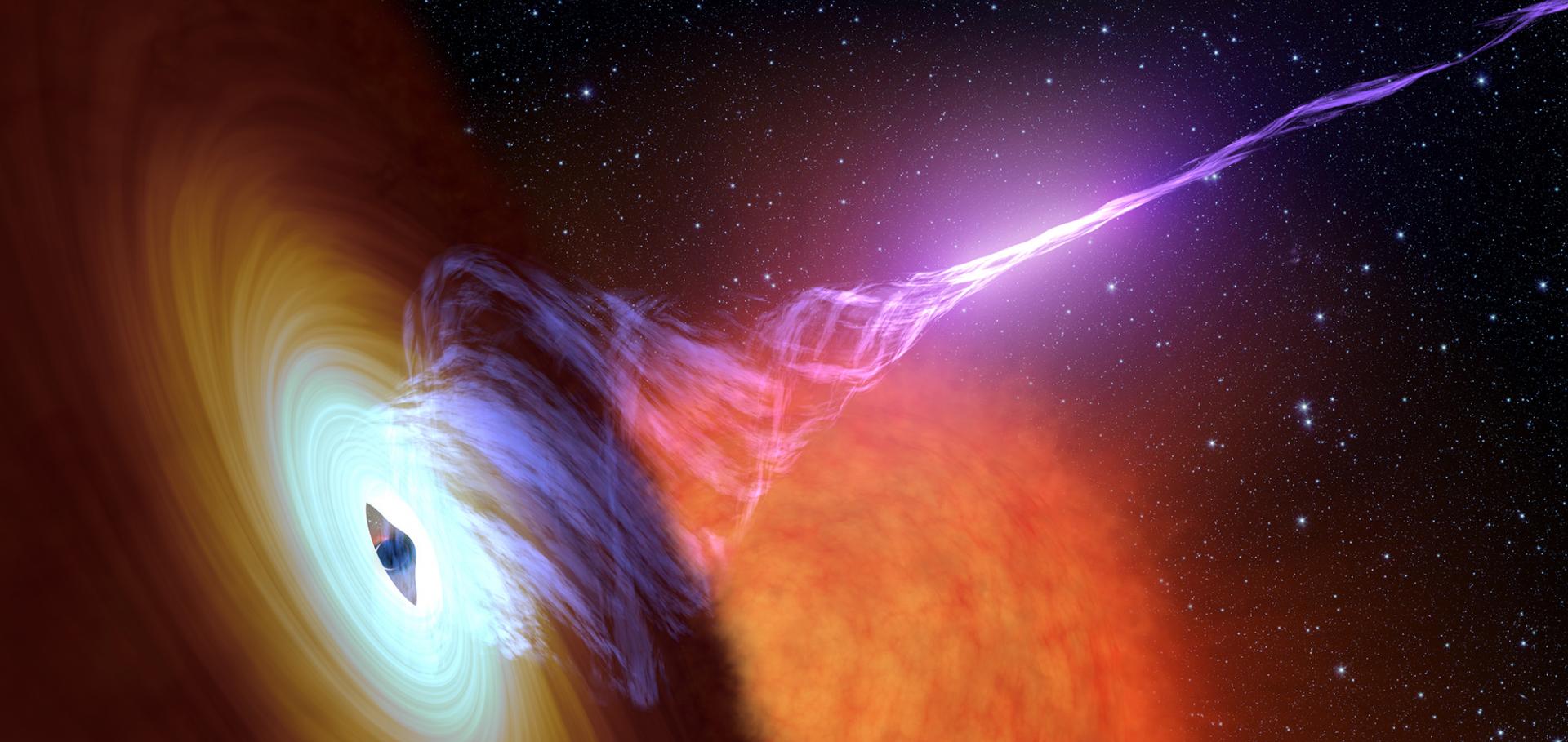
Relativistic Jet from Black Hole

An artist's impression of a relativistic jet propagating away from a black hole at close to the speed of light. Such jets are formed by the inner regions of the accretion flow: matter flowing inwards towards the black hole, via processes which are not yet fully understood. The accretion flow emits primarily in X-rays, the relativistic jet in the radio band: by combing observations in each band we can try and understand how such jets form and how much energy they carry away from the black hole.

Professor Rob Fender

Professor of Astrophysics

Research theme

  • Astronomy and astrophysics

Sub department

  • Astrophysics

Research groups

  • Hintze Centre for Astrophysical Surveys
  • MeerKAT
  • Pulsars, transients and relativistic astrophysics
  • Rubin-LSST
  • The Square Kilometre Array (SKA)
  • Gamma-ray astronomy
Rob.Fender@physics.ox.ac.uk
Telephone: 01865 (2)73435
Denys Wilkinson Building, room 712
  • About
  • Publications

XTE J1752-223 in outburst: A persistent radio jet, dramatic flaring,multiple ejections and linear polarization

Monthly Notices of the Royal Astronomical Society 432:2 (2013) 931-943

Authors:

C Brocksopp, S Corbel, A Tzioumis, JW Broderick, J Rodriguez, J Yang, RP Fender, Z Paragi

Abstract:

The black hole candidate, XTE J1752-223, was discovered in 2009 October when it entered an outburst. We obtained radio data from the Australia Telescope Compact Array for the duration of the ~9 month event. The light curves show that the radio emission from the compact jet persisted for the duration of an extended hard state and through the transition to the intermediate state. The flux then rose rapidly by a factor of 10 and the radio source entered a series of at least seven maxima, the first of which was likely to be emission associated with the compact jet. The subsequent six flares were accompanied by variable behaviour in terms of radio spectrum, degree of linear polarization, morphology and associated X-ray behaviour. They were, however, remarkably similar in terms of the estimated minimum power required to launch such an ejection event. We compare the timing of radio peaks with the location of the ejecta, imaged by contemporaneous Very Long Baseline Interferometry experiments. We then discuss the mechanism behind the events, in terms of whether discrete ejections are the most likely description of the behaviour. One ejection, at least, appears to be travelling with apparent superluminal motion. The range of properties, however, suggests that multiple mechanisms may be relevant and that at least some of the emission is coming from shocked interactions amongst the ejecta and between the ejecta and the interstellar medium. We also compare the radio flux density with the X-ray source during the hard state and conclude that XTE J1752-223 is a radio-weak/X-ray-bright outlier on the universal correlation for black hole transient sources. © 2013 The Authors Published by Oxford University Press on behalf of the Royal Astronomical Society.
More details from the publisher
More details

A return to strong radio flaring by Circinus X-1 observed with the Karoo Array Telescope test array KAT-7

MONTHLY NOTICES OF THE ROYAL ASTRONOMICAL SOCIETY 433:3 (2013) 1951-1957

Authors:

RP Armstrong, RP Fender, GD Nicolson, S Ratcliffe, M Linares, J Horrell, L Richter, MPE Schurch, M Coriat, P Woudt, J Jonas, R Booth, B Fanaroff
More details from the publisher

AN EVOLVING COMPACT JET IN THE BLACK HOLE X-RAY BINARY MAXI J1836-194

ASTROPHYSICAL JOURNAL LETTERS 768:2 (2013) ARTN L35

Authors:

DM Russell, TD Russell, JCA Miller-Jones, K O'Brien, R Soria, GR Sivakoff, T Slaven-Blair, F Lewis, S Markoff, J Homan, D Altamirano, PA Curran, MP Rupen, TM Belloni, M Cadolle Bel, P Casella, S Corbel, V Dhawan, RP Fender, E Gallo, P Gandhi, S Heinz, EG Kording, HA Krimm, D Maitra, S Migliari, RA Remillard, CL Sarazin, T Shahbaz, V Tudose
More details from the publisher

Bright radio emission from an ultraluminous stellar-mass microquasar in M31

(2012)

Authors:

Matthew J Middleton, James CA Miller-Jones, Sera Markoff, Rob Fender, Martin Henze, Natasha Hurley-Walker, Anna MM Scaife, Timothy P Roberts, Dominic Walton, John Carpenter, Jean-Pierre Macquart, Geoffrey C Bower, Mark Gurwell, Wolfgang Pietsch, Frank Haberl, Jonathan Harris, Michael Daniel, Junayd Miah, Chris Done, John Morgan, Hugh Dickinson, Phil Charles, Vadim Burwitz, Massimo Della Valle, Michael Freyberg, Jochen Greiner, Margarita Hernanz, Dieter H Hartmann, Despina Hatzidimitriou, Arno Riffeser, Gloria Sala, Stella Seitz, Pablo Reig, Arne Rau, Marina Orio, David Titterington, Keith Grainge
More details from the publisher

The LOFAR radio environment

Astronomy and Astrophysics 549 (2012)

Authors:

AR Offringa, AG De Bruyn, S Zaroubi, G Van Diepen, O Martinez-Ruby, P Labropoulos, MA Brentjens, B Ciardi, S Daiboo, G Harker, V Jelić, S Kazemi, LVE Koopmans, G Mellema, VN Pandey, RF Pizzo, J Schaye, H Vedantham, V Veligatla, SJ Wijnholds, S Yatawatta, P Zarka, A Alexov, J Anderson, A Asgekar, M Avruch, R Beck, M Bell, MR Bell, M Bentum, G Bernardi, P Best, L Birzan, A Bonafede, F Breitling, JW Broderick, M Brüggen, H Butcher, J Conway, M De Vos, RJ Dettmar, J Eisloeffel, H Falcke, R Fender, W Frieswijk, M Gerbers, JM Griessmeier, AW Gunst, TE Hassall, G Heald, J Hessels, M Hoeft, A Horneffer, A Karastergiou, V Kondratiev, Y Koopman, M Kuniyoshi, G Kuper, P Maat, G Mann, J McKean, H Meulman, M Mevius, JD Mol, R Nijboer, J Noordam, M Norden, H Paas, M Pandey, A Polatidis, D Rafferty, S Rawlings, W Reich, HJA Röttgering, AP Schoenmakers, J Sluman, O Smirnov, C Sobey, B Stappers, M Steinmetz, J Swinbank, M Tagger, Y Tang, C Tasse, A Van Ardenne, W Van Cappellen, AP Van Duin, M Van Haarlem, J Van Leeuwen, RJ Van Weeren, R Vermeulen, C Vocks, RAMJ Wijers, M Wise, O Wucknitz

Abstract:

Aims. This paper discusses the spectral occupancy for performing radio astronomy with the Low-Frequency Array (LOFAR), with a focus on imaging observations. Methods. We have analysed the radio-frequency interference (RFI) situation in two 24-h surveys with Dutch LOFAR stations, covering 30-78 MHz with low-band antennas and 115-163 MHz with high-band antennas. This is a subset of the full frequency range of LOFAR. The surveys have been observed with a 0.76 kHz/1 s resolution. Results. We measured the RFI occupancy in the low and high frequency sets to be 1.8% and 3.2% respectively. These values are found to be representative values for the LOFAR radio environment. Between day and night, there is no significant difference in the radio environment. We find that lowering the current observational time and frequency resolutions of LOFAR results in a slight loss of flagging accuracy. At LOFAR's nominal resolution of 0.76 kHz and 1 s, the false-positives rate is about 0.5%. This rate increases approximately linearly when decreasing the data frequency resolution. Conclusions. Currently, by using an automated RFI detection strategy, the LOFAR radio environment poses no perceivable problems for sensitive observing. It remains to be seen if this is still true for very deep observations that integrate over tens of nights, but the situation looks promising. Reasons for the low impact of RFI are the high spectral and time resolution of LOFAR; accurate detection methods; strong filters and high receiver linearity; and the proximity of the antennas to the ground. We discuss some strategies that can be used once low-level RFI starts to become apparent. It is important that the frequency range of LOFAR remains free of broadband interference, such as DAB stations and windmills. © 2012 ESO.
Details from ArXiV
More details from the publisher

Pagination

  • First page First
  • Previous page Prev
  • …
  • Page 106
  • Page 107
  • Page 108
  • Page 109
  • Current page 110
  • Page 111
  • Page 112
  • Page 113
  • Page 114
  • …
  • Next page Next
  • Last page Last

Footer Menu

  • Contact us
  • Giving to the Dept of Physics
  • Work with us
  • Media

User account menu

  • Log in

Follow us

FIND US

Clarendon Laboratory,

Parks Road,

Oxford,

OX1 3PU

CONTACT US

Tel: +44(0)1865272200

University of Oxfrod logo Department Of Physics text logo
IOP Juno Champion logo Athena Swan Silver Award logo

© University of Oxford - Department of Physics

Cookies | Privacy policy | Accessibility statement

Built by: Versantus

  • Home
  • Research
  • Study
  • Engage
  • Our people
  • News & Comment
  • Events
  • Our facilities & services
  • About us
  • Giving to Physics
  • Current students
  • Staff intranet