

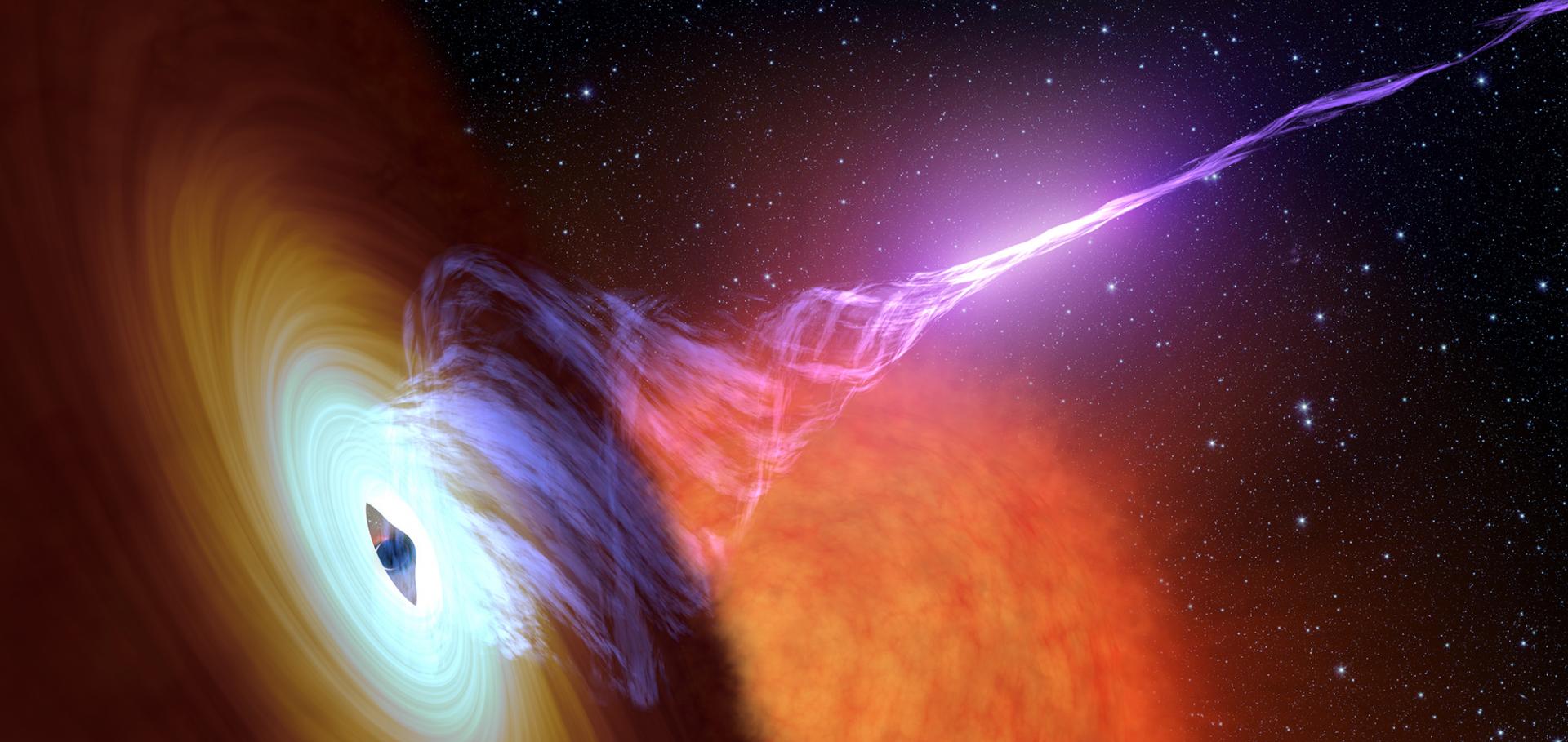

Observational constraints on the powering mechanism of transient relativistic jets
(2013)
Synchronous x-ray and radio mode switches: a rapid global transformation of the pulsar magnetosphere.
Science 339:6118 (2013) 436-439
Abstract:
Pulsars emit from low-frequency radio waves up to high-energy gamma-rays, generated anywhere from the stellar surface out to the edge of the magnetosphere. Detecting correlated mode changes across the electromagnetic spectrum is therefore key to understanding the physical relationship among the emission sites. Through simultaneous observations, we detected synchronous switching in the radio and x-ray emission properties of PSR B0943+10. When the pulsar is in a sustained radio-"bright" mode, the x-rays show only an unpulsed, nonthermal component. Conversely, when the pulsar is in a radio-"quiet" mode, the x-ray luminosity more than doubles and a 100% pulsed thermal component is observed along with the nonthermal component. This indicates rapid, global changes to the conditions in the magnetosphere, which challenge all proposed pulsar emission theories.Bright radio emission from an ultraluminous stellar-mass microquasar in M 31
Nature 493:7431 (2013) 187-190
Abstract:
A subset of ultraluminous X-ray sources (those with luminosities of less than 10 40 erg s -1; ref. 1) are thought to be powered by the accretion of gas onto black holes with masses of ∼5-20, probably by means of an accretion disk. The X-ray and radio emission are coupled in such Galactic sources; the radio emission originates in a relativistic jet thought to be launched from the innermost regions near the black hole, with the most powerful emission occurring when the rate of infalling matter approaches a theoretical maximum (the Eddington limit). Only four such maximal sources are known in the Milky Way, and the absorption of soft X-rays in the interstellar medium hinders the determination of the causal sequence of events that leads to the ejection of the jet. Here we report radio and X-ray observations of a bright new X-ray source in the nearby galaxy M 31, whose peak luminosity exceeded 10 39 erg s -1. The radio luminosity is extremely high and shows variability on a timescale of tens of minutes, arguing that the source is highly compact and powered by accretion close to the Eddington limit onto a black hole of stellar mass. Continued radio and X-ray monitoring of such sources should reveal the causal relationship between the accretion flow and the powerful jet emission. © 2013 Macmillan Publishers Limited. All rights reserved.Broad-band monitoring tracing the evolution of the jet and disc in the black hole candidate X-ray binary MAXI J1659-152
Monthly Notices of the Royal Astronomical Society 436:3 (2013) 2625-2638