Home
Department Of Physics text logo
  • Research
    • Our research
    • Our research groups
    • Our research in action
    • Research funding support
    • Summer internships for undergraduates
  • Study
    • Undergraduates
    • Postgraduates
  • Engage
    • For young people
    • For teachers
    • For the public
    • For alumni
    • For business
  • Support
Menu
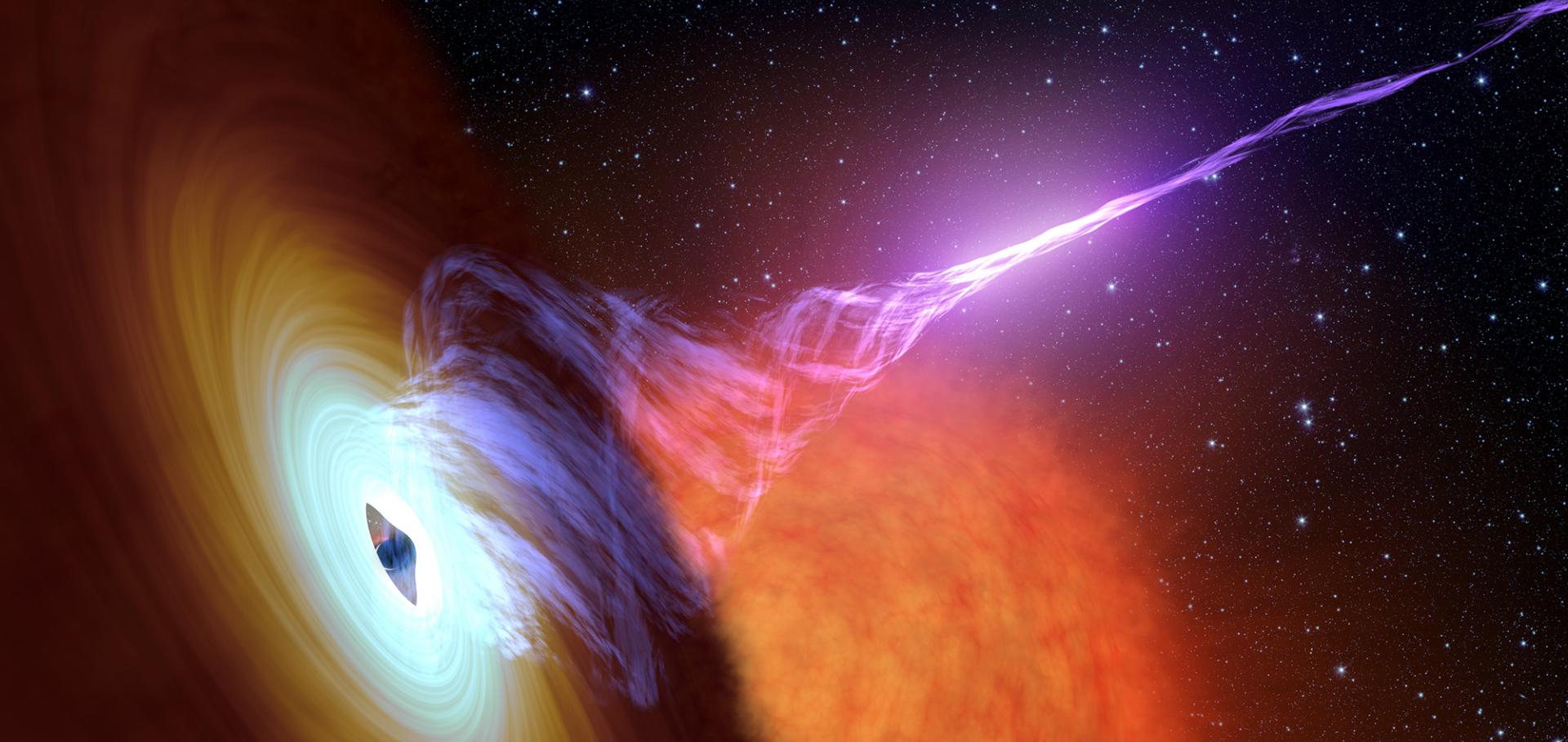
Relativistic Jet from Black Hole

An artist's impression of a relativistic jet propagating away from a black hole at close to the speed of light. Such jets are formed by the inner regions of the accretion flow: matter flowing inwards towards the black hole, via processes which are not yet fully understood. The accretion flow emits primarily in X-rays, the relativistic jet in the radio band: by combing observations in each band we can try and understand how such jets form and how much energy they carry away from the black hole.

Professor Rob Fender

Professor of Astrophysics

Research theme

  • Astronomy and astrophysics

Sub department

  • Astrophysics

Research groups

  • Hintze Centre for Astrophysical Surveys
  • MeerKAT
  • Pulsars, transients and relativistic astrophysics
  • Rubin-LSST
  • The Square Kilometre Array (SKA)
  • Gamma-ray astronomy
Rob.Fender@physics.ox.ac.uk
Telephone: 01865 (2)73435
Denys Wilkinson Building, room 712
  • About
  • Publications

New Metrics for Identifying Variables and Transients in Large Astronomical Surveys

(2025)

Authors:

Shih Ching Fu, Arash Bahramian, Aloke Phatak, James CA Miller-Jones, Suman Rakshit, Alexander Andersson, Robert Fender, Patrick A Woudt
Details from ArXiV

The First Radio-Bright Off-Nuclear TDE 2024tvd Reveals the Fastest-Evolving Double-Peaked Radio Emission

(2025)

Authors:

Itai Sfaradi, Raffaella Margutti, Ryan Chornock, Kate D Alexander, Brian D Metzger, Paz Beniamini, Rodolfo Barniol Duran, Yuhan Yao, Assaf Horesh, Wael Farah, Edo Berger, Nayana A J., Yvette Cendes, Tarraneh Eftekhari, Rob Fender, Noah Franz, Dave A Green, Erica Hammerstein, Wenbin Lu, Eli Wiston, Yirmi Bernstein, Joe Bright, Collin T Christy, Luigi F Cruz, David R DeBoer, Walter W Golay, Adelle J Goodwin, Mark Gurwell, Garrett K Keating, Tanmoy Laskar, James CA Miller-Jones, Alexander W Pollak, Ramprasad Rao, Andrew Siemion, Sofia Z Sheikh, Nadav Shoval, Sjoert van Velzen
More details from the publisher

A relativistic jet from a neutron star breaking out of its natal supernova remnant

(2025)

Authors:

KVS Gasealahwe, K Savard, IM Monageng, I Heywood, RP Fender, PA Woudt, J English, JH Matthews, H Whitehead, FJ Cowie, AK Hughes, P Saikia, SE Motta
More details from the publisher

Commensal Transient Searches with MeerKAT in Gamma-Ray Burst and Supernova Fields

The Astrophysical Journal American Astronomical Society 988:2 (2025) 227

Authors:

SI Chastain, AJ van der Horst, A Horesh, A Rowlinson, A Andersson, R Diretse, M Vaccari, RP Fender, PA Woudt

Abstract:

The sensitivity and field of view of the MeerKAT radio telescope provide excellent opportunities for commensal transient searches. We carry out a commensal transient search in supernova and short gamma-ray burst fields using methodologies established by S. I. Chastain et al. We search for transients in MeerKAT L-band images with integration times of 30 minutes, finding 13 variable sources. We compare these sources to the VLASS and RACS survey data, and examine possible explanations for the variability. Additionally, for one of these sources we examine archival Chandra ACIS data. We find that 12 of these sources are consistent with variability due to interstellar scintillation. The remaining source could possibly have some intrinsic variability. We also split the MeerKAT L band into upper and lower halves, and search for transients in images with an integration time of 8 s. We find a source with a duration of 8–16 s that is highly polarized at the lowest frequencies. This source is spatially coincident with a star detected by the Transiting Exoplanet Survey Satellite. We conclude that this source may be consistent with a stellar flare. Finally, we calculate accurate upper and lower limits on the transient rate using transient simulations.
More details from the publisher
Details from ORA
More details

A relativistic jet from a neutron star breaking out of its natal supernova remnant

Monthly Notices of the Royal Astronomical Society Oxford University Press 541:4 (2025) 4011-4024

Authors:

KVS Gasealahwe, K Savard, IM Monageng, I Heywood, RP Fender, PA Woudt, J English, JH Matthews, H Whitehead, FJ Cowie, AK Hughes, P Saikia, SE Motta

Abstract:

The young neutron star X-ray binary, Cir X-1, resides within its natal supernova remnant and experiences ongoing outbursts every 16.5 d, likely due to periastron passage in an eccentric orbit. We present the deepest ever radio image of the field, which reveals relativistic jet-punched bubbles that are aligned with the mean axis of the smaller scale jets observed close to the X-ray binary core. We are able to measure the minimum energy for the bubble, which is around = erg. The nature and morphological structure of the source were investigated through spectral index mapping and numerical simulations. The spectral index map reveals a large fraction of the nebula’s radio continuum has a steep slope, associated with optically thin synchrotron emission, although there are distinct regions with flatter spectra. Our data are not sensitive enough to measure the spectral index of the protruding bubbles. We used the pluto code to run relativistic hydrodynamic simulations to try and qualitatively reproduce the observations with a combined supernova-plus-jet system. We are able to do so using a simplified model in which the asymmetrical bubbles are best represented by supernova explosion which is closely followed (within 100 yr) by a phase of very powerful jets lasting less than 1000 yr. These are the first observations revealing the initial breakout of neutron star jets from their natal supernova remnant, and further support the scenario in which Cir X-1 is a younger relation of the archetypal jet source SS433.
More details from the publisher
Details from ORA
More details

Pagination

  • First page First
  • Previous page Prev
  • …
  • Page 11
  • Page 12
  • Page 13
  • Page 14
  • Current page 15
  • Page 16
  • Page 17
  • Page 18
  • Page 19
  • …
  • Next page Next
  • Last page Last

Footer Menu

  • Contact us
  • Giving to the Dept of Physics
  • Work with us
  • Media

User account menu

  • Log in

Follow us

FIND US

Clarendon Laboratory,

Parks Road,

Oxford,

OX1 3PU

CONTACT US

Tel: +44(0)1865272200

University of Oxfrod logo Department Of Physics text logo
IOP Juno Champion logo Athena Swan Silver Award logo

© University of Oxford - Department of Physics

Cookies | Privacy policy | Accessibility statement

Built by: Versantus

  • Home
  • Research
  • Study
  • Engage
  • Our people
  • News & Comment
  • Events
  • Our facilities & services
  • About us
  • Giving to Physics
  • Current students
  • Staff intranet