Home
Department Of Physics text logo
  • Research
    • Our research
    • Our research groups
    • Our research in action
    • Research funding support
    • Summer internships for undergraduates
  • Study
    • Undergraduates
    • Postgraduates
  • Engage
    • For alumni
    • For business
    • For schools
    • For the public
  • Support
Menu
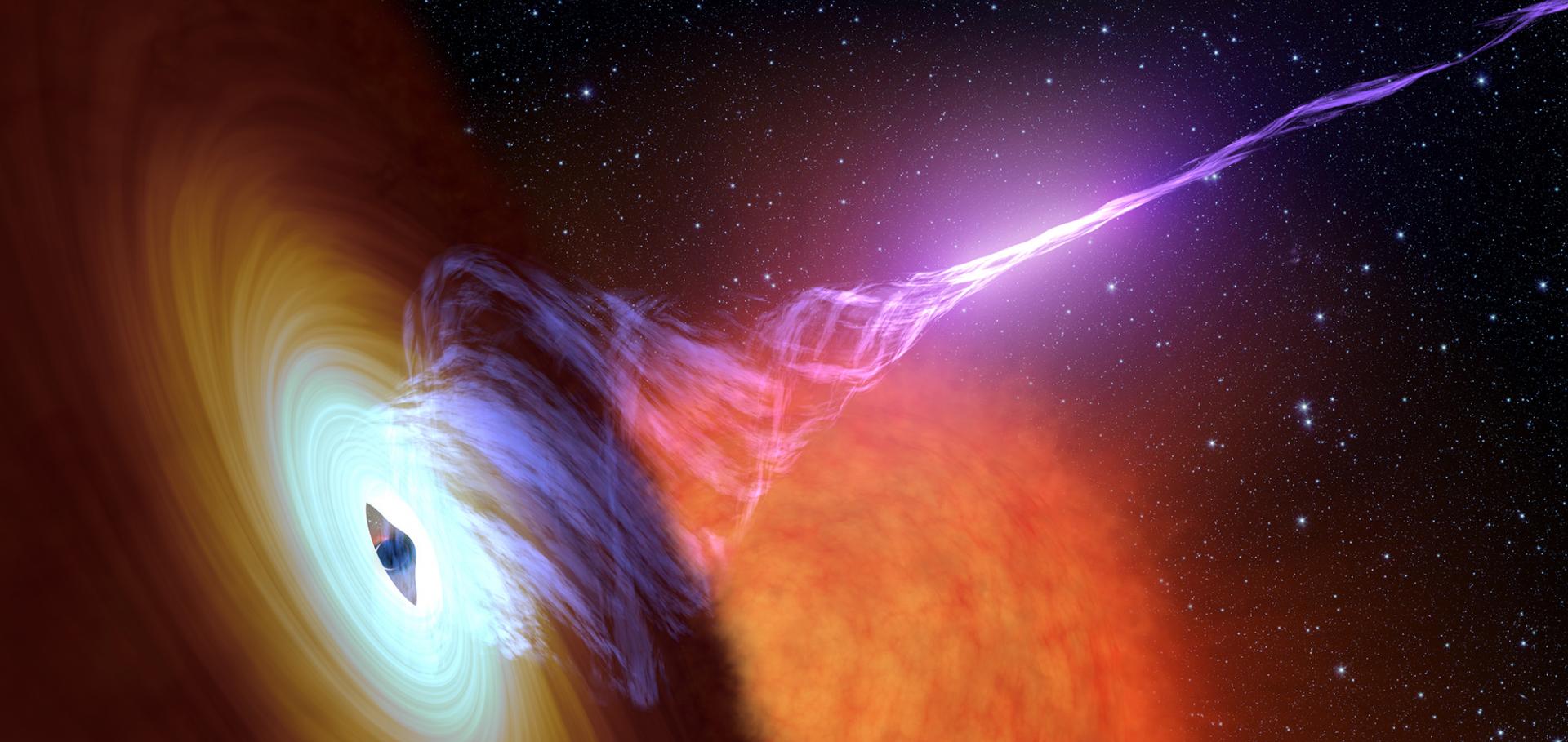
Relativistic Jet from Black Hole

An artist's impression of a relativistic jet propagating away from a black hole at close to the speed of light. Such jets are formed by the inner regions of the accretion flow: matter flowing inwards towards the black hole, via processes which are not yet fully understood. The accretion flow emits primarily in X-rays, the relativistic jet in the radio band: by combing observations in each band we can try and understand how such jets form and how much energy they carry away from the black hole.

Professor Rob Fender

Professor of Astrophysics

Research theme

  • Astronomy and astrophysics

Sub department

  • Astrophysics

Research groups

  • Hintze Centre for Astrophysical Surveys
  • MeerKAT
  • Pulsars, transients and relativistic astrophysics
  • Rubin-LSST
  • The Square Kilometre Array (SKA)
  • Gamma-ray astronomy
Rob.Fender@physics.ox.ac.uk
Telephone: 01865 (2)73435
Denys Wilkinson Building, room 712
  • About
  • Publications

Internal shocks model for microquasar jets

International Conference Recent Advances in Natural Language Processing, RANLP (2008)

Authors:

O Jamil, R Fender, C Kaiser

Abstract:

We present an internal shocks model to investigate particle acceleration and radiation production in microquasar jets. The jet is modelled with discrete ejecta at various time intervals. These ejecta (or 'shells') may have different properties including the bulk velocity. Faster shells can catch up and collide with the slower ones, thus giving rise to shocks. The particles are accelerated inside the shocked plasma. Each collision results in a new shell, which may take part in any subsequent collisions as well as radiate due to synchrotron radiation. Almost continuous energy dissipation along the jet can be obtained with a large number of shell collisions. We investigate the spectral energy distribution of such jets as well as the physical significance of various parameters (e.g. the time interval between ejections and the shell size). © Copyright owned by the author(s) under the terms of the Creative Commons Attribution-NonCommercial-ShareAlike Licence.

Measuring the accretion rate and kinetic luminosity functions of supermassive black holes

Monthly Notices of the Royal Astronomical Society 383:1 (2008) 277-288

Authors:

EG Körding, S Jester, R Fender

Abstract:

We derive accretion rate functions (ARFs) and kinetic luminosity functions (KLFs) for jet-launching supermassive black holes. The accretion rate as well as the kinetic power of an active galaxy is estimated from the radio emission of the jet. For compact low-power jets, we use the core radio emission while the jet power of high-power radio-loud quasars is estimated using the extended low-frequency emission to avoid beaming effects. We find that at low luminosities the ARF derived from the radio emission is in agreement with the measured bolometric luminosity function (BLF) of active galactic nucleus (AGN), i.e. all low-luminosity AGN launch strong jets. We present a simple model, inspired by the analogy between X-ray binaries (XRBs) and AGN, that can reproduce both the measured ARF of jet-emitting sources as well as the BLF. The model suggests that the break in power-law slope of the BLF is due to the inefficient accretion of strongly sub-Eddington sources. As our accretion measure is based on the jet power it also allows us to calculate the KLF and therefore the total kinetic power injected by jets into the ambient medium. We compare this with the kinetic power output from supernova remnants (SNRs) and XRBs, and determine its cosmological evolution. © 2007 The Authors.
More details from the publisher
More details
Details from ArXiV

Polarized infrared emission from X-ray binary jets

Monthly Notices of the Royal Astronomical Society 387:2 (2008) 713-723

Authors:

DM Russell, RP Fender

Abstract:

Near-infrared (NIR) and optical polarimetric observations of a selection of X-ray binaries are presented. The targets were observed using the Very Large Telescope and the United Kingdom Infrared Telescope. We detect a significant level (3σ) of linear polarization in four sources. The polarization is found to be intrinsic (at the >3σ level) in two sources; GRO J1655-40 (∼4-7 per cent in the H and Ks bands during an outburst) and Sco X-1 (∼0.1-0.9 per cent in the H and K bands), which is stronger at lower frequencies. This is likely to be the signature of optically thin synchrotron emission from the collimated jets in these systems, whose presence indicates that a partially ordered magnetic field is present at the inner regions of the jets. In Sco X-1, the intrinsic polarization is variable (and sometimes absent) in the H and K bands. In the J band (i.e. at higher frequencies), the polarization is not significantly variable and is consistent with an interstellar origin. The optical light from GX 339-4 is also polarized, but at a level and position angle consistent with scattering by interstellar dust. The other polarized source is SS 433, which has a low level (0.5-0.8 per cent) of J-band polarization, likely due to local scattering. The NIR counterparts of GRO J0422+32, XTE J1118+480, 4U 0614+09 and Aql X-1 (which were all in or near quiescence) have a linear polarization level of <16 per cent (3σ upper limit, some are <6 per cent). We discuss how such observations may be used to constrain the ordering of the magnetic field close to the base of the jet in such systems. © 2008 The Authors.
More details from the publisher
More details
Details from ArXiV

Studying the X-ray hysteresis in GX 339-4: The disc and iron line over one decade

Monthly Notices of the Royal Astronomical Society 387:2 (2008) 545-563

Authors:

RJH Dunn, RP Fender, EG Körding, C Cabanac, T Belloni

Abstract:

We report on a comprehensive and consistent investigation into the X-ray emission from GX 339-4. All public observations in the 11 year RXTE archive were analysed. Three different types of model - single power law, broken power law and a disc + power law - were fitted to investigate the evolution of the disc, along with a fixed Gaussian component at 6.4 keV to investigate any iron line in the spectrum. We show that the relative variation in flux and X-ray colour between the two best sampled outbursts are very similar. The decay of the disc temperature during the outburst is clearly seen in the soft state. The expected decay is SDisc ∝ T4; we measure T 4.75±0.23. This implies that the inner disc radius is approximately constant in the soft state. We also show a significant anticorrelation between the iron line equivalent width (EW) and the X-ray flux in the soft state while in the hard state the EW is independent of the flux. This results in hysteresis in the relation between X-ray flux and both line flux and EW. To compare the X-ray binary outburst to the behaviour seen in active galactic nuclei (AGN), we construct a disc fraction luminosity diagram for GX 339-4, the first for an X-ray binary. The shape qualitatively matches that produced for AGN. Linking this with the radio emission from GX 339-4 the change in radio spectrum between the disc and power-law-dominated states is clearly visible. © 2008 The Authors.
More details from the publisher
More details
Details from ArXiV

The disc-jet coupling in Aql X-1

International Conference Recent Advances in Natural Language Processing, RANLP (2008)

Authors:

V Tudose, R Fender, M Linares, D Maitra

Abstract:

We present a multiwavelength analysis of the outbursts from the neutron star X-ray binary Aql X-1. We focus on three outbursts for which quasi-simultaneous data in radio, optical and Xray bands exist. We find evidence that the disc/jet coupling in Aql X-1 is similar to the one documented for black hole X-ray binaries, at least from the point of view of the general behaviour revealed during outbursts. © Copyright owned by the author(s) under the terms of the Creative Commons Attribution-NonCommercial-ShareAlike Licence.

Pagination

  • First page First
  • Previous page Prev
  • …
  • Page 148
  • Page 149
  • Page 150
  • Page 151
  • Current page 152
  • Page 153
  • Page 154
  • Page 155
  • Page 156
  • …
  • Next page Next
  • Last page Last

Footer Menu

  • Contact us
  • Giving to the Dept of Physics
  • Work with us
  • Media

User account menu

  • Log in

Follow us

FIND US

Clarendon Laboratory,

Parks Road,

Oxford,

OX1 3PU

CONTACT US

Tel: +44(0)1865272200

University of Oxfrod logo Department Of Physics text logo
IOP Juno Champion logo Athena Swan Silver Award logo

© University of Oxford - Department of Physics

Cookies | Privacy policy | Accessibility statement

Built by: Versantus

  • Home
  • Research
  • Study
  • Engage
  • Our people
  • News & Comment
  • Events
  • Our facilities & services
  • About us
  • Giving to Physics
  • Current students
  • Staff intranet