Home
Department Of Physics text logo
  • Research
    • Our research
    • Our research groups
    • Our research in action
    • Research funding support
    • Summer internships for undergraduates
  • Study
    • Undergraduates
    • Postgraduates
  • Engage
    • For alumni
    • For business
    • For schools
    • For the public
  • Support
Menu
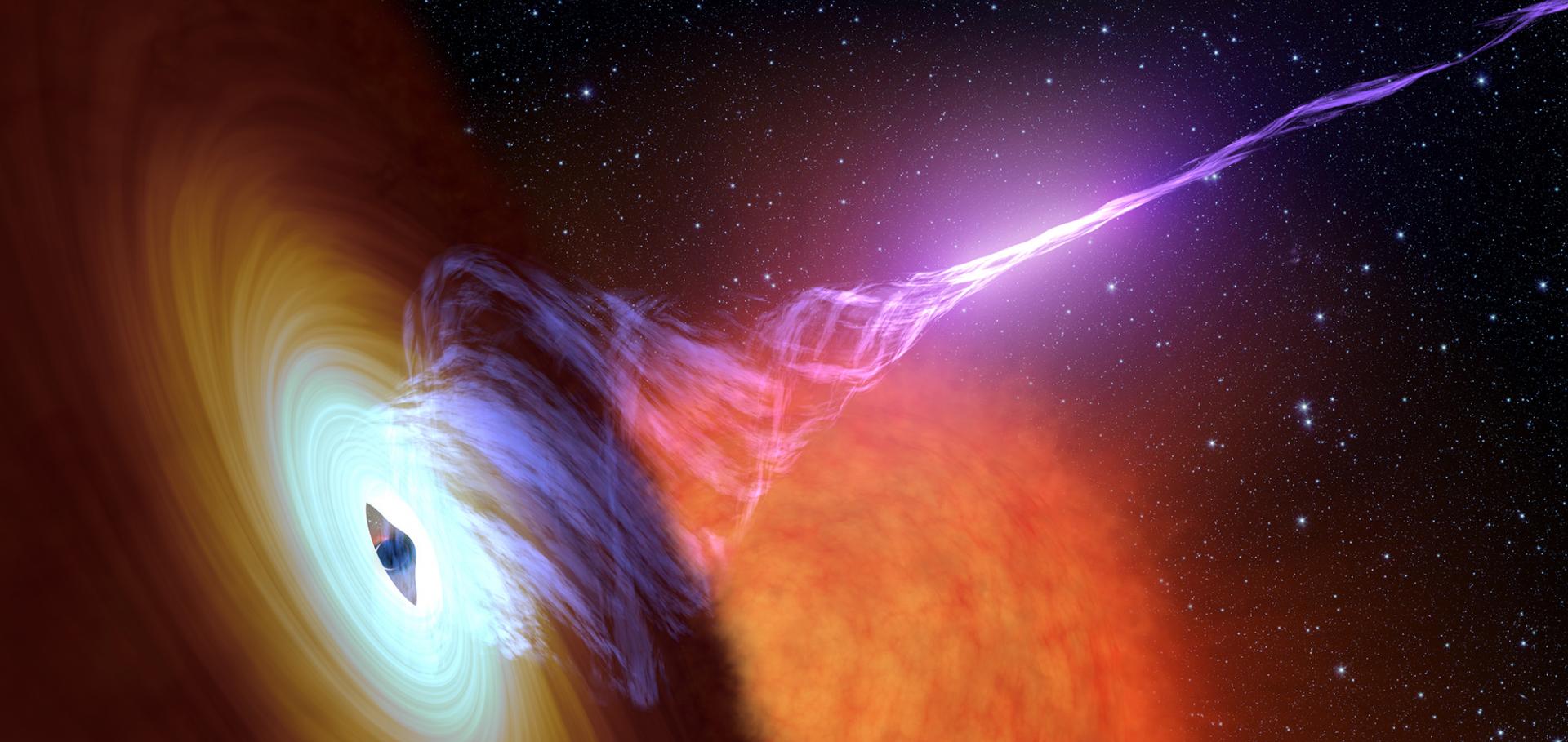
Relativistic Jet from Black Hole

An artist's impression of a relativistic jet propagating away from a black hole at close to the speed of light. Such jets are formed by the inner regions of the accretion flow: matter flowing inwards towards the black hole, via processes which are not yet fully understood. The accretion flow emits primarily in X-rays, the relativistic jet in the radio band: by combing observations in each band we can try and understand how such jets form and how much energy they carry away from the black hole.

Professor Rob Fender

Professor of Astrophysics

Research theme

  • Astronomy and astrophysics

Sub department

  • Astrophysics

Research groups

  • Hintze Centre for Astrophysical Surveys
  • MeerKAT
  • Pulsars, transients and relativistic astrophysics
  • Rubin-LSST
  • The Square Kilometre Array (SKA)
  • Gamma-ray astronomy
Rob.Fender@physics.ox.ac.uk
Telephone: 01865 (2)73435
Denys Wilkinson Building, room 712
  • About
  • Publications

The disc-jet coupling in Aql X-1

International Conference Recent Advances in Natural Language Processing, RANLP (2008)

Authors:

V Tudose, R Fender, M Linares, D Maitra

Abstract:

We present a multiwavelength analysis of the outbursts from the neutron star X-ray binary Aql X-1. We focus on three outbursts for which quasi-simultaneous data in radio, optical and Xray bands exist. We find evidence that the disc/jet coupling in Aql X-1 is similar to the one documented for black hole X-ray binaries, at least from the point of view of the general behaviour revealed during outbursts. © Copyright owned by the author(s) under the terms of the Creative Commons Attribution-NonCommercial-ShareAlike Licence.

X-ray jets from the X-ray binary cir X-1

International Conference Recent Advances in Natural Language Processing, RANLP (2008)

Authors:

P Soleri, S Heinz, R Fender, R Wijnands, V Tudose, D Altamirano, PG Jonker, M Van Der Klis, L Kuiper, C Kaiser, P Casella

Abstract:

We present the results of the analysis of two Chandra observations of Circinus X-1 performed in 2007, for a total exposure time of ∼50 ks. The source was observed with the High Resolution Camera during a long X-ray low-flux state of the source. Cir X-1 is an accreting neutron-star binary system that exhibits ultra-relativistic arcsec-scale radio jets and an extended arcmin-scale radio nebula. Furthermore, a recent paper has shown an X-ray excess on arcmin-scale prominent on the side of the receding radio jet. In our images we clearly detect X-ray structures both on the side of the receding and the approaching radio jet. The X-ray emission is consistent with being from synchrotron origin. Our detection is consistent with neutron-star binaries being as efficient as black-hole binaries in producing X-ray outflows, despite their shallower gravitational potential. © Copyright owned by the author(s) under the terms of the Creative Commons Attribution-NonCommercial-ShareAlike Licence.

X-ray jets from the X-ray binary cir X-1

International Conference Recent Advances in Natural Language Processing, RANLP (2008)

Authors:

P Soleri, S Heinz, R Fender, R Wijnands, V Tudose, D Altamirano, PG Jonker, M Van Der Klis, L Kuiper, C Kaiser, P Casella

Abstract:

We present the results of the analysis of two Chandra observations of Circinus X-1 performed in 2007, for a total exposure time of ∼50 ks. The source was observed with the High Resolution Camera during a long X-ray low-flux state of the source. Cir X-1 is an accreting neutron-star binary system that exhibits ultra-relativistic arcsec-scale radio jets and an extended arcmin-scale radio nebula. Furthermore, a recent paper has shown an X-ray excess on arcmin-scale prominent on the side of the receding radio jet. In our images we clearly detect X-ray structures both on the side of the receding and the approaching radio jet. The X-ray emission is consistent with being from synchrotron origin. Our detection is consistent with neutron-star binaries being as efficient as black-hole binaries in producing X-ray outflows, despite their shallower gravitational potential. © Copyright owned by the author(s) under the terms of the Creative Commons Attribution-NonCommercial-ShareAlike Licence.

Zooming in on a sleeping giant: Milliarcsecond High Sensitivity Array imaging of the black hole binary V404 Cyg in quiescence

Monthly Notices of the Royal Astronomical Society 388:4 (2008) 1751-1758

Authors:

JCA Miller-Jones, E Gallo, MP Rupen, AJ Mioduszewski, W Brisken, RP Fender, PG Jonker, TJ Maccarone

Abstract:

Observations of the black hole X-ray binary V404 Cyg with the very long baseline interferometer the High Sensitivity Array (HSA) have detected the source at a frequency of 8.4 GHz, providing a source position accurate to 0.3 mas relative to the calibrator source. The observations put an upper limit of 1.3 mas on the source size (5.2 au at 4 kpc) and a lower limit of 7 × 10⁶ K on its brightness temperature during the normal quiescent state, implying that the radio emission must be non-thermal, most probably synchrotron radiation, possibly from a jet. The radio light curves show a short flare, with a rise time of ∼30 min, confirming that the source remains active in the quiescent state. © 2008 The Authors.
More details from the publisher
More details
Details from ArXiV

The First Polarimetric Signatures of Infrared Jets in X-Ray Binaries

\apj 672 (2008) 510-515-510-515

Authors:

T Shahbaz, RP Fender, CA Watson, K O Brien
More details from the publisher
More details
Details from ArXiV

Pagination

  • First page First
  • Previous page Prev
  • …
  • Page 149
  • Page 150
  • Page 151
  • Page 152
  • Current page 153
  • Page 154
  • Page 155
  • Page 156
  • Page 157
  • …
  • Next page Next
  • Last page Last

Footer Menu

  • Contact us
  • Giving to the Dept of Physics
  • Work with us
  • Media

User account menu

  • Log in

Follow us

FIND US

Clarendon Laboratory,

Parks Road,

Oxford,

OX1 3PU

CONTACT US

Tel: +44(0)1865272200

University of Oxfrod logo Department Of Physics text logo
IOP Juno Champion logo Athena Swan Silver Award logo

© University of Oxford - Department of Physics

Cookies | Privacy policy | Accessibility statement

Built by: Versantus

  • Home
  • Research
  • Study
  • Engage
  • Our people
  • News & Comment
  • Events
  • Our facilities & services
  • About us
  • Giving to Physics
  • Current students
  • Staff intranet