Home
Department Of Physics text logo
  • Research
    • Our research
    • Our research groups
    • Our research in action
    • Research funding support
    • Summer internships for undergraduates
  • Study
    • Undergraduates
    • Postgraduates
  • Engage
    • For alumni
    • For business
    • For schools
    • For the public
  • Support
Menu
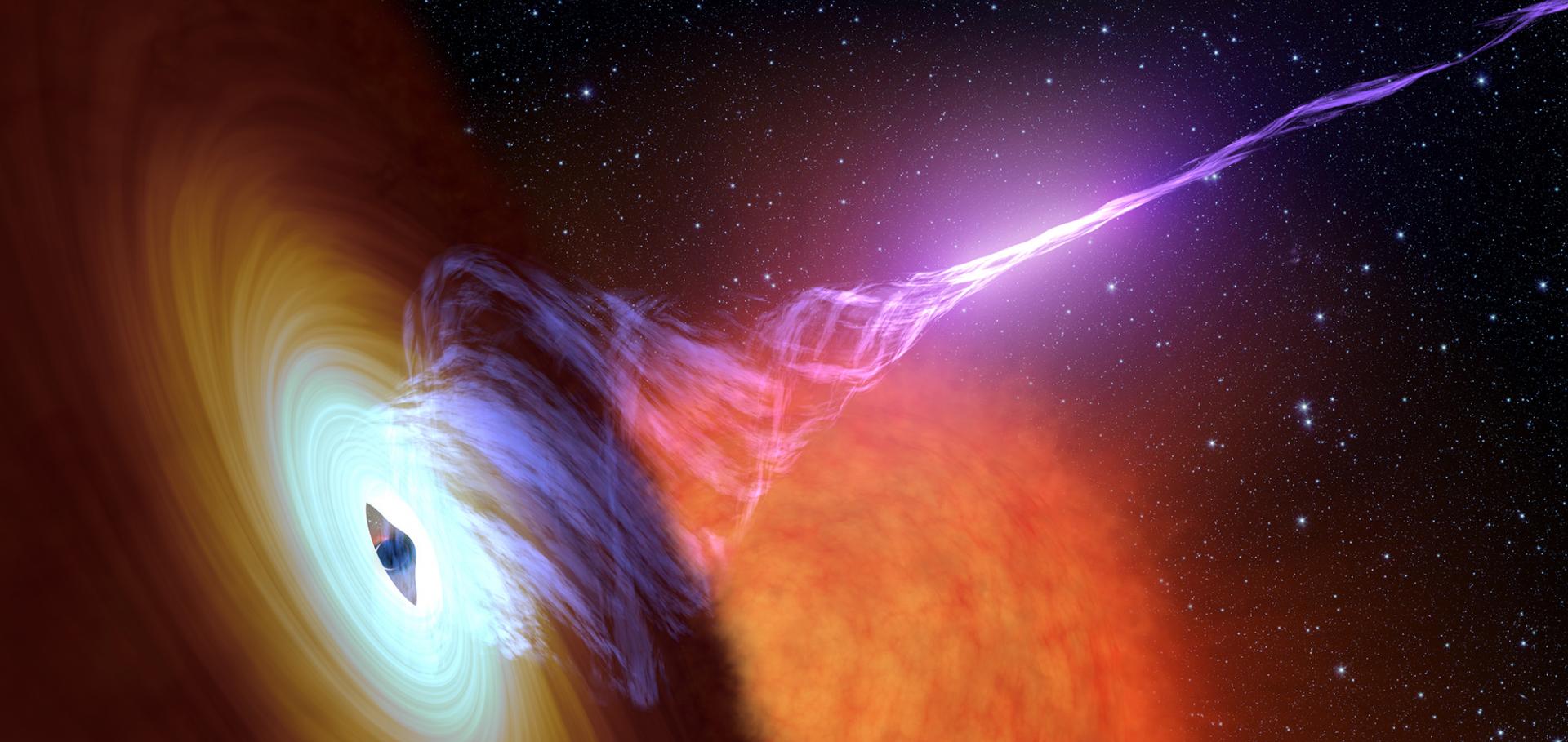
Relativistic Jet from Black Hole

An artist's impression of a relativistic jet propagating away from a black hole at close to the speed of light. Such jets are formed by the inner regions of the accretion flow: matter flowing inwards towards the black hole, via processes which are not yet fully understood. The accretion flow emits primarily in X-rays, the relativistic jet in the radio band: by combing observations in each band we can try and understand how such jets form and how much energy they carry away from the black hole.

Professor Rob Fender

Professor of Astrophysics

Research theme

  • Astronomy and astrophysics

Sub department

  • Astrophysics

Research groups

  • Hintze Centre for Astrophysical Surveys
  • MeerKAT
  • Pulsars, transients and relativistic astrophysics
  • Rubin-LSST
  • The Square Kilometre Array (SKA)
  • Gamma-ray astronomy
Rob.Fender@physics.ox.ac.uk
Telephone: 01865 (2)73435
Denys Wilkinson Building, room 712
  • About
  • Publications

A global study of X-ray binaries

International Conference Recent Advances in Natural Language Processing, RANLP (2008)

Authors:

R Dunn, R Fender, E Körding, C Cabanac, T Belloni

Abstract:

We present preliminary results on a global study of X-ray binaries using 14 Ms of data from the Rossi X-ray Timing Explorer RXTE satellite. Our initial study on GX 339-4 is recapped as an introduction to the methods used. We use a consistent analysis scheme for all objects, with three different spectral models to fit the powerlaw and disc components. We also take into account the possibility of a line being present in the data. The resulting almost 4000 observations allow the tracking of the spectral properties of the binaries as they evolve through an outburst. Our investigations concentrate on the disc and line properties of the binaries when in outburst. We also show the Disc-Fraction Luminosity diagram for the population of X-ray binaries studied which will enable us to further links with AGN. © Copyright owned by the author(s) under the terms of the Creative Commons Attribution-NonCommercial-ShareAlike Licence.

Evolution of the disc radii during outburst of x-ray binaries as infered from thermal emission

International Conference Recent Advances in Natural Language Processing, RANLP (2008)

Authors:

C Cabanac, R Fender, E Körding, R Dunn

Abstract:

Compact object displays drastic spectral and timing changing from the beginning to the end of an outburst, showing the different efficiencies of accretion processes. Black hole binaries hence exhibit schematically two different states in X-ray spectra: The first dominated by a thermal component and the second by a hard powerlaw shape like. Whereas the hard component is often attributed to the emission of a radiatively inefficient corona, the thermal component is interpreted as the emission of the optically thick accretion disc. The commonly accepted picture suggests that the observed transition between hard and soft states is associated by a drop in the accretion efficiency of the thermal component by a recession of the internal disc radius in hard states. However, recent studies based on relativistically broadened iron line and the thermal component strength analysis would tend to show the presence of the disc in the vicinity of the horizon. By a reanalysis of archive spectra where thermal emission is present, we tracked the values of the disc radii during outbursts among several sources. Indeed, whereas a constant inner radius would imply that the disc luminosity should monotonically depends on the temperature, we show that this relationship seems to deviate at the lowest luminosities. © Copyright owned by the author(s) under the terms of the Creative Commons Attribution-NonCommercial-ShareAlike Licence.

Evolution of the disc radii during outburst of x-ray binaries as infered from thermal emission

International Conference Recent Advances in Natural Language Processing, RANLP (2008)

Authors:

C Cabanac, R Fender, E Körding, R Dunn

Abstract:

Compact object displays drastic spectral and timing changing from the beginning to the end of an outburst, showing the different efficiencies of accretion processes. Black hole binaries hence exhibit schematically two different states in X-ray spectra: The first dominated by a thermal component and the second by a hard powerlaw shape like. Whereas the hard component is often attributed to the emission of a radiatively inefficient corona, the thermal component is interpreted as the emission of the optically thick accretion disc. The commonly accepted picture suggests that the observed transition between hard and soft states is associated by a drop in the accretion efficiency of the thermal component by a recession of the internal disc radius in hard states. However, recent studies based on relativistically broadened iron line and the thermal component strength analysis would tend to show the presence of the disc in the vicinity of the horizon. By a reanalysis of archive spectra where thermal emission is present, we tracked the values of the disc radii during outbursts among several sources. Indeed, whereas a constant inner radius would imply that the disc luminosity should monotonically depends on the temperature, we show that this relationship seems to deviate at the lowest luminosities. © Copyright owned by the author(s) under the terms of the Creative Commons Attribution-NonCommercial-ShareAlike Licence.

High energy astrophysics with the next generation of radio astronomy facilities

International Conference Recent Advances in Natural Language Processing, RANLP (2008)

Abstract:

High energy astrophysics has made good use of combined high energy (X-ray, g-ray) and radio observations to uncover connections between outbursts, accretion, particle acceleration and kinetic feedback to the local ambient medium. In the field of microquasars the connections have been particularly important. However, radio astronomy has been relying on essentially the same facilities for the past ∼ 25 years, whereas high-energy astrophysics, in particular space-based research, has had a series of newer and more powerful missions. In the next fifteen years this imbalance is set to be redressed, with a whole familiy of new radio facilities under development en route to the Square Kilometre Array (SKA) in the 2020s. In this brief review I will summarize these future prospects for radio astronomy, and focus on possibly the most exciting of the new facilities to be built in the next decade, the Low Frequency Array LOFAR, and its uses in high energy astrophysics. © Copyright owned by the author(s) under the terms of the Creative Commons Attribution-NonCommercial- ShareAlike Licence.

High energy astrophysics with the next generation of radio astronomy facilities

International Conference Recent Advances in Natural Language Processing, RANLP (2008)

Abstract:

High energy astrophysics has made good use of combined high energy (X-ray, g-ray) and radio observations to uncover connections between outbursts, accretion, particle acceleration and kinetic feedback to the local ambient medium. In the field of microquasars the connections have been particularly important. However, radio astronomy has been relying on essentially the same facilities for the past ∼ 25 years, whereas high-energy astrophysics, in particular space-based research, has had a series of newer and more powerful missions. In the next fifteen years this imbalance is set to be redressed, with a whole familiy of new radio facilities under development en route to the Square Kilometre Array (SKA) in the 2020s. In this brief review I will summarize these future prospects for radio astronomy, and focus on possibly the most exciting of the new facilities to be built in the next decade, the Low Frequency Array LOFAR, and its uses in high energy astrophysics. © Copyright owned by the author(s) under the terms of the Creative Commons Attribution-NonCommercial- ShareAlike Licence.

Pagination

  • First page First
  • Previous page Prev
  • …
  • Page 147
  • Page 148
  • Page 149
  • Page 150
  • Current page 151
  • Page 152
  • Page 153
  • Page 154
  • Page 155
  • …
  • Next page Next
  • Last page Last

Footer Menu

  • Contact us
  • Giving to the Dept of Physics
  • Work with us
  • Media

User account menu

  • Log in

Follow us

FIND US

Clarendon Laboratory,

Parks Road,

Oxford,

OX1 3PU

CONTACT US

Tel: +44(0)1865272200

University of Oxfrod logo Department Of Physics text logo
IOP Juno Champion logo Athena Swan Silver Award logo

© University of Oxford - Department of Physics

Cookies | Privacy policy | Accessibility statement

Built by: Versantus

  • Home
  • Research
  • Study
  • Engage
  • Our people
  • News & Comment
  • Events
  • Our facilities & services
  • About us
  • Giving to Physics
  • Current students
  • Staff intranet