Home
Department Of Physics text logo
  • Research
    • Our research
    • Our research groups
    • Our research in action
    • Research funding support
    • Summer internships for undergraduates
  • Study
    • Undergraduates
    • Postgraduates
  • Engage
    • For alumni
    • For business
    • For schools
    • For the public
  • Support
Menu
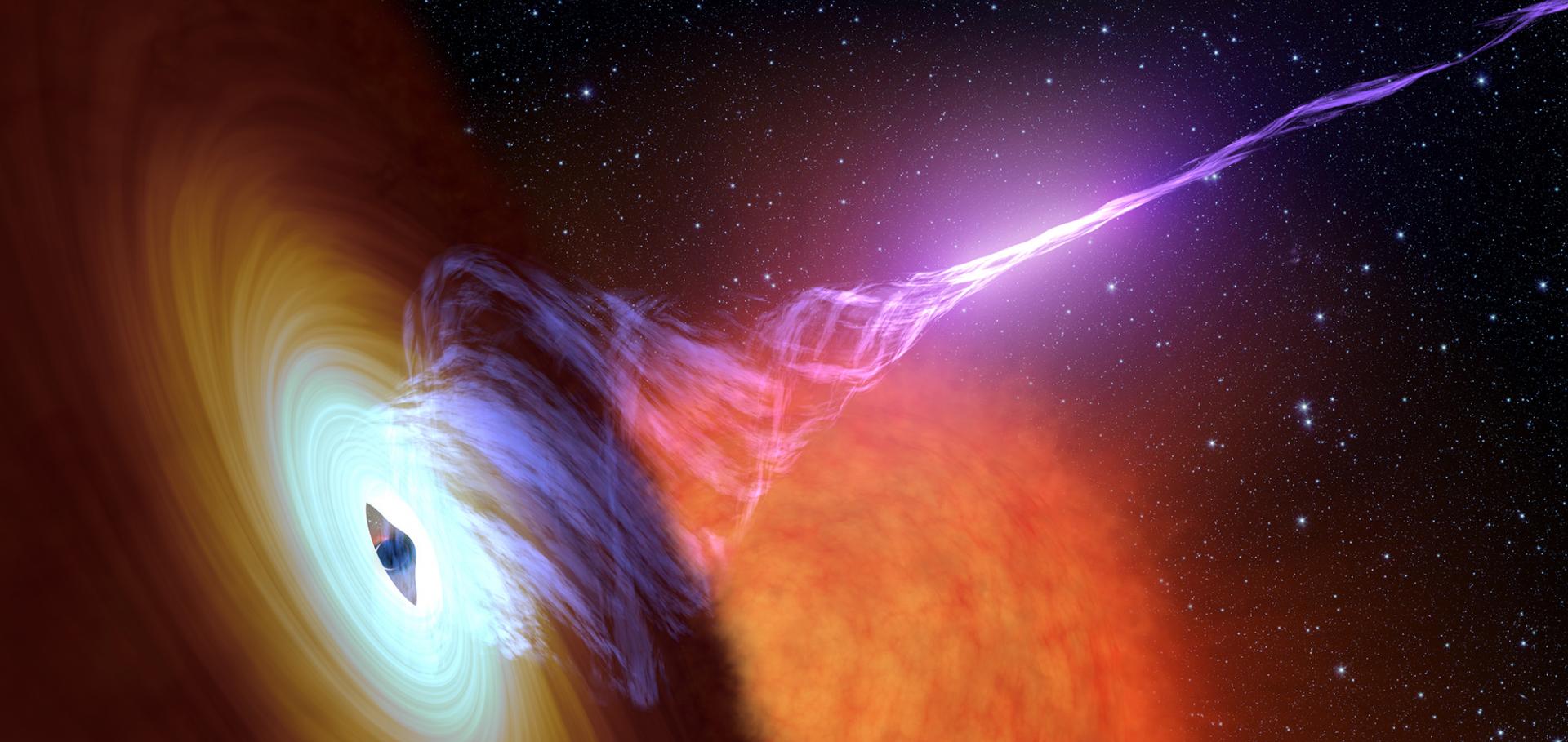
Relativistic Jet from Black Hole

An artist's impression of a relativistic jet propagating away from a black hole at close to the speed of light. Such jets are formed by the inner regions of the accretion flow: matter flowing inwards towards the black hole, via processes which are not yet fully understood. The accretion flow emits primarily in X-rays, the relativistic jet in the radio band: by combing observations in each band we can try and understand how such jets form and how much energy they carry away from the black hole.

Professor Rob Fender

Professor of Astrophysics

Research theme

  • Astronomy and astrophysics

Sub department

  • Astrophysics

Research groups

  • Hintze Centre for Astrophysical Surveys
  • MeerKAT
  • Pulsars, transients and relativistic astrophysics
  • Rubin-LSST
  • The Square Kilometre Array (SKA)
  • Gamma-ray astronomy
Rob.Fender@physics.ox.ac.uk
Telephone: 01865 (2)73435
Denys Wilkinson Building, room 712
  • About
  • Publications

The Continuous Jets of Cygnus X-1

Chapter in Microquasars, Springer Nature (2001) 255-258

Authors:

R Spencer, C De La Force, A Stirling, M Garrett, R Fender, R Ogley
More details from the publisher

The Disc — Jet Connection in GRS 1915+105

Chapter in Microquasars, Springer Nature (2001) 291-292

Authors:

M Klein-Wolt, RP Fender, GG Pooley, T Belloni, S Migliari, EH Morgan, M Van Der Klis
More details from the publisher

VLBA Observations of the Superluminal Radio Jet from Cygnus X-1 in the Low/Hard X-Ray State

Chapter in Microquasars, Springer Nature (2001) 121-122

Authors:

Chris De La Force, Ralph Spencer, A Stirling, M Garrett, R Fender
More details from the publisher

Coupling of the X-ray and radio emission in the black hole candidate and compact jet source GX 339-4

Astronomy and Astrophysics 359:1 (2000) 251-268

Authors:

S Corbel, RP Fender, AK Tzioumis, M Nowak, V McIntyre, P Durouchoux, R Sood

Abstract:

We report the results of a long-term campaign of radio, soft- and hard- X-ray observations of the galactic black hole candidate GX 339-4. In the Low-Hard X-ray state the system displays a strong 3-way linear correlation between soft-and hard-X-rays and radio emission, implying a coupling between the Comptonising corona and a radio-emitting compact jet. In this state the radio emission is linearly polarised at a level of around 2%, with an almost constant polarisation angle, indicative of a favored axis in this system probably related to the compact jet and/or black hole spin axis. In the Off X-ray state the radio emission declines with the X-ray emission to below detectable levels, suggesting that it is simply a lower-luminosity version of the Low-Hard state. In the High-Soft state both the hard-X-ray and radio emission are suppressed. We also note that the transitions from the Low-Hard state to the High-Soft state (and the reverse) are possibly associated with discrete ejection(s) of expanding relativistic plasma.

Disk mass accretion rate and infrared flares in GRS 1915+105

Astronomy and Astrophysics 358:2 (2000)

Authors:

T Belloni, S Migliari, RP Fender

Abstract:

We have analyzed in detail a set of Rossi X-ray Timing Explorer (RXTE) observations of the galactic microquasar GRS 1915+105 corresponding to times when quasi-periodic oscillations in the infrared have been reported. From time-resolved spectral analysis, we have estimated the mass accretion rate through the (variable) inner edge of the accretion disk. We compare this accretion rate to an estimate of the mass/energy outflow rate in the jet. We discuss the possible implications of these results in terms of disk-instability and jet ejection, and in particular note an apparent anti-correlation between the accretion and ejection rates, implying that the gas expelled in the jet must leave the accretion disk before reaching its innermost radius.

Pagination

  • First page First
  • Previous page Prev
  • …
  • Page 208
  • Page 209
  • Page 210
  • Page 211
  • Current page 212
  • Page 213
  • Page 214
  • Page 215
  • Page 216
  • …
  • Next page Next
  • Last page Last

Footer Menu

  • Contact us
  • Giving to the Dept of Physics
  • Work with us
  • Media

User account menu

  • Log in

Follow us

FIND US

Clarendon Laboratory,

Parks Road,

Oxford,

OX1 3PU

CONTACT US

Tel: +44(0)1865272200

University of Oxfrod logo Department Of Physics text logo
IOP Juno Champion logo Athena Swan Silver Award logo

© University of Oxford - Department of Physics

Cookies | Privacy policy | Accessibility statement

Built by: Versantus

  • Home
  • Research
  • Study
  • Engage
  • Our people
  • News & Comment
  • Events
  • Our facilities & services
  • About us
  • Giving to Physics
  • Current students
  • Staff intranet