Home
Department Of Physics text logo
  • Research
    • Our research
    • Our research groups
    • Our research in action
    • Research funding support
    • Summer internships for undergraduates
  • Study
    • Undergraduates
    • Postgraduates
  • Engage
    • For alumni
    • For business
    • For schools
    • For the public
  • Support
Menu
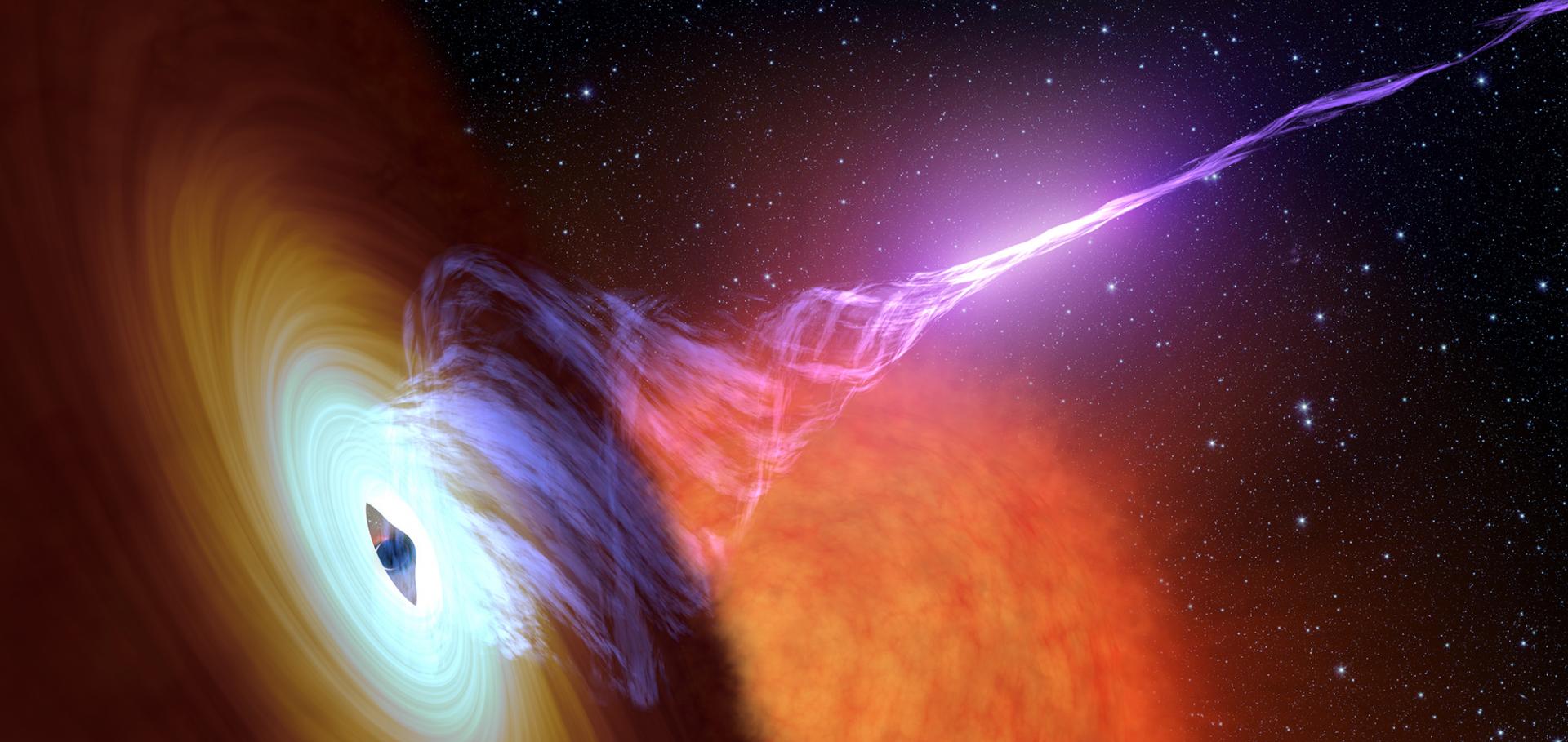
Relativistic Jet from Black Hole

An artist's impression of a relativistic jet propagating away from a black hole at close to the speed of light. Such jets are formed by the inner regions of the accretion flow: matter flowing inwards towards the black hole, via processes which are not yet fully understood. The accretion flow emits primarily in X-rays, the relativistic jet in the radio band: by combing observations in each band we can try and understand how such jets form and how much energy they carry away from the black hole.

Professor Rob Fender

Professor of Astrophysics

Research theme

  • Astronomy and astrophysics

Sub department

  • Astrophysics

Research groups

  • Hintze Centre for Astrophysical Surveys
  • MeerKAT
  • Pulsars, transients and relativistic astrophysics
  • Rubin-LSST
  • The Square Kilometre Array (SKA)
  • Gamma-ray astronomy
Rob.Fender@physics.ox.ac.uk
Telephone: 01865 (2)73435
Denys Wilkinson Building, room 712
  • About
  • Publications

Resolving the radio nebula around β Lyrae

Astronomy and Astrophysics 358:1 (2000) 229-232

Authors:

G Umana, PFL Maxted, C Trigilio, RP Fender, F Leone, SK Yerli

Abstract:

In this paper we present high spatial resolution radio images of the puzzling binary system β Lyrae obtained with MERLIN at 5 GHz. We find a nebula surrounding the binary with a brightness temperature of (11000 ± 700) K approximately 40 AU across. This definitively confirms the thermal origin of the radio emission, which is consistent with emission from the wind of the B6-8 II component (mass loss of order of 10-7 M⊙yr-1), ionized by the radiation field of the hotter companion. This nebula, surrounding the binary, is the proof that β Lyrae evolved in a non-conservative way, i. e. not all the mass lost by the primary is accretted by the secondary, and present measurements indicate that almost 0.015 M⊙ had been lost from the system since the onset of the Roche lobe overflow phase. Moreover, the nebula is aligned with the jet-like structures inferred from recent optical measurements, indicating a possible connection among them.

Light Curves and Radio Structure of the 1999 September Transient Event in V4641 Sagittarii (=XTE J1819–254=SAX J1819.3–2525)

The Astrophysical Journal American Astronomical Society 544:2 (2000) 977-992

Authors:

RM Hjellming, MP Rupen, RW Hunstead, D Campbell-Wilson, AJ Mioduszewski, BM Gaensler, DA Smith, RJ Sault, RP Fender, RE Spencer, CJ de la Force, AMS Richards, ST Garrington, SA Trushkin, FD Ghigo, EB Waltman, M McCollough
More details from the publisher

The 1997 hard state outburst of the X-ray transient GS 1354-64 / BW Cir

(2000)

Authors:

C Brocksopp, PG Jonker, RP Fender, PJ Groot, M van der Klis, SJ Tingay
More details from the publisher

The disc-jet connection in GRS 1915+105

(2000)

Authors:

M Klein-Wolt, RP Fender, GG Pooley, T Belloni, S Migliari, EH Morgan, M van der Klis
More details from the publisher

Energetics of jets from X-ray binaries

(2000)
More details from the publisher

Pagination

  • First page First
  • Previous page Prev
  • …
  • Page 209
  • Page 210
  • Page 211
  • Page 212
  • Current page 213
  • Page 214
  • Page 215
  • Page 216
  • Page 217
  • …
  • Next page Next
  • Last page Last

Footer Menu

  • Contact us
  • Giving to the Dept of Physics
  • Work with us
  • Media

User account menu

  • Log in

Follow us

FIND US

Clarendon Laboratory,

Parks Road,

Oxford,

OX1 3PU

CONTACT US

Tel: +44(0)1865272200

University of Oxfrod logo Department Of Physics text logo
IOP Juno Champion logo Athena Swan Silver Award logo

© University of Oxford - Department of Physics

Cookies | Privacy policy | Accessibility statement

Built by: Versantus

  • Home
  • Research
  • Study
  • Engage
  • Our people
  • News & Comment
  • Events
  • Our facilities & services
  • About us
  • Giving to Physics
  • Current students
  • Staff intranet