Home
Department Of Physics text logo
  • Research
    • Our research
    • Our research groups
    • Our research in action
    • Research funding support
    • Summer internships for undergraduates
  • Study
    • Undergraduates
    • Postgraduates
  • Engage
    • For alumni
    • For business
    • For schools
    • For the public
Menu
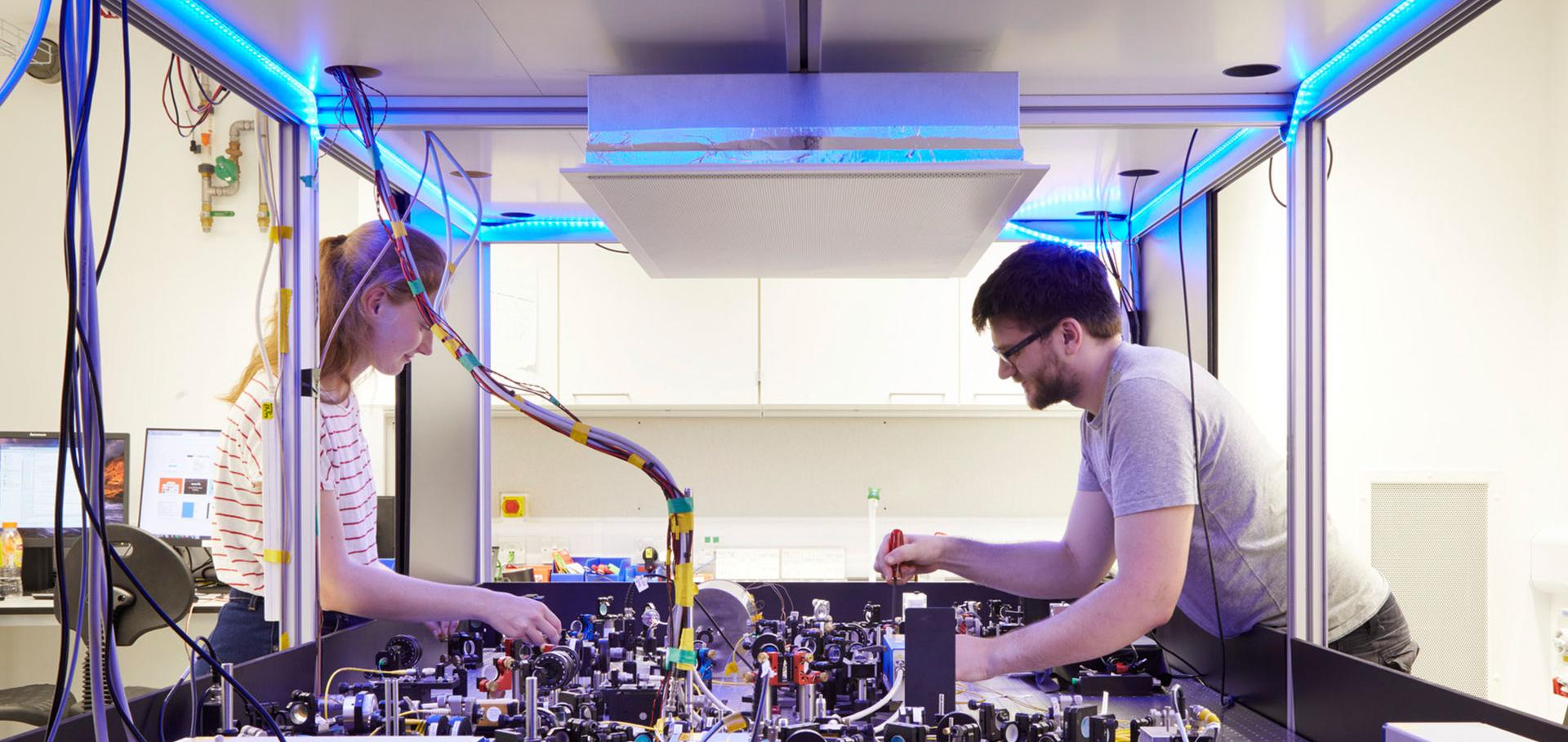
Atomic and Laser Physics
Credit: Jack Hobhouse

Professor Christopher Foot

Professor of Physics

Research theme

  • Quantum optics & ultra-cold matter

Sub department

  • Atomic and Laser Physics

Research groups

  • Ultracold quantum matter
  • AION/Magis
Christopher.Foot@physics.ox.ac.uk
Telephone: 01865 (2)72256
Clarendon Laboratory, room 161
  • About
  • Publications

Capturing long range correlations in two-dimensional quantum lattice systems using correlator product states

ArXiv 1107.0936 (2011)

Authors:

S Al-Assam, SR Clark, CJ Foot, D Jaksch

Abstract:

We study the suitability of correlator product states for describing ground-state properties of two-dimensional spin models. Our ansatz for the many-body wave function takes the form of either plaquette or bond correlator product states and the energy is optimized by varying the correlators using Monte Carlo minimization. For the Ising model we find that plaquette correlators are best for estimating the energy while bond correlators capture the expected long-range correlations and critical behavior of the system more faithfully. For the antiferromagnetic Heisenberg model, however, plaquettes outperform bond correlators at describing both local and long-range correlations because of the substantially larger number of local parameters they contain. These observations have quantitative implications for the application of correlator product states to other more complex systems, and give important heuristic insights: in particular the necessity of carefully tailoring the choice of correlators to the system considered, its interactions and symmetries.
Details from ArXiV
More details from the publisher
More details

Capturing long range correlations in two-dimensional quantum lattice systems using correlator product states

(2011)

Authors:

S Al-Assam, SR Clark, CJ Foot, D Jaksch
More details from the publisher

Double well potentials and quantum gates

American Journal of Physics 79:7 (2011) 762-768

Authors:

CJ Foot, MD Shotter

Abstract:

A system of particles in a double well potential is a widely studied and useful example for understanding quantum mechanics. This simple system has recently been used in theoretical proposals and related experiments as a way to make quantum logic gates for ultracold atoms confined in optical lattices. Such quantum gates are the fundamental building blocks for quantum information processing; in these proposals, a regular array of cold atoms in an optical lattice serves as the quantum register. We explain how this research can be understood in terms of well-known principles for systems of identical particles. © 2011 American Association of Physics Teachers.
More details from the publisher
More details

Erratum: Time-averaged adiabatic ring potential for ultracold atoms (Physical Review A - Atomic, Molecular, and Optical Physics (2011) 83 (043408))

Physical Review A - Atomic, Molecular, and Optical Physics 83:5 (2011)

Authors:

BE Sherlock, M Gildemeister, E Owen, E Nugent, CJ Foot
More details from the publisher

Time-averaged adiabatic ring potential for ultracold atoms

Physical Review A - Atomic, Molecular, and Optical Physics 83:4 (2011)

Authors:

BE Sherlock, M Gildemeister, E Owen, E Nugent, CJ Foot

Abstract:

We report the experimental realization of a versatile ring trap for ultracold atoms. The ring geometry is created by the time-averaged adiabatic potential resulting from the application of an oscillating magnetic bias field to a rf-dressed quadrupole trap. Lifetimes for a Bose-Einstein condensate in the ring exceed 11s and the ring radius was continuously varied from 50μm to 262μm. An efficient method of loading the ring from a conventional time-averaged orbiting potential trap is presented together with a rotation scheme which introduces angular momentum into the system. The ring presents an opportunity to study the superfluid properties of a condensate in a multiply connected geometry and also has applications for matter-wave interferometry. © 2011 American Physical Society.
More details from the publisher
More details

Pagination

  • First page First
  • Previous page Prev
  • …
  • Page 9
  • Page 10
  • Page 11
  • Page 12
  • Current page 13
  • Page 14
  • Page 15
  • Page 16
  • Page 17
  • …
  • Next page Next
  • Last page Last

Footer Menu

  • Contact us
  • Giving to the Dept of Physics
  • Work with us
  • Media

User account menu

  • Log in

Follow us

FIND US

Clarendon Laboratory,

Parks Road,

Oxford,

OX1 3PU

CONTACT US

Tel: +44(0)1865272200

University of Oxfrod logo Department Of Physics text logo
IOP Juno Champion logo Athena Swan Silver Award logo

© University of Oxford - Department of Physics

Cookies | Privacy policy | Accessibility statement

Built by: Versantus

  • Home
  • Research
  • Study
  • Engage
  • Our people
  • News & Comment
  • Events
  • Our facilities & services
  • About us
  • Giving to Physics
  • Current students
  • Staff intranet