

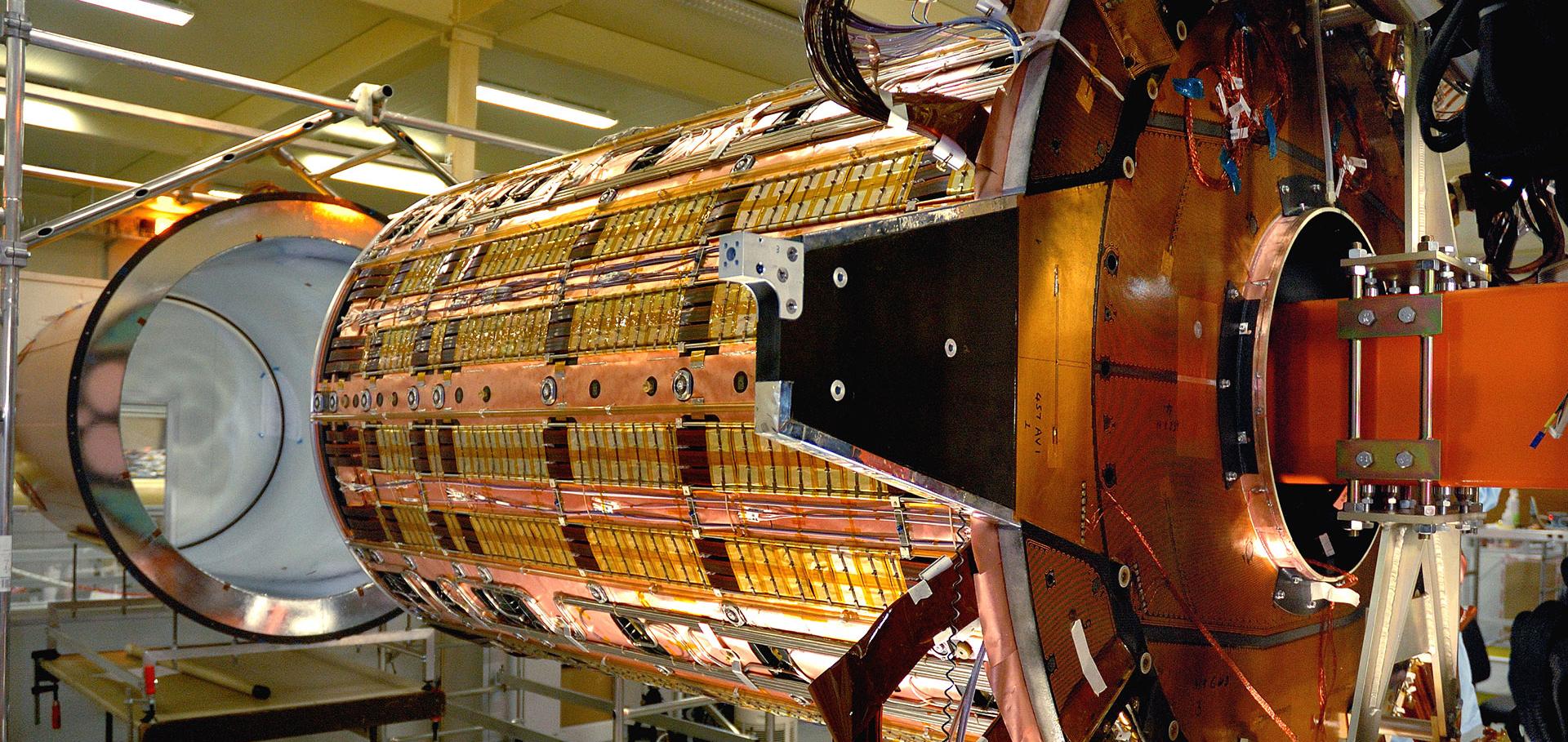

Search for low-mass WIMPs with EDELWEISS-II heat-and-ionization detectors
Physical Review D - Particles, Fields, Gravitation and Cosmology 86:5 (2012)
Abstract:
We report on a search for low-energy (E<20keV) WIMP-induced nuclear recoils using data collected in 2009-2010 by EDELWEISS from four germanium detectors equipped with thermal sensors and an electrode design (ID) which allows to efficiently reject several sources of background. The data indicate no evidence for an exponential distribution of low-energy nuclear recoils that could be attributed to WIMP elastic scattering after an exposure of 113kg•d. For weakly interacting massive particles (WIMPs) of mass 10 GeV, the observation of one event in the WIMP search region results in a 90% C.L. limit of 1.0×10 -5pb on the spin-independent WIMP-nucleon scattering cross-section, which constrains the parameter space associated with the findings reported by the CoGeNT, DAMA and CRESST experiments. © 2012 American Physical Society.A multi-tiered data structure and process management system based on ROOT and CouchDB
Nuclear Instruments and Methods in Physics Research, Section A: Accelerators, Spectrometers, Detectors and Associated Equipment 684 (2012) 63-72
Abstract:
A multi-tiered data structure, analysis toolkit and data processing management system has been constructed using ROOT and CouchDB. This system is well suited for experiments that acquire many computer files of raw data over the course of months or years, that are distributed to different computing centers and further reduced in size by several steps of data processing. Data handling for experiments searching for rare events extracted from digitized pulse traces typically fit this description. An implementation of this system has been constructed for the EDELWEISS-III experiment and is described here in some detail. This solution may also serve as a prototype system for the proposed EURECA experiment. © 2012 Elsevier B.V. All rights reserved.Extending the CRESST-II commissioning run limits to lower masses
Physical Review D - Particles, Fields, Gravitation and Cosmology 85:2 (2012)
Abstract:
Motivated by the recent interest in light weakly interacting massive particles (WIMPs) of mass ∼O(10GeV/c2), an extension of the elastic, spin-independent, WIMP-nucleon cross-section limits resulting from the CRESST-II commissioning run (2007) are presented. Previously, these data were used to set cross-section limits from 1000GeV/c2 down to ∼17GeV/c2, using tungsten recoils, in 47.9 kg-days of exposure of calcium tungstate. Here, the overlap of the oxygen and calcium bands with the acceptance region of the commissioning run data set is reconstructed using previously published quenching factors. The resulting elastic WIMP cross-section limits, accounting for the additional exposure of oxygen and calcium, are presented down to 5GeV/c2. © 2012 American Physical Society.Extending the CRESST-II commissioning run limits to lower masses
PHYSICAL REVIEW D 85:2 (2012) ARTN 021301
Investigation of luminescence and scintillation properties of a ZnS-Ag/ 6LiF scintillator in the 7-295 K temperature range
Journal of Luminescence (2012)