Home
Department Of Physics text logo
  • Research
    • Our research
    • Our research groups
    • Our research in action
    • Research funding support
    • Summer internships for undergraduates
  • Study
    • Undergraduates
    • Postgraduates
  • Engage
    • For alumni
    • For business
    • For schools
    • For the public
Menu
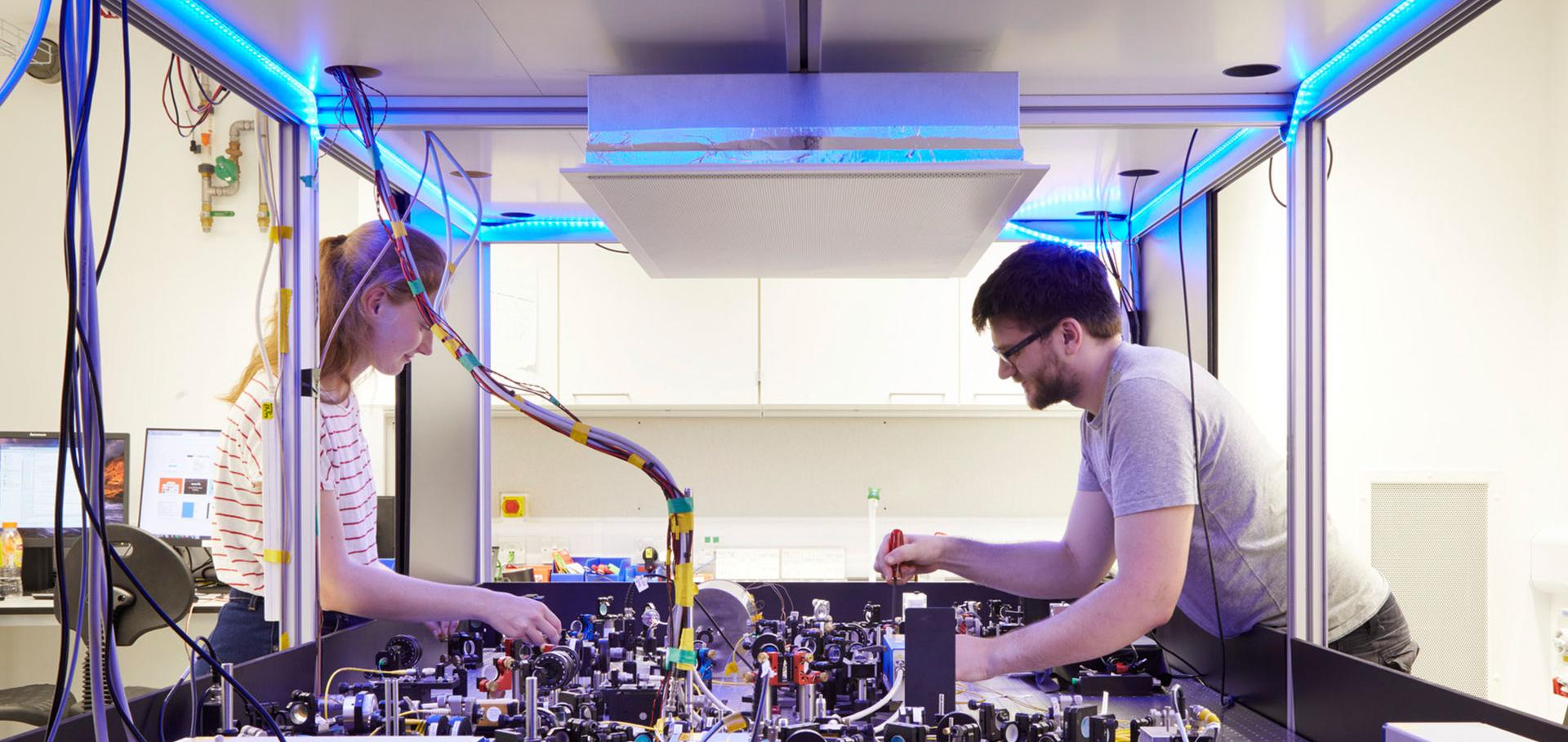
Atomic and Laser Physics
Credit: Jack Hobhouse

Sunny Howard

Graduate Students

Sub department

  • Atomic and Laser Physics
sunny.howard@physics.ox.ac.uk
Clarendon Laboratory, room 244
  • About
  • Publications

CoordGate: efficiently computing spatially-varying convolutions in convolutional neural networks

British Machine Vision Association (2023)

Authors:

Sunny Howard, Peter Norreys, Andreas Döpp

Abstract:

Optical imaging systems are inherently limited in their resolution due to the point spread function (PSF), which applies a static, yet spatially-varying, convolution to the image. This degradation can be addressed via Convolutional Neural Networks (CNNs), particularly through deblurring techniques. However, current solutions face certain limitations in efficiently computing spatially-varying convolutions. In this paper we propose CoordGate, a novel lightweight module that uses a multiplicative gate and a coordinate encoding network to enable efficient computation of spatially-varying convolutions in CNNs. CoordGate allows for selective amplification or attenuation of filters based on their spatial position, effectively acting like a locally connected neural network. The effectiveness of the CoordGate solution is demonstrated within the context of U-Nets and applied to the challenging problem of image deblurring. The experimental results show that CoordGate outperforms existing approaches, offering a more robust and spatially aware solution for CNNs in various computer vision applications.
Details from ORA

Hyperspectral compressive wavefront sensing

High Power Laser Science and Engineering Cambridge University Press 11 (2023) e32

Authors:

Sunny Howard, Jannik Esslinger, Robin HW Wang, Peter Norreys, Andreas Döpp

Abstract:

Presented is a novel way to combine snapshot compressive imaging and lateral shearing interferometry in order to capture the spatio-spectral phase of an ultrashort laser pulse in a single shot. A deep unrolling algorithm is utilized for snapshot compressive imaging reconstruction due to its parameter efficiency and superior speed relative to other methods, potentially allowing for online reconstruction. The algorithm’s regularization term is represented using a neural network with 3D convolutional layers to exploit the spatio-spectral correlations that exist in laser wavefronts. Compressed sensing is not typically applied to modulated signals, but we demonstrate its success here. Furthermore, we train a neural network to predict the wavefronts from a lateral shearing interferogram in terms of Zernike polynomials, which again increases the speed of our technique without sacrificing fidelity. This method is supported with simulation-based results. While applied to the example of lateral shearing interferometry, the methods presented here are generally applicable to a wide range of signals, including Shack–Hartmann-type sensors. The results may be of interest beyond the context of laser wavefront characterization, including within quantitative phase imaging.
More details from the publisher
Details from ORA
More details

Towards more robust ignition of inertial fusion targets

Physics of Plasmas AIP Publishing 30 (2023) 022702

Authors:

Jordan Lee, Rusko T Ruskov, Heath S Martin, Stephen Hughes, Marko W von der Leyen, Robert W Paddock, Robin Timmis, Iustin Ouatu, Qingsong S Feng, Sunny Howard, Eduard Atonga, Ramy Aboushelbaya, TD Arber, R Bingham, Peter Norreys

Abstract:

Following the 1.3 MJ fusion milestone at the National Ignition Facility, the further development of inertial confinement fusion, both as a source for future electricity generation and for high energy density physics applications, requires the development of more robust ignition concepts at current laser facility energy scales. This can potentially be achieved by auxiliary heating the hotspot of low convergence wetted foam implosions where hydrodynamic and parametric instabilities are minimised. This paper presents the first multi-dimensional Vlasov-Maxwell and particle-in-cell simulations to model this collisionless interaction, only recently made possible by access to the largest modern supercomputers. The key parameter of interest is the maximum fraction of energy that can be extracted from the electron beams into the hotspot plasma. The simulations indicate that significant coupling efficiencies are achieved over a wide range of beam parameters and spatial configurations. The implications for experimental tests on the National Ignition Facility are discussed.
More details from the publisher
Details from ORA
More details

Single-shot spatio-temporal vector field measurements of petawatt laser pulses

Abstract:

The field structure of ultra-intense laser pulses plays a critical role in their applications. Spatiotemporal couplings (STCs), though undetectable by conventional diagnostics, can significantly impact the pulse's properties. For example, undesirable STCs reduce the peak focused intensity, while deliberate STCs, such as those in the "flying focus", underpin advancements in structured light. Furthermore, as evidenced by a growing body of simulation-based literature, the polarisation state of the pulse can also add a valuable dimension of control and flexibility. A key barrier to the experimental realisation of structuring ultra-intense light is the fact that no method currently exists to characterise the spatiotemporal vector field of individual ultra-intense pulses. This thesis presents the development and realisation of a robust method for the single-shot characterisation of the spatiotemporal vector field, which also provides uncertainty estimates. Its efficacy is demonstrated by characterising the ATLAS-3000 PW laser and vectorial pulses such as circularly polarised optical vortices. It is hoped that the technique will be pivotal for advancing structured light applications in ultra-intense laser physics.
Details from ORA

Pagination

  • First page First
  • Previous page Prev
  • Page 1
  • Current page 2

Footer Menu

  • Contact us
  • Giving to the Dept of Physics
  • Work with us
  • Media

User account menu

  • Log in

Follow us

FIND US

Clarendon Laboratory,

Parks Road,

Oxford,

OX1 3PU

CONTACT US

Tel: +44(0)1865272200

University of Oxfrod logo Department Of Physics text logo
IOP Juno Champion logo Athena Swan Silver Award logo

© University of Oxford - Department of Physics

Cookies | Privacy policy | Accessibility statement

Built by: Versantus

  • Home
  • Research
  • Study
  • Engage
  • Our people
  • News & Comment
  • Events
  • Our facilities & services
  • About us
  • Giving to Physics
  • Current students
  • Staff intranet