Home
Department Of Physics text logo
  • Research
    • Our research
    • Our research groups
    • Our research in action
    • Research funding support
    • Summer internships for undergraduates
  • Study
    • Undergraduates
    • Postgraduates
  • Engage
    • For young people
    • For teachers
    • For the public
    • For alumni
    • For business
  • Support
Menu
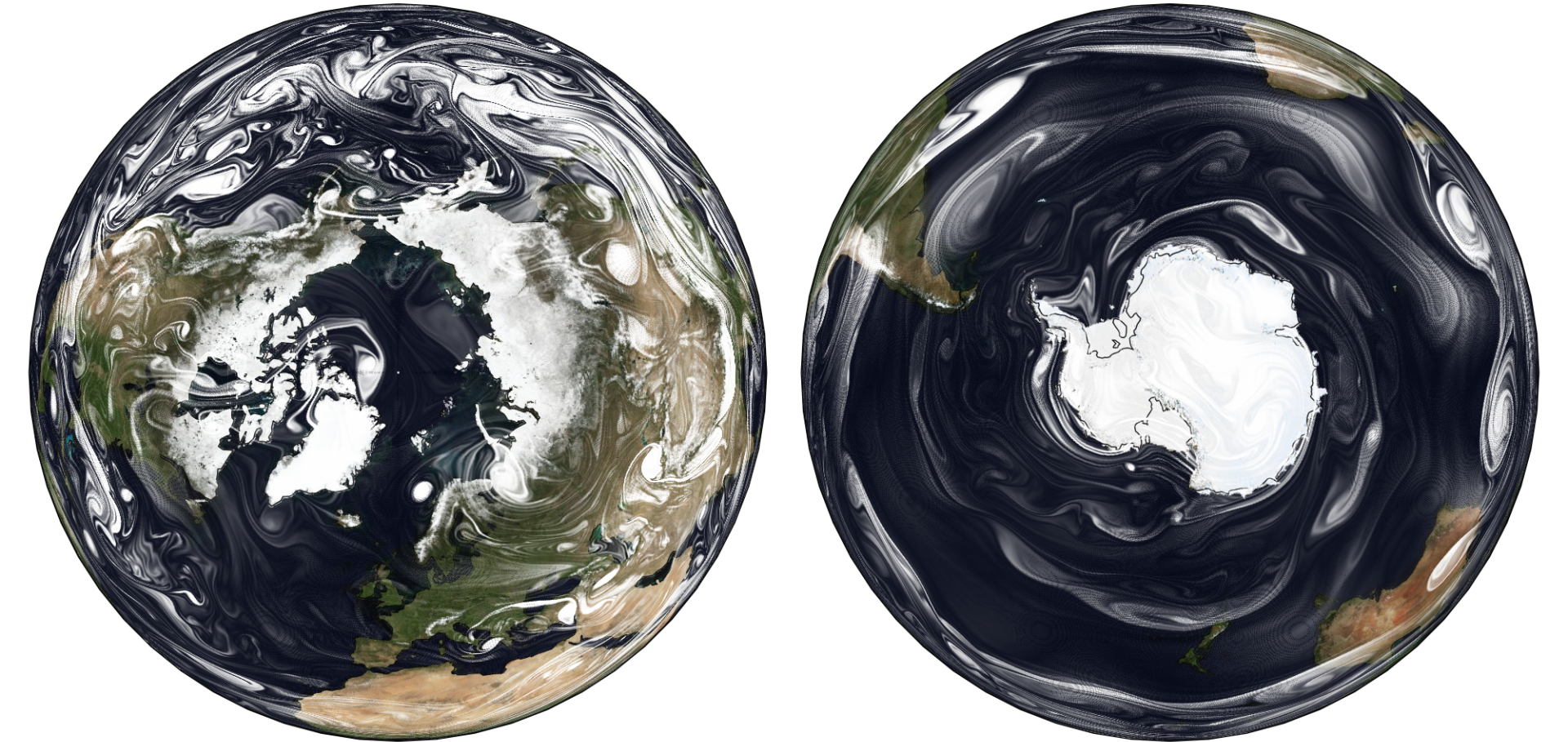
Relative vorticity in SpeedyWeather, painted like clouds.

Milan Kloewer (he|him)

NERC Research Fellow

Research theme

  • Climate physics

Sub department

  • Atmospheric, Oceanic and Planetary Physics

Research groups

  • Climate processes
milan.kloewer@physics.ox.ac.uk
personal website
github
  • About
  • Publications

Periodic orbits in chaotic systems simulated at low precision

Scientific Reports Nature Research 13:1 (2023) 11410

Authors:

Milan Klöwer, Peter V Coveney, E Adam Paxton, Tim N Palmer

Abstract:

Non-periodic solutions are an essential property of chaotic dynamical systems. Simulations with deterministic finite-precision numbers, however, always yield orbits that are eventually periodic. With 64-bit double-precision floating-point numbers such periodic orbits are typically negligible due to very long periods. The emerging trend to accelerate simulations with low-precision numbers, such as 16-bit half-precision floats, raises questions on the fidelity of such simulations of chaotic systems. Here, we revisit the 1-variable logistic map and the generalised Bernoulli map with various number formats and precisions: floats, posits and logarithmic fixed-point. Simulations are improved with higher precision but stochastic rounding prevents periodic orbits even at low precision. For larger systems the performance gain from low-precision simulations is often reinvested in higher resolution or complexity, increasing the number of variables. In the Lorenz 1996 system, the period lengths of orbits increase exponentially with the number of variables. Moreover, invariant measures are better approximated with an increased number of variables than with increased precision. Extrapolating to large simulations of natural systems, such as million-variable climate models, periodic orbit lengths are far beyond reach of present-day computers. Such orbits are therefore not expected to be problematic compared to high-precision simulations but the deviation of both from the continuum solution remains unclear
More details from the publisher
Details from ORA
More details
More details

Forecasting feels-like temperatures as a strategy to reduce heat illnesses during sport events

British Journal of Sports Medicine BMJ 57:10 (2023) 564-565

Authors:

Milan Klöwer, Pascal Edouard, Andreas M Niess, Sebastien Racinais, Yannis P Pitsiladis, Florian Pappenberger, Karsten Hollander
More details from the publisher
More details
More details

Earth Virtualization Engines: A Technical Perspective

Computing in Science & Engineering Institute of Electrical and Electronics Engineers (IEEE) 25:3 (2023) 50-59

Authors:

Torsten Hoefler, Bjorn Stevens, Andreas F Prein, Johanna Baehr, Thomas Schulthess, Thomas F Stocker, John Taylor, Daniel Klocke, Pekka Manninen, Piers M Forster, Tobias Kölling, Nicolas Gruber, Hartwig Anzt, Claudia Frauen, Florian Ziemen, Milan Klöwer, Karthik Kashinath, Christoph Schär, Oliver Fuhrer, Bryan N Lawrence
More details from the publisher
More details

Productivity meets Performance: Julia on A64FX

ArXiv 2207.12762 (2022)

Authors:

Mosè Giordano, Milan Klöwer, Valentin Churavy
Details from ArXiV

Fluid simulations accelerated with 16 bits: Approaching 4x speedup on A64FX by squeezing ShallowWaters.jl into Float16

Journal of Advances in Modelling Earth Systems Wiley 14:2 (2022) e2021MS002684

Authors:

Milan Kloewer, Sam Hatfield, Matteo Croci, Peter D Düben, Tim N Palmer

Abstract:

Most Earth-system simulations run on conventional central processing units in 64-bit double precision floating-point numbers Float64, although the need for high-precision calculations in the presence of large uncertainties has been questioned. Fugaku, currently the world's fastest supercomputer, is based on A64FX microprocessors, which also support the 16-bit low-precision format Float16. We investigate the Float16 performance on A64FX with ShallowWaters.jl, the first fluid circulation model that runs entirely with 16-bit arithmetic. The model implements techniques that address precision and dynamic range issues in 16 bits. The precision-critical time integration is augmented to include compensated summation to minimize rounding errors. Such a compensated time integration is as precise but faster than mixed precision with 16 and 32-bit floats. As subnormals are inefficiently supported on A64FX the very limited range available in Float16 is 6 × 10⁻⁵ to 65,504. We develop the analysis-number format Sherlogs.jl to log the arithmetic results during the simulation. The equations in ShallowWaters.jl are then systematically rescaled to fit into Float16, using 97% of the available representable numbers. Consequently, we benchmark speedups of up to 3.8x on A64FX with Float16. Adding a compensated time integration, speedups reach up to 3.6x. Although ShallowWaters.jl is simplified compared to large Earth-system models, it shares essential algorithms and therefore shows that 16-bit calculations are indeed a competitive way to accelerate Earth-system simulations on available hardware.
More details from the publisher
Details from ORA
More details
More details

Pagination

  • First page First
  • Previous page Prev
  • Page 1
  • Page 2
  • Page 3
  • Current page 4
  • Page 5
  • Page 6
  • Page 7
  • Next page Next
  • Last page Last

Footer Menu

  • Contact us
  • Giving to the Dept of Physics
  • Work with us
  • Media

User account menu

  • Log in

Follow us

FIND US

Clarendon Laboratory,

Parks Road,

Oxford,

OX1 3PU

CONTACT US

Tel: +44(0)1865272200

University of Oxfrod logo Department Of Physics text logo
IOP Juno Champion logo Athena Swan Silver Award logo

© University of Oxford - Department of Physics

Cookies | Privacy policy | Accessibility statement

Built by: Versantus

  • Home
  • Research
  • Study
  • Engage
  • Our people
  • News & Comment
  • Events
  • Our facilities & services
  • About us
  • Giving to Physics
  • Current students
  • Staff intranet