Home
Department Of Physics text logo
  • Research
    • Our research
    • Our research groups
    • Our research in action
    • Research funding support
    • Summer internships for undergraduates
  • Study
    • Undergraduates
    • Postgraduates
  • Engage
    • For alumni
    • For business
    • For schools
    • For the public
Menu
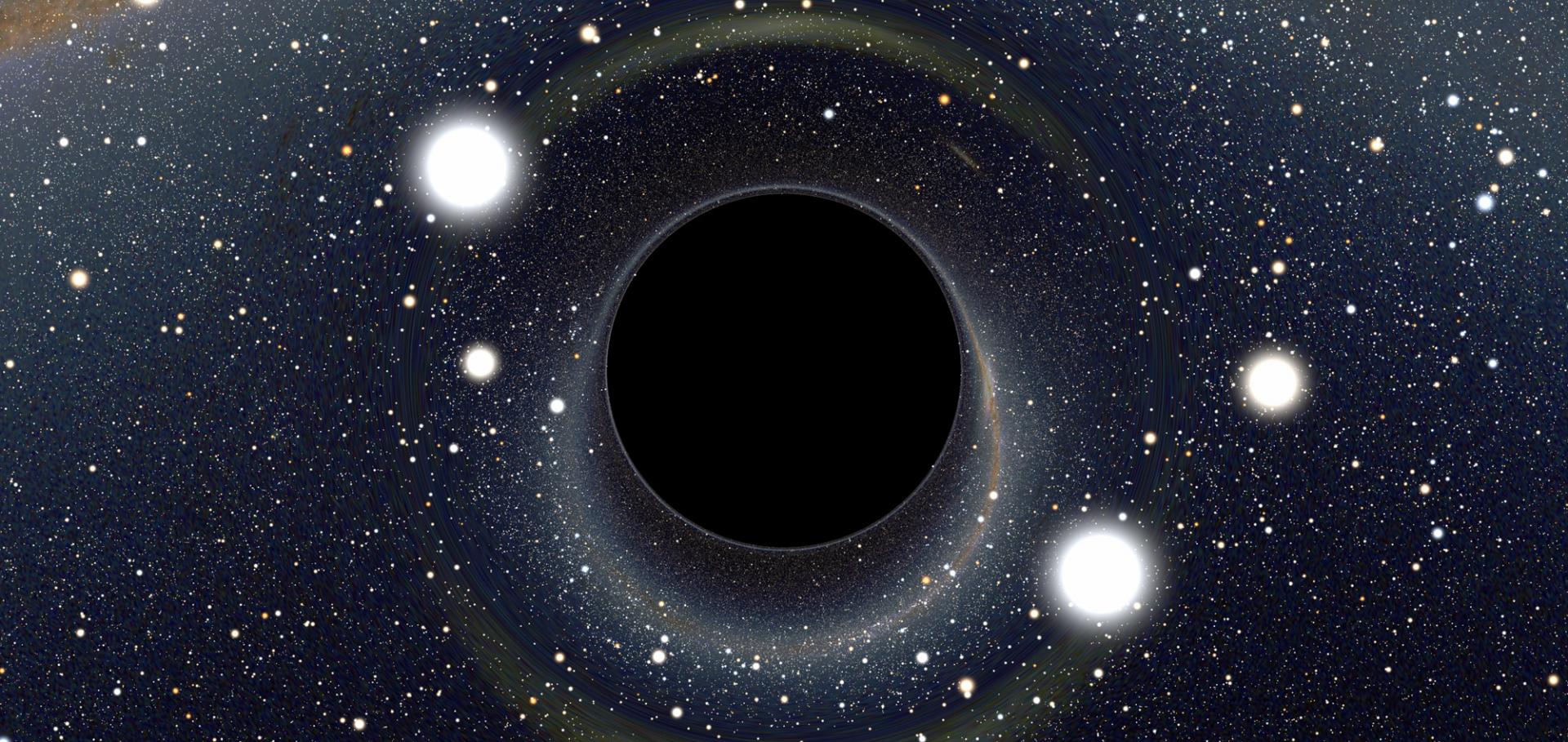
Black Hole

Lensing of space time around a black hole. At Oxford we study black holes observationally and theoretically on all size and time scales - it is some of our core work.

Credit: ALAIN RIAZUELO, IAP/UPMC/CNRS. CLICK HERE TO VIEW MORE IMAGES.

Lance Miller

Professor of Astrophysics

Research theme

  • Astronomy and astrophysics

Sub department

  • Astrophysics

Research groups

  • Beecroft Institute for Particle Astrophysics and Cosmology
  • Cosmology
  • Euclid
Lance.Miller@physics.ox.ac.uk
  • About
  • Publications

Towards emulating cosmic shear data: revisiting the calibration of the shear measurements for the Kilo-Degree Survey

Astronomy and Astrophysics EDP Sciences 624 (2019) A92

Authors:

A Kannawadi, H Hoekstra, Lance Miller, M Viola, IF Conti, R Herbonnet, T Erben, C Heymans, H Hildebrandt, K Kuijken, M Vakili, AH Wright

Abstract:

Exploiting the full statistical power of future cosmic shear surveys will necessitate improvements to the accuracy with which the gravitational lensing signal is measured. We present a framework for calibrating shear with image simulations that demonstrates the importance of including realistic correlations between galaxy morphology, size and more importantly, photometric redshifts. This realism is essential so that selection and shape measurement biases can be calibrated accurately for a tomographic cosmic shear analysis. We emulate Kilo-Degree Survey (KiDS) observations of the COSMOS field using morphological information from {\it Hubble} Space Telescope imaging, faithfully reproducing the measured galaxy properties from KiDS observations of the same field. We calibrate our shear measurements from lensfit, and find through a range of sensitivity tests that lensfit is robust and unbiased within the allowed 2 per cent tolerance of our study. Our results show that the calibration has to be performed by selecting the tomographic samples in the simulations, consistent with the actual cosmic shear analysis, because the joint distributions of galaxy properties are found to vary with redshift. Ignoring this redshift variation could result in misestimating the shear bias by an amount that exceeds the allowed tolerance. To improve the calibration for future cosmic shear analyses, it will be essential to also correctly account for the measurement of photometric redshifts, which requires simulating multi-band observations.
More details from the publisher
Details from ORA
Details from ArXiV

A rapid occultation event in NGC 3227

Monthly Notices of the Royal Astronomical Society Oxford University Press (OUP) 481:2 (2018) 2470-2478

Authors:

TJ Turner, JN Reeves, V Braito, A Lobban, S Kraemer, L Miller
More details from the publisher

Weak-lensing study in VOICE survey – I. Shear measurement

Monthly Notices of the Royal Astronomical Society Oxford University Press (OUP) 479:3 (2018) 3858-3872

Authors:

Liping Fu, Dezi Liu, Mario Radovich, Xiangkun Liu, Chuzhong Pan, Zuhui Fan, Giovanni Covone, Mattia Vaccari, Valeria Amaro, Massimo Brescia, Massimo Capaccioli, Demetra De Cicco, Aniello Grado, Luca Limatola, Lance Miller, Nicola R Napolitano, Maurizio Paolillo, Giuliano Pignata
More details from the publisher
More details
Details from ArXiV

A rapid occultation event in NGC 3227

ArXiv 1809.01172 (2018)

Authors:

TJ Turner, JN Reeves, V Braito, A Lobban, SB Kraemer, L Miller
Details from ArXiV

Weak Lensing Study in VOICE Survey II: Shear Bias Calibrations

Monthly Notices of the Royal Astronomical Society Oxford University Press 478:2 (2018) 3858-3872

Authors:

Lance Miller, L Fu, D Liu, M Radovich, X Liu, C Pan, Z Fan, G Covone, M Vaccari, V Amaro, M Brescia, M Capaccioli, D De Cicco, A Grado, L Limatola, L Miller, NR Napolitano, M Paolillo, G Pignata

Abstract:

The VST Optical Imaging of the CDFS and ES1 Fields (VOICE) Survey is proposed to obtain deep optical ugri imaging of the CDFS and ES1 fields using the VLT Survey Telescope (VST). At present, the observations for the CDFS field have been completed, and comprise in total about 4.9 deg2 down to rAB ∼ 26 mag. In the companion paper by Fu et al. (2018), we present the weak lensing shear measurements for r-band images with seeing ≤ 0.9 arcsec. In this paper, we perform image simulations to calibrate possible biases of the measured shear signals. Statistically, the properties of the simulated point spread function (PSF) and galaxies show good agreements with those of observations. The multiplicative bias is calibrated to reach an accuracy of ∼3.0%. We study the bias sensitivities to the undetected faint galaxies and to the neighboring galaxies. We find that undetected galaxies contribute to the multiplicative bias at the level of ∼0.3%. Further analysis shows that galaxies with lower signal-to-noise ratio (SNR) are impacted more significantly because the undetected galaxies skew the background noise distribution. For the neighboring galaxies, we find that although most have been rejected in the shape measurement procedure, about one third of them still remain in the final shear sample. They show a larger ellipticity dispersion and contribute to ∼0.2% of the multiplicative bias. Such a bias can be removed by further eliminating these neighboring galaxies. But the effective number density of the galaxies can be reduced considerably. Therefore efficient methods should be developed for future weak lensing deep surveys.
More details from the publisher
Details from ORA
More details
More details

Pagination

  • First page First
  • Previous page Prev
  • …
  • Page 4
  • Page 5
  • Page 6
  • Page 7
  • Current page 8
  • Page 9
  • Page 10
  • Page 11
  • Page 12
  • …
  • Next page Next
  • Last page Last

Footer Menu

  • Contact us
  • Giving to the Dept of Physics
  • Work with us
  • Media

User account menu

  • Log in

Follow us

FIND US

Clarendon Laboratory,

Parks Road,

Oxford,

OX1 3PU

CONTACT US

Tel: +44(0)1865272200

University of Oxfrod logo Department Of Physics text logo
IOP Juno Champion logo Athena Swan Silver Award logo

© University of Oxford - Department of Physics

Cookies | Privacy policy | Accessibility statement

Built by: Versantus

  • Home
  • Research
  • Study
  • Engage
  • Our people
  • News & Comment
  • Events
  • Our facilities & services
  • About us
  • Giving to Physics
  • Current students
  • Staff intranet