Home
Department Of Physics text logo
  • Research
    • Our research
    • Our research groups
    • Our research in action
    • Research funding support
    • Summer internships for undergraduates
  • Study
    • Undergraduates
    • Postgraduates
  • Engage
    • For alumni
    • For business
    • For schools
    • For the public
Menu
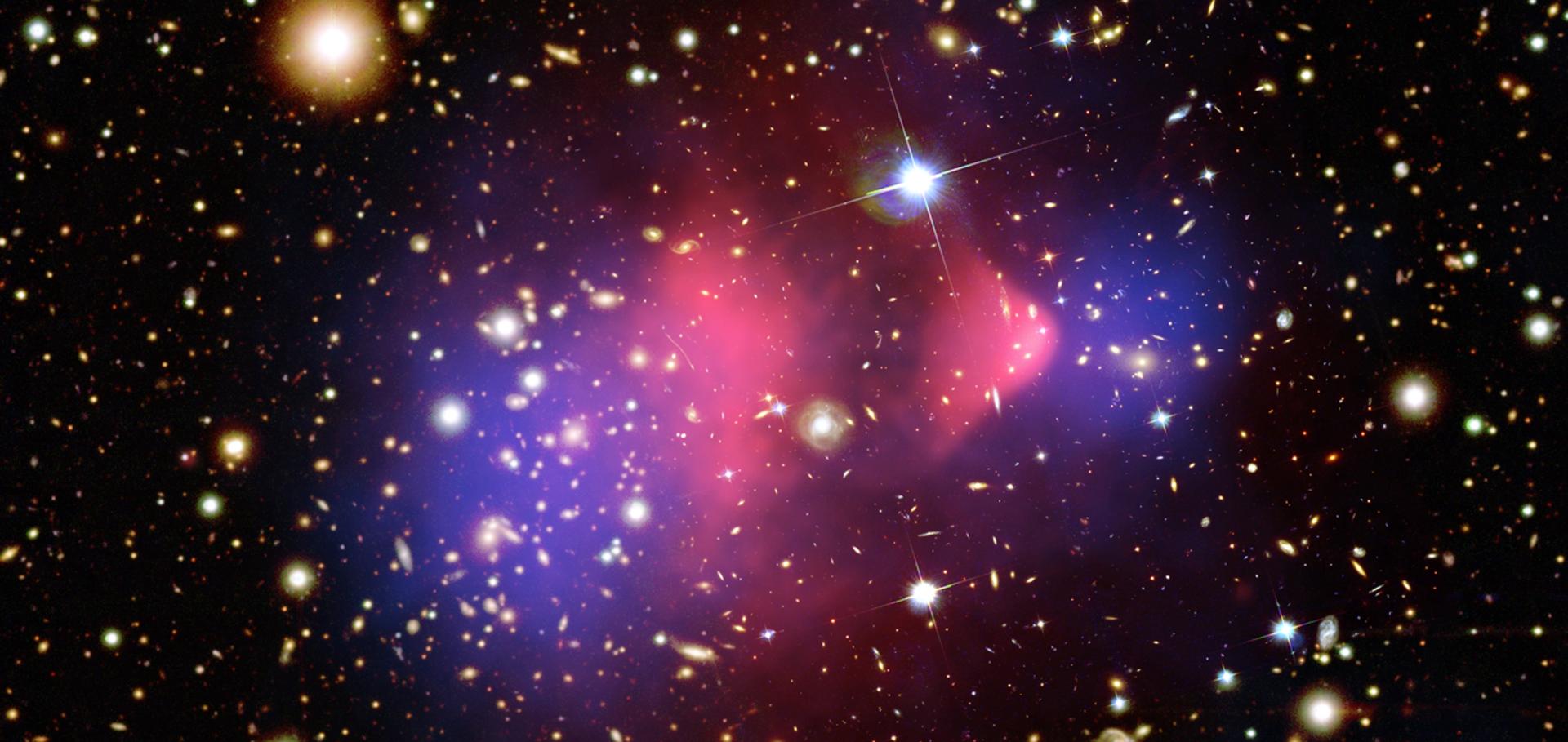
Bullet cluster image
Credit: Credit: X-ray: NASA/CXC/CfA/M.Markevitch et al.; Optical: NASA/STScI; Magellan/U.Arizona/D.Clowe et al.; Lensing Map: NASA/STScI

Professor Jocelyn Monroe

Professor of Particle Physics

Research theme

  • Particle astrophysics & cosmology

Sub department

  • Particle Physics
jocelyn.monroe@physics.ox.ac.uk
Telephone: 273317
en.wikipedia.org/wiki/Jocelyn_Monroe
  • About
  • Publications

Fermilab booster orbit correction

Proceedings of the IEEE Particle Accelerator Conference 3 (2003) 1587-1589

Authors:

L Coney, J Monroe, W Pellico, E Prebys

Abstract:

The Fermilab particle physics program has recently expanded to include the MiniBooNE experiment in addition to the RunII program. As a result, the effective and reliable performance of the Fermilab Booster has become crucial to the lab. The Booster is an 8 GeV proton synchrotron and is a key element of the Fermilab accelerator chain. It must meet increasing demands for proton intensity and high repetition rates. One important requirement placed on the machine is low radiation levels. These levels are highly correlated with losses in the machine, and can limit Booster production. We will describe how a system of ramped dipole corrector magnets are being used to maintain orbital position throughout the acceleration cycle in order to minimize beam losses, maximize proton intensity, and maintain the required repetition rate.

Initial operation of the Fermilab MiniBooNE beamline

Proceedings of the IEEE Particle Accelerator Conference 3 (2003) 1652-1654

Authors:

C Moore, J Anderson, R Ducar, R Ford, T Kobilarcik, E Prebys, A Russell, R Stefanski, J Monroe

Abstract:

The MiniBooNE neutrino experiment is projected to take more intensity in a single year than was delivered during the seventeen years of running the Fixed Target Program. The experiment will require almost continuous running (18,000 pulses/hour) at full intensity (5E12 protons per pulse). In order to safely handle this intensity various measures have been instituted. The design of the beamline ensures sufficient clearance between the beam and apertures. A MiniBooNE Beam Permit System has been installed that is able to check various digital and analogue information against nominal values on a pulse by pulse basis. An automated total beam loss monitoring system (electronic berm) measures any beam loss between the beginning and end of the line. An automated correction system (Autotune) finds and corrects minor beam wandering. A description of the beamline design and relevant instrumentation is given.
More details

Design and simulation of muon ionization cooling channels for the Fermilab Neutrino Factory feasibility study

Physical Review Special Topics Accelerators and Beams 4:4 (2001) 41-42

Authors:

J Monroe, P Spentzouris, V Balbekov, P Lebrun, G Penn, C Kim, ES Kim, DM Kaplan

Abstract:

In the past few years, the concept of a high intensity muon storage ring has been pursued as an option for the next generation neutrino source. To produce the high intensity muon beam needed for the successful operation of a neutrino source, on the order of 1020 muon decays per year, the phase space occupied by the muon beam must be significantly reduced before the beam is accelerated. The initial transverse emittance of the muon beam before acceleration is assumed to be 9π mm rad. Because of the time limitation imposed by the muon lifetime, the technique employed to accomplish the desired emittance reduction is ionization cooling. In this paper we present two ionization cooling lattice designs, which use solenoidal focusing elements and liquid hydrogen absorbers to reduce the muon beam phase space. We discuss the design concepts and engineering constraints for these lattices and present simulation results obtained using a detailed tracing code with a complete model of muon-matter interactions. The reduction in transverse emittance is approximately a factor of 5. This result is within a factor of 2 of the total cooling requirements for a successful neutrino factory design and within a factor of 1.4 of the requirements for the main cooling section specified in the conceptual design of this machine. © 2001 The American Physical Society.
More details from the publisher
More details

Search for neutral heavy leptons in a high-energy neutrino beam

Physical Review Letters 83:24 (1999) 4943-4946

Authors:

A Vaitaitis, RB Drucker, J Formaggio, S Koutsoliotas, T Adams, A Alton, S Avvakumov, L De Barbaro, P De Barbaro, RH Bernstein, A Bodek, T Bolton, J Brau, D Buchholz, H Budd, L Bugel, J Conrad, BT Fleming, R Frey, J Goldman, M Goncharov, DA Harris, RA Johnson, JH Kim, MJ Lamm, W Marsh, D Mason, KS Mc Farland, C Mc Nulty, J Monroe, D Naples, P Nienaber, A Romosan, WK Sakumoto, H Schellman, MH Shaevitz, P Spentzouris, EG Stern, M Vakili, V Wu, UK Yang, J Yu, GP Zeller, ED Zimmerman

Abstract:

A search for neutral heavy leptons (NHLs) has been performed using an instrumented decay channel at the NuTeV (E-815) experiment at Fermilab. The data were examined for NHLs decaying into muonic final states (μμν, μeν, μπ, and μρ); no evidence has been found for NHLs in the 0.25-2.0 GeV mass range. This analysis places limits on the mixing of NHLs with standard light neutrinos at a level up to an order of magnitude more restrictive than previous search limits in this mass range. 1999 © The American Physical Society.
More details from the publisher
More details

Pagination

  • First page First
  • Previous page Prev
  • …
  • Page 17
  • Page 18
  • Page 19
  • Page 20
  • Page 21
  • Page 22
  • Page 23
  • Page 24
  • Current page 25

Footer Menu

  • Contact us
  • Giving to the Dept of Physics
  • Work with us
  • Media

User account menu

  • Log in

Follow us

FIND US

Clarendon Laboratory,

Parks Road,

Oxford,

OX1 3PU

CONTACT US

Tel: +44(0)1865272200

University of Oxfrod logo Department Of Physics text logo
IOP Juno Champion logo Athena Swan Silver Award logo

© University of Oxford - Department of Physics

Cookies | Privacy policy | Accessibility statement

Built by: Versantus

  • Home
  • Research
  • Study
  • Engage
  • Our people
  • News & Comment
  • Events
  • Our facilities & services
  • About us
  • Giving to Physics
  • Current students
  • Staff intranet