Home
Department Of Physics text logo
  • Research
    • Our research
    • Our research groups
    • Our research in action
    • Research funding support
    • Summer internships for undergraduates
  • Study
    • Undergraduates
    • Postgraduates
  • Engage
    • For alumni
    • For business
    • For schools
    • For the public
Menu
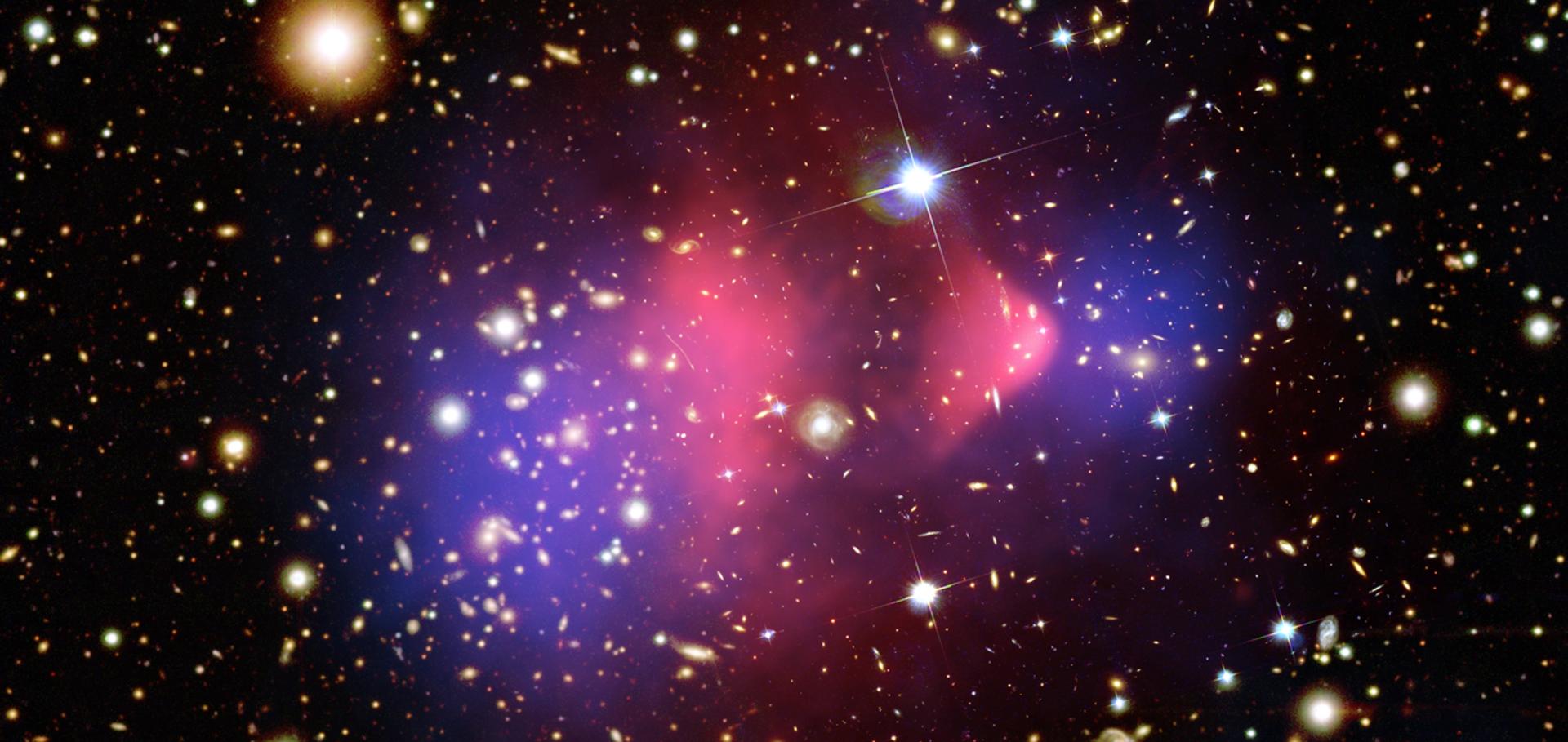
Bullet cluster image
Credit: Credit: X-ray: NASA/CXC/CfA/M.Markevitch et al.; Optical: NASA/STScI; Magellan/U.Arizona/D.Clowe et al.; Lensing Map: NASA/STScI

Professor Jocelyn Monroe

Professor of Particle Physics

Research theme

  • Particle astrophysics & cosmology

Sub department

  • Particle Physics
jocelyn.monroe@physics.ox.ac.uk
Telephone: 273317
en.wikipedia.org/wiki/Jocelyn_Monroe
  • About
  • Publications

The DEAP-3600 Experiment

Proceedings of Science 395 (2022)

Authors:

M Stringer, P Adhikari, R Ajaj, M Alpízar-Venegas, DJ Auty, H Benmansour, CE Bina, W Bonivento, MG Boulay, M Cadeddu, B Cai, M Cárdenas-Montes, S Cavuoti, Y Chen, BT Cleveland, JM Corning, S Daugherty, P DelGobbo, P Di Stefano, L Doria, M Dunford, E Ellingwood, A Erlandson, SS Farahani, N Fatemighomi, G Fiorillo, D Gallacher, P García Abia, S Garg, P Giampa, D Goeldi, P Gorel, K Graham, A Grobov, AL Hallin, M Hamstra, T Hugues, A Ilyasov, A Joy, B Jigmeddorj, CJ Jillings, O Kamaev, G Kaur, A Kemp, I Kochanek, M Kuźniak, M Lai, S Langrock, B Lehnert, A Leonhardt, N Levashko, X Li, M Lissia, O Litvinov, J Lock, G Longo, I Machulin, AB McDonald, T McElroy, JB McLaughlin, C Mielnichuk, L Mirasola, J Monroe, G Oliviéro, S Pal, SJM Peeters, M Perry, V Pesudo, E Picciau, MC Piro, TR Pollmann, ET Rand, C Rethmeier, F Retière, I Rodríguez-García, L Roszkowski, JB Ruhland, E Sanchez García, T Sánchez-Pastor, R Santorelli, S Seth, D Sinclair, P Skensved, B Smith, NJT Smith, T Sonley, R Stainforth, B Sur, E Vázquez-Jáuregui, S Viel, J Walding, M Waqar, M Ward, S Westerdale, J Willis, A Zuñiga-Reyes

Abstract:

The DEAP-3600 experiment searches for dark matter via the interactions of WIMPs with a liquid argon target. The experiment is located at SNOLAB in Sudbury, Ontario, 2 km underground to shield the detector from cosmic rays. The detector consists of an acrylic sphere with an inner diameter of ∼170 cm containing ∼3300 kg of liquid argon. Liquid argon is chosen as a target due to its ability to reject electromagnetic backgrounds by examining its scintillation pulse shape. The argon volume is instrumented with 255 PMTs which are connected to the vessel via acrylic light guides. As liquid argon scintillates at a wavelength of 128 nm, its scintillation light needs to be shifted to a wavelength into a region where the PMTs are more sensitive; this is done by coating the inside of the acrylic vessel with TPB wavelength shifter, which re-emits the argon scintillation light at a wavelength of 420 nm. This talk will describe the current status of the experiment and some recent analyses performed by the collaboration. The status of planned upgrades to the detector and the plans for the future of the experiment will also be detailed.

Correction to: Gamma-ray flux measurement and geotechnical studies at the selected site for the LABChico underground laboratory (The European Physical Journal Plus, (2022), 137, 2, (210), 10.1140/epjp/s13360-022-02407-1)

European Physical Journal Plus 137:3 (2022)

Authors:

A Aguilar-Arevalo, X Bertou, C Canet, MA Cruz, A Deisting, A Dias, JC D’Olivo, F Favela-Pérez, EA Garcés, E González García, A González Muñoz, JO Guerra-Pulido, J Mancera-Alejandrez, DJ Marín-Lámbarri, AM Martínez Mendoza, M Martínez Montero, J Monroe, S Paling, S Peeters, PR Scovell, C Türkoğlu, IG Vallejo Castillo, E Vázquez-Jáuregui, J Walding

Abstract:

In this article, the affiliation ’Instituto de Ciencias Nucleares, Universidad Nacional Autónoma de México, Ciudad de México, México’ for D. J. Marín-Lámbarri was missing. Affiliations 3 and 5 have been corrected: 3 Centro de Ciencias de la Atmósfera, Universidad Nacional Autónoma de México, Ciudad de México, 04510, México 5 Instituto de Física, Universidad Nacional Autónoma de México, Ciudad de México, 01000, México The original article has been revised.
More details from the publisher
More details

Gamma-ray flux measurement and geotechnical studies at the selected site for the LABChico underground laboratory

European Physical Journal Plus 137:2 (2022)

Authors:

A Aguilar-Arevalo, X Bertou, C Canet, MA Cruz, A Deisting, A Dias, JC D’Olivo, F Favela-Pérez, EA Garcés, EG García, AG Muñoz, JO Guerra-Pulido, J Mancera-Alejandrez, DJ Marín-Lámbarri, AMM Mendoza, MM Montero, J Monroe, S Paling, S Peeters, PR Scovell, C Türkoğlu, IGV Castillo, E Vázquez-Jáuregui, J Walding

Abstract:

The γ-ray flux inside La Quaalude mine, the selected site for the construction of the underground laboratory LABChico in Mexico, is reported for energies below 3 MeV. Data were recorded with a 0.669 kg thallium-activated sodium iodide (NaI) crystal detector deployed for 3.6 hr. The detector response was calculated via Monte Carlo simulations with GEANT4 and validated against point-like calibration sources, and the γ-ray spectrum was extracted using an unfolding technique. The γ-ray flux above 250 keV and below 3 MeV is 0.1768 γ/cm2/s. The two most intense γ-rays in the natural radioactive background, 40K and 208Tl, were identified. The flux measured for these isotopes is 0.0363 ± 0.0020 γ/cm2/s and 0.0016 ± 0.0005 γ/cm2/s, respectively. A γ-ray spectrometry analysis of rock samples showed 674.0 ± 2.0 Bq/kg, 24.0 ± 0.1 Bq/kg, and 17.7 ± 0.2 Bq/kg, of 40K, 232Th, and 238U, respectively. These results are compared with deep underground facilities such as SURF, SNOLAB, Boulby, Modane, and Gran Sasso, with differences observed mainly due to the rock composition. Geotechnical studies of the mine and its rock composition are also reported.
More details from the publisher
More details

Erratum: Constraints on dark matter-nucleon effective couplings in the presence of kinematically distinct halo substructures using the DEAP-3600 detector (Physical Review D (2020) 102 (082001) DOI: 10.1103/PhysRevD.102.082001)

Physical Review D 105:2 (2022)

Authors:

P Adhikari, R Ajaj, DJ Auty, CE Bina, W Bonivento, MG Boulay, M Cadeddu, B Cai, M Cárdenas-Montes, S Cavuoti, Y Chen, BT Cleveland, JM Corning, S Daugherty, P Delgobbo, P Di Stefano, L Doria, M Dunford, A Erlandson, SS Farahani, N Fatemighomi, G Fiorillo, D Gallacher, EA Garcés, P García Abia, S Garg, P Giampa, D Goeldi, P Gorel, K Graham, A Grobov, AL Hallin, M Hamstra, T Hugues, A Ilyasov, A Joy, B Jigmeddorj, CJ Jillings, O Kamaev, G Kaur, A Kemp, I Kochanek, M Kuźniak, M Lai, S Langrock, B Lehnert, N Levashko, X Li, O Litvinov, J Lock, G Longo, I Machulin, AB McDonald, T McElroy, JB McLaughlin, C Mielnichuk, J Monroe, G Oliviéro, S Pal, SJM Peeters, V Pesudo, MC Piro, TR Pollmann, ET Rand, C Rethmeier, F Retière, I Rodríguez-García, L Roszkowski, E Sanchez García, T Sánchez-Pastor, R Santorelli, D Sinclair, P Skensved, B Smith, NJT Smith, T Sonley, R Stainforth, M Stringer, B Sur, E Vázquez-Jáuregui, S Viel, AC Vincent, J Walding, M Waqar, M Ward, S Westerdale, J Willis, A Zuñiga-Reyes

Abstract:

In the article, the Non-Relativistic Effective Field Theory (NREFT) rate calculations were determined using the wimpy_nreft software [1], which was updated on September 29, 2021, to include a previously missing (q/mN)2 factor in the implementation. This update affects the results related to the O3 operator that now scales as (q/mN)4 instead of (q/mN)2. The corrections to Figs. 2, 6, 9, 10, and 11 are presented below. The couplings to O3 constrained by this analysis are higher than those reported in the article. Additionally: (i) In Sec. V A, operator O3 is suppressed at low recoil energies, exhibiting now a peak around 50 keV (Fig. 2). (ii) The third paragraph in Sec. V B should read as follows: “The operator O3 is proportional to (q/mN)4, while O11 goes as (q/mN)2. O3 is described by the F'' multipole operator [discussed in Eqs. (9) and (10)], while O11 is described by M. Since the former operator is related to spin-orbit coupling, it couples to the two unpaired neutrons and proton holes in 40 Ar , rather than to all 40 nucleons. This leads to a suppression of ~10 2 in addition to the extra q2 suppression.” (iii) In Sec. V F, the statement “Operators that introduce a factor of q2 to the DM response function, such as O3, O5, and O11 change the shape of the recoil energy spectrum, compared to O1” should read “Operators that introduce a factor of q2 or q4 to the DM response function, such as O3, O5, and O11 change the shape of the recoil energy spectrum, compared to O1.” (iv) The sentence in Sec. VI “Constraints on operators proportional to v? are weaker than those proportional to q, which are weaker than those proportional to neither” should read “Constraints on operators proportional to vn? are weaker than those proportional to q raised to the same power, which in turn are weaker than constant couplings.” (v) In Sec. VI, exclusion curves on O3 and data to reproduce its recoil energy spectra were uploaded to a new Zenodo version [2]. (Figure Presented).
More details from the publisher
More details

First direct detection constraints on Planck-scale mass dark matter with multiple-scatter signatures using the DEAP-3600 detector

Physical Review Letters American Physical Society 128:1 (2022) 11801

Authors:

P Adhikari, R Ajaj, M Alpízar-Venegas, Dj Auty, H Benmansour, Ce Bina, W Bonivento, Mg Boulay, M Cadeddu, B Cai, M Cárdenas-Montes, S Cavuoti, Y Chen, Bt Cleveland, Jm Corning, S Daugherty, P DelGobbo, P Di Stefano, L Doria, M Dunford, E Ellingwood, A Erlandson, Ss Farahani, N Fatemighomi, G Fiorillo, D Gallacher, P García Abia, S Garg, P Giampa, D Goeldi, P Gorel, K Graham, A Grobov, Al Hallin, M Hamstra, T Hugues, A Ilyasov, A Joy, B Jigmeddorj, Cj Jillings, O Kamaev, G Kaur, Ashlea Kemp, I Kochanek, M Kuźniak, M Lai, S Langrock, B Lehnert, A Leonhardt, N Levashko

Abstract:

Dark matter with Planck-scale mass (≃1019 GeV=c2) arises in well-motivated theories and could be produced by several cosmological mechanisms. A search for multiscatter signals from supermassive dark matter was performed with a blind analysis of data collected over a 813 d live time with DEAP-3600, a 3.3 t single-phase liquid argon-based detector at SNOLAB. No candidate signals were observed, leading to the first direct detection constraints on Planck-scale mass dark matter. Leading limits constrain dark matter masses between 8.3 × 10⁶ and 1.2 × 10¹⁹ GeV=c2, and 40Ar-scattering cross sections between 1.0 × 10⁻²³ and 2.4 × 10⁻¹⁸ cm2. These results are interpreted as constraints on composite dark matter models with two different nucleon-to-nuclear cross section scalings.

More details from the publisher
Details from ORA
More details
More details

Pagination

  • First page First
  • Previous page Prev
  • …
  • Page 2
  • Page 3
  • Page 4
  • Page 5
  • Current page 6
  • Page 7
  • Page 8
  • Page 9
  • Page 10
  • …
  • Next page Next
  • Last page Last

Footer Menu

  • Contact us
  • Giving to the Dept of Physics
  • Work with us
  • Media

User account menu

  • Log in

Follow us

FIND US

Clarendon Laboratory,

Parks Road,

Oxford,

OX1 3PU

CONTACT US

Tel: +44(0)1865272200

University of Oxfrod logo Department Of Physics text logo
IOP Juno Champion logo Athena Swan Silver Award logo

© University of Oxford - Department of Physics

Cookies | Privacy policy | Accessibility statement

Built by: Versantus

  • Home
  • Research
  • Study
  • Engage
  • Our people
  • News & Comment
  • Events
  • Our facilities & services
  • About us
  • Giving to Physics
  • Current students
  • Staff intranet