Home
Department Of Physics text logo
  • Research
    • Our research
    • Our research groups
    • Our research in action
    • Research funding support
    • Summer internships for undergraduates
  • Study
    • Undergraduates
    • Postgraduates
  • Engage
    • For alumni
    • For business
    • For schools
    • For the public
Menu
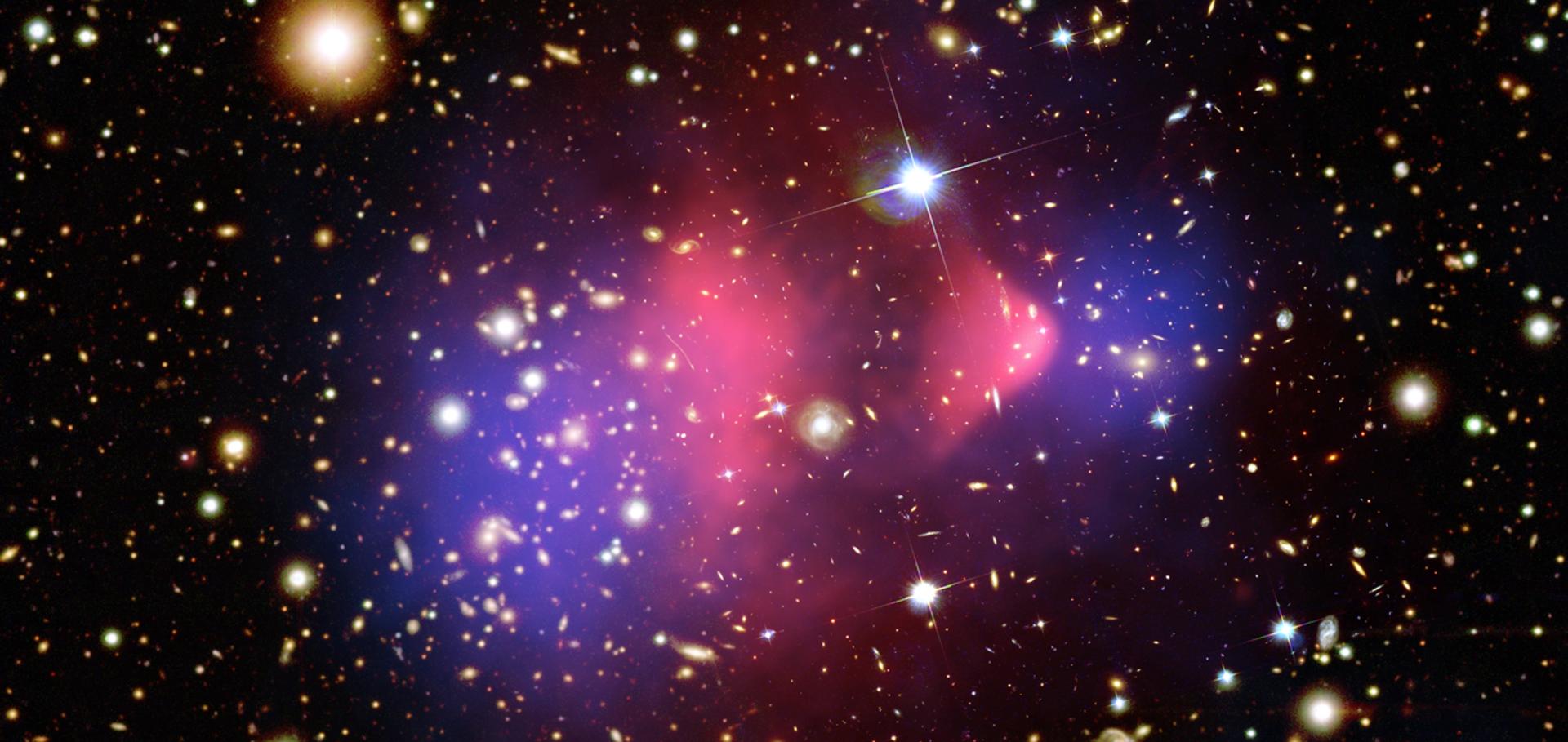
Bullet cluster image
Credit: Credit: X-ray: NASA/CXC/CfA/M.Markevitch et al.; Optical: NASA/STScI; Magellan/U.Arizona/D.Clowe et al.; Lensing Map: NASA/STScI

Professor Jocelyn Monroe

Professor of Particle Physics

Research theme

  • Particle astrophysics & cosmology

Sub department

  • Particle Physics
jocelyn.monroe@physics.ox.ac.uk
Telephone: 273317
en.wikipedia.org/wiki/Jocelyn_Monroe
  • About
  • Publications

Long-term temporal stability of the DarkSide-50 dark matter detector

Journal of Instrumentation 19:5 (2024)

Authors:

P Agnes, I Albuquerque, T Alexander, A Alton, M Ave, H Back, G Batignani, K Biery, V Bocci, W Bonivento, B Bottino, S Bussino, M Cadeddu, M Cadoni, F Calaprice, A Caminata, M Campos, N Canci, M Caravati, N Cargioli, M Cariello, M Carlini, V Cataudella, P Cavalcante, S Cavuoti, S Chashin, A Chepurnov, C Cicalò, G Covone, D D'Angelo, S Davini, A De Candia, S De Cecco, G De Filippis, G De Rosa, A Derbin, A Devoto, M D'Incecco, C Dionisi, F Dordei, M Downing, D D'Urso, M Fairbairn, G Fiorillo, D Franco, F Gabriele, C Galbiati, C Ghiano, C Giganti, G Giovanetti, A Goretti, G Grilli di Cortona, A Grobov, M Gromov, M Guan, M Gulino, B Hackett, K Herner, T Hessel, B Hosseini, F Hubaut, T Hugues, E Hungerford, A Ianni, V Ippolito, K Keeter, C Kendziora, M Kimura, I Kochanek, D Korablev, G Korga, A Kubankin, M Kuss, M Kuźniak, M La Commara, M Lai, X Li, M Lissia, G Longo, O Lychagina, I Machulin, L Mapelli, S Mari, J Maricic, A Messina, R Milincic, J Monroe, M Morrocchi, X Mougeot, V Muratova, P Musico, A Nozdrina, A Oleinik, F Ortica, L Pagani, M Pallavicini, L Pandola, E Pantic, E Paoloni, K Pelczar

Abstract:

The stability of a dark matter detector on the timescale of a few years is a key requirement due to the large exposure needed to achieve a competitive sensitivity. It is especially crucial to enable the detector to potentially detect any annual event rate modulation, an expected dark matter signature. In this work, we present the performance history of the DarkSide-50 dual-phase argon time projection chamber over its almost three-year low-radioactivity argon run. In particular, we focus on the electroluminescence signal that enables sensitivity to sub-keV energy depositions. The stability of the electroluminescence yield is found to be better than 0.5%. Finally, we show the temporal evolution of the observed event rate around the sub-keV region being consistent to the background prediction.
More details from the publisher

QUEST-DMC superfluid 3 He detector for sub-GeV dark matter

The European Physical Journal C SpringerOpen 84:3 (2024) 248

Authors:

S Autti, A Casey, N Eng, N Darvishi, P Franchini, RP Haley, PJ Heikkinen, A Jennings, A Kemp, E Leason, LV Levitin, J Monroe, J March-Russel, MT Noble, JR Prance, X Rojas, T Salmon, J Saunders, R Smith, MD Thompson, V Tsepelin, SM West, L Whitehead, VV Zavjalov

Abstract:

The focus of dark matter searches to date has been on Weakly Interacting Massive Particles (WIMPs) in the GeV/c2-TeV/c2 mass range. The direct, indirect and collider searches in this mass range have been extensive but ultimately unsuccessful, providing a strong motivation for widening the search outside this range. Here we describe a new concept for a dark matter experiment, employing superfluid 3He as a detector for dark matter that is close to the mass of the proton, of order 1 GeV/c2. The QUEST-DMC detector concept is based on quasiparticle detection in a bolometer cell by a nanomechanical resonator. In this paper we develop the energy measurement methodology and detector response model, simulate candidate dark matter signals and expected background interactions, and calculate the sensitivity of such a detector. We project that such a detector can reach sub-eV nuclear recoil energy threshold, opening up new windows on the parameter space of both spin-dependent and spin-independent interactions of light dark matter candidates.
More details from the publisher
Details from ORA
More details

First operation of an ALICE OROC operated in high pressure Ar-CO2 and Ar-CH4

European Physical Journal C Springer Nature 83:12 (2023) 1139

Authors:

A Ritchie-Yates, A Deisting, G Barker, S Boyd, D Brailsford, Z Chen-Wishart, L Cremonesi, P Dunne, J Eeles, P Hamilton, Ac Kaboth, N Khan, A Klustová, J Monroe, J Nowak, P Singh, Av Waldron, J Walding, L Warsame, Mo Wascko, I Xiotidis

Abstract:

New neutrino–nucleus interaction cross-section measurements are required to improve nuclear models sufficiently for future long baseline neutrino experiments to meet their sensitivity goals. A time projection chamber (TPC) filled with a high-pressure gas is a promising detector to characterise the neutrino sources used for such experiments. A gas-filled TPC is ideal for measuring low-energy particles, which travel further in gas than in solid or liquid detectors and using high-pressure increases the target density, resulting in more neutrino interactions. We examine the suitability of multiwire proportional chambers (MWPCs) from the ALICE TPC for use as the readout chambers of a high-pressure gas TPC. These chambers were previously operated at atmospheric pressure. We report the successful operation of an ALICE TPC outer readout chamber (OROC) at pressures up to 4.2 bar absolute (barA) with Ar-CH 4 mixtures with a CH 4 content between 2.8 and 5.0%, and so far up to 4 bar absolute with Ar-CO 2 (90-10). The charge gain of the OROC was measured with signals induced by an 55Fe source. The largest gain achieved at 4.2 bar was (29 ± 1) · 10 3 in Ar-CH 4 with 4.0% CH 4 with an anode voltage of 2975V . In Ar-CO 2 with 10% CO 2 at 4 barA, a gain of (4.2 ± 0.1) · 10 3 was observed with anode voltage 2975V . We extrapolate that at 10 barA, an interesting pressure for future neutrino experiments, a gain of 5000 in Ar-CO 2 with 10% CO 2 (10,000 in Ar-CH 4 with ∼4%CH 4) may be achieved with anode voltage of 4.6kV (∼3.6kV).
More details from the publisher

Precision measurement of the specific activity of 39Ar in atmospheric argon with the DEAP-3600 detector

European Physical Journal C Springer Nature 83:7 (2023) 642

Authors:

P Adhikari, R Ajaj, M Alpízar-Venegas, P-A Amaudruz, J Anstey, GR Araujo, DJ Auty, M Baldwin, M Batygov, B Beltran, H Benmansour, CE Bina, J Bonatt, W Bonivento, MG Boulay, B Broerman, JF Bueno, PM Burghardt, A Butcher, M Cadeddu, B Cai, M Cárdenas-Montes, S Cavuoti, M Chen, Y Chen, S Choudhary, BT Cleveland, JM Corning, R Crampton, D Cranshaw, S Daugherty, P DelGobbo, K Dering, P Di Stefano, J DiGioseffo, G Dolganov, L Doria, FA Duncan, M Dunford, E Ellingwood, A Erlandson, SS Farahani, N Fatemighomi, G Fiorillo, S Florian, A Flower, RJ Ford, R Gagnon, D Gallacher, P García Abia, S Garg, P Giampa, A Giménez-Alcázar, D Goeldi, VV Golovko, P Gorel, K Graham, DR Grant, A Grobov, AL Hallin, M Hamstra, PJ Harvey, S Haskins, C Hearns, J Hu, J Hucker, T Hugues, A Ilyasov, B Jigmeddorj, CJ Jillings, A Joy, O Kamaev, G Kaur, A Kemp, M Kuźniak, F La Zia, M Lai, S Langrock, B Lehnert, A Leonhardt, J LePage-Bourbonnais, N Levashko, J Lidgard, T Lindner, M Lissia, J Lock, L Luzzi, I Machulin, P Majewski, A Maru, J Mason, AB McDonald, T McElroy, T McGinn, JB McLaughlin, R Mehdiyev, C Mielnichuk, L Mirasola, J Monroe, P Nadeau, C Nantais, C Ng, AJ Noble, E O’Dwyer, G Oliviéro, C Ouellet, S Pal, D Papi, P Pasuthip, SJM Peeters, M Perry, V Pesudo, E Picciau, M-C Piro, TR Pollmann, F Rad, ET Rand, C Rethmeier, F Retière, I Rodríguez García, L Roszkowski, JB Ruhland, R Santorelli, FG Schuckman II, N Seeburn, S Seth, V Shalamova, K Singhrao, P Skensved, NJT Smith, B Smith, K Sobotkiewich, T Sonley, J Sosiak, J Soukup, R Stainforth, C Stone, V Strickland, M Stringer, B Sur, J Tang, E Vázquez-Jáuregui, L Veloce, S Viel, B Vyas, M Walczak, J Walding, M Ward, S Westerdale, J Willis, A Zuñiga-Reyes
More details from the publisher
More details

Search for low mass dark matter in DarkSide-50: the bayesian network approach

European Physical Journal C 83:4 (2023)

Authors:

P Agnes, IFM Albuquerque, T Alexander, AK Alton, M Ave, HO Back, G Batignani, K Biery, V Bocci, WM Bonivento, B Bottino, S Bussino, M Cadeddu, M Cadoni, F Calaprice, A Caminata, MD Campos, N Canci, M Caravati, N Cargioli, M Cariello, M Carlini, V Cataudella, P Cavalcante, S Cavuoti, S Chashin, A Chepurnov, C Cicalò, G Covone, D D’Angelo, S Davini, A De Candia, S De Cecco, G De Filippis, G De Rosa, AV Derbin, A Devoto, M D’Incecco, C Dionisi, F Dordei, M Downing, D D’Urso, M Fairbairn, G Fiorillo, D Franco, F Gabriele, C Galbiati, C Ghiano, C Giganti, GK Giovanetti, AM Goretti, G Grilli di Cortona, A Grobov, M Gromov, M Guan, M Gulino, BR Hackett, K Herner, T Hessel, B Hosseini, F Hubaut, EV Hungerford, A Ianni, V Ippolito, K Keeter, CL Kendziora, M Kimura, I Kochanek, D Korablev, G Korga, A Kubankin, M Kuss, M La Commara, M Lai, X Li, M Lissia, G Longo, O Lychagina, IN Machulin, LP Mapelli, SM Mari, J Maricic, A Messina, R Milincic, J Monroe, M Morrocchi, X Mougeot, VN Muratova, P Musico, AO Nozdrina, A Oleinik, F Ortica, L Pagani, M Pallavicini, L Pandola, E Pantic, E Paoloni, K Pelczar, N Pelliccia, S Piacentini

Abstract:

We present a novel approach for the search of dark matter in the DarkSide-50 experiment, relying on Bayesian Networks. This method incorporates the detector response model into the likelihood function, explicitly maintaining the connection with the quantity of interest. No assumptions about the linearity of the problem or the shape of the probability distribution functions are required, and there is no need to morph signal and background spectra as a function of nuisance parameters. By expressing the problem in terms of Bayesian Networks, we have developed an inference algorithm based on a Markov Chain Monte Carlo to calculate the posterior probability. A clever description of the detector response model in terms of parametric matrices allows us to study the impact of systematic variations of any parameter on the final results. Our approach not only provides the desired information on the parameter of interest, but also potential constraints on the response model. Our results are consistent with recent published analyses and further refine the parameters of the detector response model.
More details from the publisher

Pagination

  • First page First
  • Previous page Prev
  • Page 1
  • Page 2
  • Page 3
  • Current page 4
  • Page 5
  • Page 6
  • Page 7
  • Page 8
  • Page 9
  • …
  • Next page Next
  • Last page Last

Footer Menu

  • Contact us
  • Giving to the Dept of Physics
  • Work with us
  • Media

User account menu

  • Log in

Follow us

FIND US

Clarendon Laboratory,

Parks Road,

Oxford,

OX1 3PU

CONTACT US

Tel: +44(0)1865272200

University of Oxfrod logo Department Of Physics text logo
IOP Juno Champion logo Athena Swan Silver Award logo

© University of Oxford - Department of Physics

Cookies | Privacy policy | Accessibility statement

Built by: Versantus

  • Home
  • Research
  • Study
  • Engage
  • Our people
  • News & Comment
  • Events
  • Our facilities & services
  • About us
  • Giving to Physics
  • Current students
  • Staff intranet