Home
Department Of Physics text logo
  • Research
    • Our research
    • Our research groups
    • Our research in action
    • Research funding support
    • Summer internships for undergraduates
  • Study
    • Undergraduates
    • Postgraduates
  • Engage
    • For alumni
    • For business
    • For schools
    • For the public
  • Support
Menu
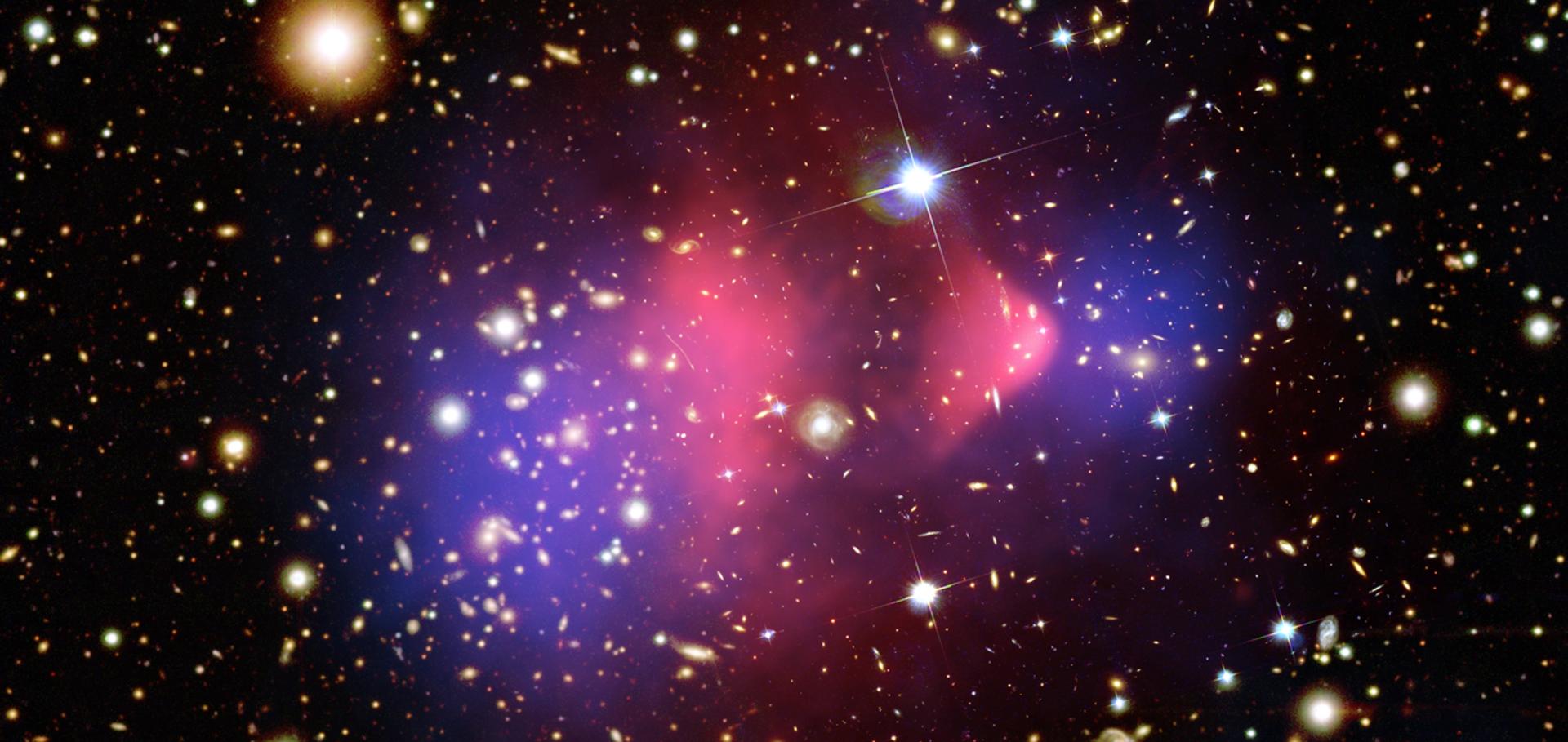
Bullet cluster image
Credit: Credit: X-ray: NASA/CXC/CfA/M.Markevitch et al.; Optical: NASA/STScI; Magellan/U.Arizona/D.Clowe et al.; Lensing Map: NASA/STScI

Professor Jocelyn Monroe

Professor of Particle Physics

Research theme

  • Particle astrophysics & cosmology

Sub department

  • Particle Physics
jocelyn.monroe@physics.ox.ac.uk
Telephone: 273317
en.wikipedia.org/wiki/Jocelyn_Monroe
  • About
  • Publications

A review of the discovery reach of directional Dark Matter detection

Physics Reports 627 (2016) 1-49

Authors:

F Mayet, AM Green, JBR Battat, J Billard, N Bozorgnia, GB Gelmini, P Gondolo, BJ Kavanagh, SK Lee, D Loomba, J Monroe, B Morgan, CAJ O'Hare, AHG Peter, NS Phan, SE Vahsen

Abstract:

Cosmological observations indicate that most of the matter in the Universe is Dark Matter. Dark Matter in the form of Weakly Interacting Massive Particles (WIMPs) can be detected directly, via its elastic scattering off target nuclei. Most current direct detection experiments only measure the energy of the recoiling nuclei. However, directional detection experiments are sensitive to the direction of the nuclear recoil as well. Due to the Sun's motion with respect to the Galactic rest frame, the directional recoil rate has a dipole feature, peaking around the direction of the Solar motion. This provides a powerful tool for demonstrating the Galactic origin of nuclear recoils and hence unambiguously detecting Dark Matter. Furthermore, the directional recoil distribution depends on the WIMP mass, scattering cross section and local velocity distribution. Therefore, with a large number of recoil events it will be possible to study the physics of Dark Matter in terms of particle and astrophysical properties. We review the potential of directional detectors for detecting and characterizing WIMPs.
More details from the publisher
More details

DEAP-3600 Dark Matter Search

Nuclear and Particle Physics Proceedings Elsevier 273 (2016) 340-346

Authors:

M Kuźniak, DEAP Collaboration, P-A Amaudruz, M Batygov, B Beltran, J Bonatt, MG Boulay, B Broerman, JF Bueno, A Butcher, B Cai, M Chen, R Chouinard, BT Cleveland, K Dering, J DiGioseffo, F Duncan, T Flower, R Ford, P Giampa, P Gorel, K Graham, DR Grant, E Guliyev, AL Hallin, M Hamstra, P Harvey, CJ Jillings, I Lawson, O Li, P Liimatainen, P Majewski, AB McDonald, T McElroy, K McFarlane, J Monroe, A Muir, C Nantais, C Ng, AJ Noble, C Ouellet, K Palladino, P Pasuthip, SJM Peeters, T Pollmann, W Rau, F Retière, N Seeburn, K Singhrao, P Skensved, B Smith, T Sonley, J Tang, E Vázquez-Jáuregui, L Veloce, J Walding, M Ward
More details from the publisher
More details

Design of the MiniCLEAN dark matter search veto detector subsystem

Nuclear Instruments and Methods in Physics Research Section A Accelerators Spectrometers Detectors and Associated Equipment Elsevier 781 (2015) 78-85

Authors:

Robert Abruzzio, Benjamin Buck, Stephen Jaditz, James Kelsey, Jocelyn Monroe, Kimberly Palladino
More details from the publisher
More details
Details from ArXiV

Improving photoelectron counting and particle identification in scintillation detectors with Bayesian techniques

Astroparticle Physics Elsevier 65 (2015) 40-54

Authors:

M Akashi-Ronquest, P-A Amaudruz, M Batygov, B Beltran, M Bodmer, MG Boulay, B Broerman, B Buck, A Butcher, B Cai, T Caldwell, M Chen, Y Chen, B Cleveland, K Coakley, K Dering, FA Duncan, JA Formaggio, R Gagnon, D Gastler, F Giuliani, M Gold, VV Golovko, P Gorel, K Graham, E Grace, N Guerrero, V Guiseppe, AL Hallin, P Harvey, C Hearns, R Henning, A Hime, J Hofgartner, S Jaditz, CJ Jillings, C Kachulis, E Kearns, J Kelsey, JR Klein, M Kuźniak, A LaTorre, I Lawson, O Li, JJ Lidgard, P Liimatainen, S Linden, K McFarlane, DN McKinsey, S MacMullin, A Mastbaum, R Mathew, AB McDonald, D-M Mei, J Monroe, A Muir, C Nantais, K Nicolics, JA Nikkel, T Noble, E O’Dwyer, K Olsen, GD Orebi Gann, C Ouellet, K Palladino, P Pasuthip, G Perumpilly, T Pollmann, P Rau, F Retière, K Rielage, R Schnee, S Seibert, P Skensved, T Sonley, E Vázquez-Jáuregui, L Veloce, J Walding, B Wang, J Wang, M Ward, C Zhang
More details from the publisher
Details from ArXiV

Track Reconstruction Progress from the DMTPC Directional Dark Matter Experiment

Physics Procedia 61 (2015) 39-44

Authors:

C Deaconu, G Druitt, R Eggleston, P Fisher, J Lopez, J Monroe, H Tomita, E Zayas

Abstract:

The Dark Matter Time Projection Chamber (DMTPC) collaboration is developing prototype detectors to measure both the energies and directions of nuclear recoils. The intended application is to exploit the expected directional anisotropy of dark matter velocities at Earth to unambiguously observe dark matter induced recoils. The detector consist of low-pressure CF4 TPC's with CCD cameras, PMT's, and charge amplifiers for readout. This talk gives an overview of the experiment and describes recent advances in hardware and analysis.
More details from the publisher
More details

Pagination

  • First page First
  • Previous page Prev
  • …
  • Page 9
  • Page 10
  • Page 11
  • Page 12
  • Current page 13
  • Page 14
  • Page 15
  • Page 16
  • Page 17
  • …
  • Next page Next
  • Last page Last

Footer Menu

  • Contact us
  • Giving to the Dept of Physics
  • Work with us
  • Media

User account menu

  • Log in

Follow us

FIND US

Clarendon Laboratory,

Parks Road,

Oxford,

OX1 3PU

CONTACT US

Tel: +44(0)1865272200

University of Oxfrod logo Department Of Physics text logo
IOP Juno Champion logo Athena Swan Silver Award logo

© University of Oxford - Department of Physics

Cookies | Privacy policy | Accessibility statement

Built by: Versantus

  • Home
  • Research
  • Study
  • Engage
  • Our people
  • News & Comment
  • Events
  • Our facilities & services
  • About us
  • Giving to Physics
  • Current students
  • Staff intranet