Home
Department Of Physics text logo
  • Research
    • Our research
    • Our research groups
    • Our research in action
    • Research funding support
    • Summer internships for undergraduates
  • Study
    • Undergraduates
    • Postgraduates
  • Engage
    • For young people
    • For teachers
    • For the public
    • For alumni
    • For business
  • Support
Menu
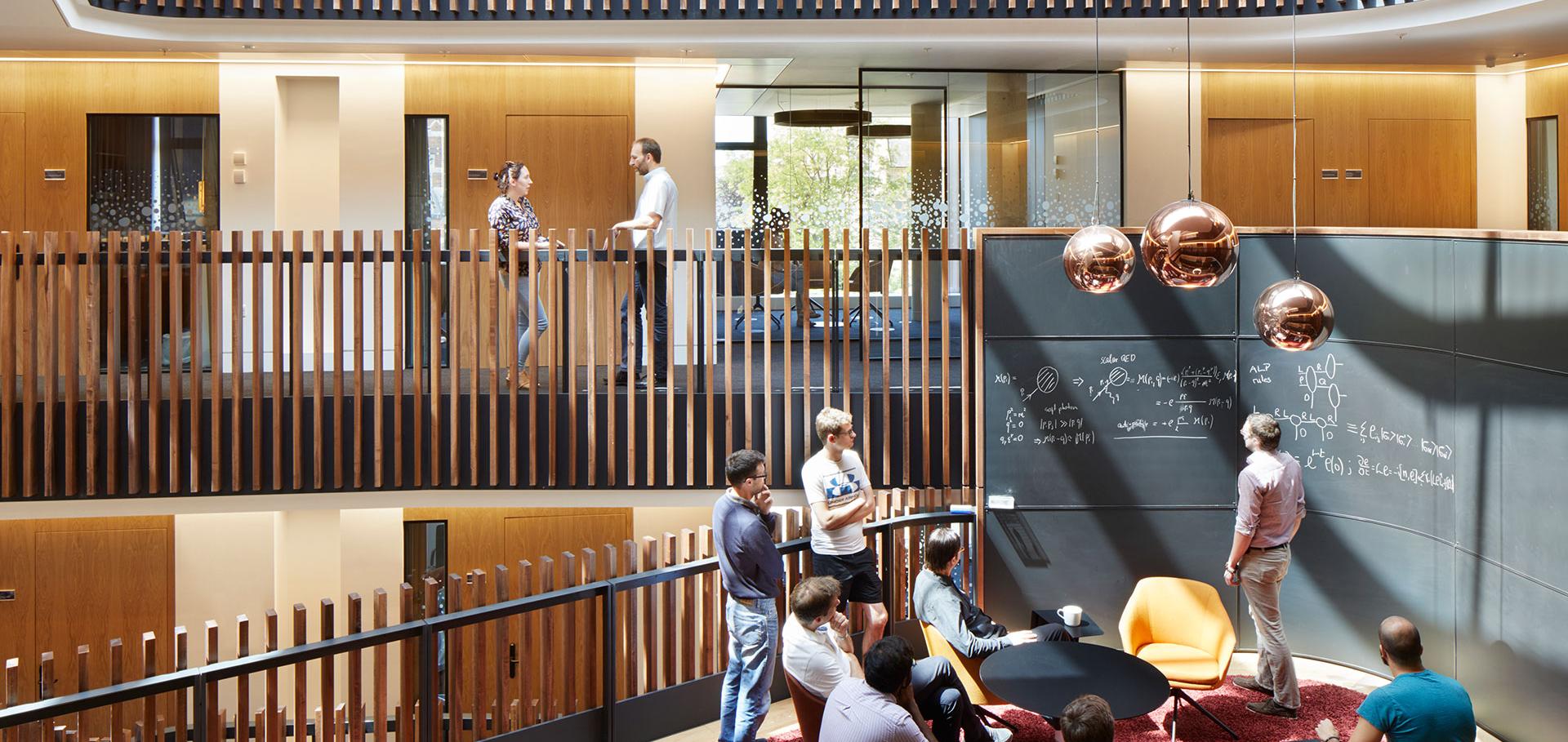
Theoretical physicists working at a blackboard collaboration pod in the Beecroft building.
Credit: Jack Hobhouse

Benedikt Placke

Academic Visitor

Research theme

  • Quantum information and computation
  • Quantum materials

Sub department

  • Rudolf Peierls Centre for Theoretical Physics

Research groups

  • Condensed Matter Theory
benedikt.placke@physics.ox.ac.uk
Rudolf Peierls Centre for Theoretical Physics, room 50.28
  • About
  • Publications

Bottlenecks in quantum channels and finite temperature phases of matter

ArXiv 2412.09598 (2024)

Authors:

Tibor Rakovszky, Benedikt Placke, Nikolas P Breuckmann, Vedika Khemani
Details from ArXiV

Ising fracton spin liquid on the honeycomb lattice

Physical Review B 110:2 (2024)

Authors:

B Placke, O Benton, R Moessner

Abstract:

We study a classical Ising model on the honeycomb lattice with local two-body interactions and present strong evidence that at low temperature it realizes a higher-rank Coulomb liquid with fracton excitations. We show that the excitations are (type-I) fractons, appearing at the corners of membranes of spin flips. Because of the threefold rotational symmetry of the honeycomb lattice, these membranes can be locally combined such that no excitations are created, giving rise to a set of ground states described as a liquid of membranes. We devise a cluster Monte Carlo algorithm purposefully designed for this problem that moves pairs of defects, and use it to study the finite-temperature behavior of the model. We show evidence for a first order transition from a high-temperature paramagnet to a low-temperature phase whose correlations precisely match those predicted for a higher-rank Coulomb phase.
More details from the publisher

Slow measurement-only dynamics of entanglement in Pauli subsystem codes

(2024)

Authors:

Benedikt Placke, SA Parameswaran
More details from the publisher
Details from ArXiV

Dipolar Spin Ice Regime Proximate to an All-In-All-Out Néel Ground State in the Dipolar-Octupolar Pyrochlore Ce2Sn2 O7

Physical Review X 14:1 (2024)

Authors:

DR Yahne, B Placke, R Schäfer, O Benton, R Moessner, M Powell, JW Kolis, CM Pasco, AF May, MD Frontzek, EM Smith, BD Gaulin, S Calder, KA Ross

Abstract:

The dipolar-octupolar (DO) pyrochlores, R2M2O7 (R=Ce,Sm,Nd), are key players in the search for realizable novel quantum spin liquid (QSL) states as a large parameter space within the DO pyrochlore phase diagram is theorized to host QSL states of both dipolar and octupolar nature. New single crystals and powders of Ce2Sn2O7, synthesized by hydrothermal techniques, present an opportunity for a new characterization of the exchange parameters in Ce2Sn2O7 using the near-neighbor XYZ model Hamiltonian associated with DO pyrochlores. Utilizing quantum numerical linked cluster expansion fits to heat capacity and magnetic susceptibility measurements, and classical Monte Carlo calculations to the diffuse neutron diffraction of the new hydrothermally grown Ce2Sn2O7 samples, we place Ce2Sn2O7's ground state within the ordered dipolar all-in-all-out (AIAO) Néel phase, with quantum Monte Carlo calculations showing a transition to long-range order at temperatures below those accessed experimentally. Indeed, our new neutron diffraction measurements on the hydrothermally grown Ce2Sn2O7 powders show a broad signal at low scattering wave vectors, reminiscent of a dipolar spin ice, in striking contrast from previous powder neutron diffraction on samples grown from solid-state synthesis, which found diffuse scattering at high scattering wave vectors associated with magnetic octupoles and suggested an octupolar quantum spin ice state. We conclude that new hydrothermally grown Ce2Sn2O7 samples host a finite-temperature proximate dipolar spin ice phase, above the expected transition to AIAO Néel order.
More details from the publisher
More details

Abundance of Hard-Hexagon Crystals in the Quantum Pyrochlore Antiferromagnet.

Physical review letters 131:9 (2023) 096702

Authors:

Robin Schäfer, Benedikt Placke, Owen Benton, Roderich Moessner

Abstract:

We propose a simple family of valence-bond crystals as potential ground states of the S=1/2 and S=1 Heisenberg antiferromagnet on the pyrochlore lattice. Exponentially numerous in the linear size of the system, these can be visualized as hard-hexagon coverings, with each hexagon representing a resonating valence-bond ring. This ensemble spontaneously breaks rotation, inversion, and translation symmetries. A simple, yet accurate, variational wave function allows a precise determination of the energy, confirmed by the density matrix renormalization group and numerical linked cluster expansion, and extended by an analysis of excited states. The identification of the origin of the stability indicates applicability to a broad class of frustrated lattices, which we demonstrate for the checkerboard and ruby lattices. Our work suggests a perspective on such quantum magnets, in which unfrustrated motifs are effectively uncoupled by the frustration of their interactions.
More details from the publisher
More details
More details

Pagination

  • First page First
  • Previous page Prev
  • Page 1
  • Page 2
  • Current page 3
  • Page 4
  • Page 5
  • Page 6
  • Next page Next
  • Last page Last

Footer Menu

  • Contact us
  • Giving to the Dept of Physics
  • Work with us
  • Media

User account menu

  • Log in

Follow us

FIND US

Clarendon Laboratory,

Parks Road,

Oxford,

OX1 3PU

CONTACT US

Tel: +44(0)1865272200

University of Oxfrod logo Department Of Physics text logo
IOP Juno Champion logo Athena Swan Silver Award logo

© University of Oxford - Department of Physics

Cookies | Privacy policy | Accessibility statement

Built by: Versantus

  • Home
  • Research
  • Study
  • Engage
  • Our people
  • News & Comment
  • Events
  • Our facilities & services
  • About us
  • Giving to Physics
  • Current students
  • Staff intranet