Home
Department Of Physics text logo
  • Research
    • Our research
    • Our research groups
    • Our research in action
    • Research funding support
    • Summer internships for undergraduates
  • Study
    • Undergraduates
    • Postgraduates
  • Engage
    • For alumni
    • For business
    • For schools
    • For the public
  • Support
Menu
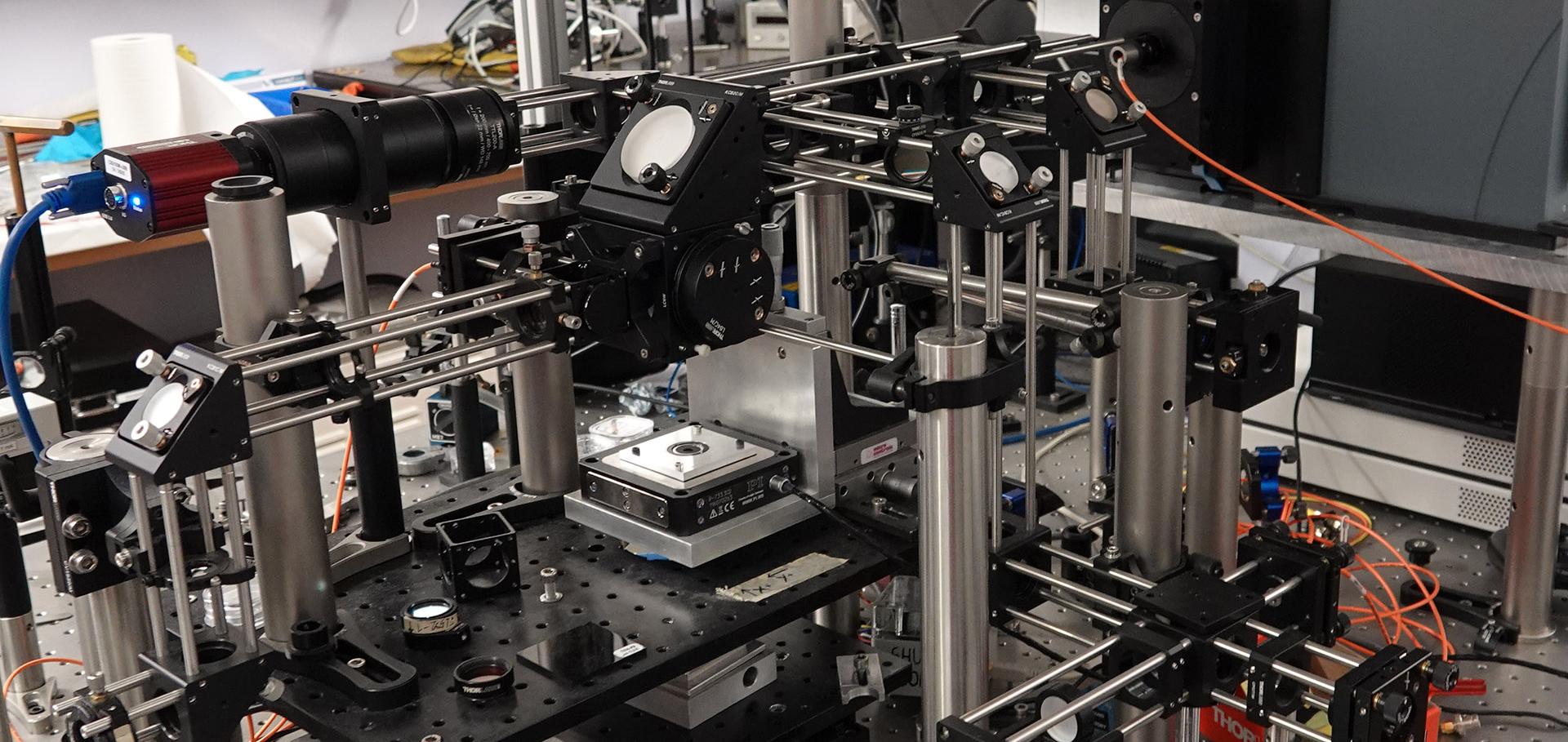
MicroPL optical setup

Professor Robert Taylor

Emeritus Professor of Condensed Matter Physics

Research theme

  • Photovoltaics and nanoscience

Sub department

  • Condensed Matter Physics

Research groups

  • Quantum Optoelectronics
Robert.Taylor@physics.ox.ac.uk
Telephone: 01865 (2)72230
Clarendon Laboratory, room 164
orcid.org/0000-0003-2578-9645
  • About
  • Teaching
  • Positions available
  • Publications

Lasing in perovskite nanocrystals

Image of transverse modes from lasing nanocrystals
Nano Research, 14, 108, 2021

Excited exciton and biexciton localised states in a single quantum ring

(2013)

Authors:

HD Kim, K Kyhm, RA Taylor, A Nicolet, M Potemski, G Nogues, KC Je, EH Lee, JD Song
More details from the publisher

Origins of spectral diffusion in the micro-photoluminescence of single InGaN quantum dots

Japanese Journal of Applied Physics 52:8 PART 2 (2013)

Authors:

BPL Reid, T Zhu, TJ Puchtler, LJ Fletcher, CCS Chan, RA Oliver, RA Taylor

Abstract:

We report on optical characterization of self-assembled InGaN quantum dots (QDs) grown on three GaN pseudo-substrates with differing threading dislocation densities. QD density is estimated via microphotoluminscence on a masked sample patterned with circular apertures, and appears to increase with dislocation density. A non-linear excitation technique is used to observe the sharp spectral lines characteristic of QD emission. Temporal variations of the wavelength of emission from single QDs are observed and attributed to spectral diffusion. The magnitude of these temporal variations is seen to increase with dislocation density, suggesting locally fluctuating electric fields due to charges captured by dislocations are responsible for the spectral diffusion in this system. © 2013 The Japan Society of Applied Physics.
More details from the publisher
More details

Photoluminescence of single GaN/InGaN nanorod light emitting diode fabricated on a wafer scale

Japanese Journal of Applied Physics 52:8 PART 2 (2013)

Authors:

CCS Chan, YD Zhuang, BPL Reid, W Jia, MJ Holmes, JA Alexander-Webber, S Nakazawa, PA Shields, DWE Allsopp, RA Taylor

Abstract:

Nanorod arrays were fabricated on a blue InGaN/GaN single quantum well (QW) LED wafer using nanoimprint lithography. A regular hexagonal lattice of nanorods was made at a pitch of 2 μm producing single quantum disks in the nanorods with diameter of ̃400 nm. Time integrated micro-photoluminescence was performed to investigate the emission properties of top down processed single nanorods at 4.2 K. Microphotoluminescence maps were made to study the spatial isolation of the photoluminescence emission, showing a good contrast ratio between nanorods. Excitation power dependent studies show screening of the quantum confined Stark effect for both the unprocessed wafer and the single nanorod. At low excitation powers, localised states appearing as sharp peaks in the photoluminescence spectrum were visible with a density of approximately four peaks per nanorod. © 2013 The Japan Society of Applied Physics.
More details from the publisher
More details

Confocal microphotoluminescence mapping of coupled and detuned states in photonic molecules

Optics Express 21:14 (2013) 16934-16945

Authors:

FSF Brossard, BPL Reid, CCS Chan, XL Xu, JP Griffiths, DA Williams, R Murray, RA Taylor

Abstract:

We study the coupling of cavities defined by the local modulation of the waveguide width using confocal photoluminescence microscopy. We are able to spatially map the profile of the antisymmetric (antibonding) and symmetric (bonding) modes of a pair of strongly coupled cavities (photonic molecule) and follow the coupled cavity system from the strong coupling to the weak coupling regime in the presence of structural disorder. The effect of disorder on this photonic molecule is also investigated numerically with a finite-difference time-domain method and a semi-analytical approach, which enables us to quantify the light localization observed in either cavity as a function of detuning. © 2013 Optical Society of America.
More details from the publisher
More details
More details

Non-polar (11-20) InGaN quantum dots with short exciton lifetimes grown by metal-organic vapor phase epitaxy

Applied Physics Letters 102:25 (2013)

Authors:

T Zhu, F Oehler, BPL Reid, RM Emery, RA Taylor, MJ Kappers, RA Oliver

Abstract:

We report on the optical characterization of non-polar a-plane InGaN quantum dots (QDs) grown by metal-organic vapor phase epitaxy using a short nitrogen anneal treatment at the growth temperature. Spatial and spectral mapping of sub-surface QDs has been achieved by cathodoluminescence at 8 K. Microphotoluminescence studies of the QDs reveal resolution limited sharp peaks with typical linewidth of 1 meV at 4.2 K. Time-resolved photoluminescence studies suggest the excitons in these QDs have a typical lifetime of 538 ps, much shorter than that of the c-plane QDs, which is strong evidence of the significant suppression of the internal electric fields. © 2013 AIP Publishing LLC.
More details from the publisher
More details

Pagination

  • First page First
  • Previous page Prev
  • …
  • Page 32
  • Page 33
  • Page 34
  • Page 35
  • Current page 36
  • Page 37
  • Page 38
  • Page 39
  • Page 40
  • …
  • Next page Next
  • Last page Last

Footer Menu

  • Contact us
  • Giving to the Dept of Physics
  • Work with us
  • Media

User account menu

  • Log in

Follow us

FIND US

Clarendon Laboratory,

Parks Road,

Oxford,

OX1 3PU

CONTACT US

Tel: +44(0)1865272200

University of Oxfrod logo Department Of Physics text logo
IOP Juno Champion logo Athena Swan Silver Award logo

© University of Oxford - Department of Physics

Cookies | Privacy policy | Accessibility statement

Built by: Versantus

  • Home
  • Research
  • Study
  • Engage
  • Our people
  • News & Comment
  • Events
  • Our facilities & services
  • About us
  • Giving to Physics
  • Current students
  • Staff intranet