Home
Department Of Physics text logo
  • Research
    • Our research
    • Our research groups
    • Our research in action
    • Research funding support
    • Summer internships for undergraduates
  • Study
    • Undergraduates
    • Postgraduates
  • Engage
    • For young people
    • For teachers
    • For the public
    • For alumni
    • For business
  • Support
Menu
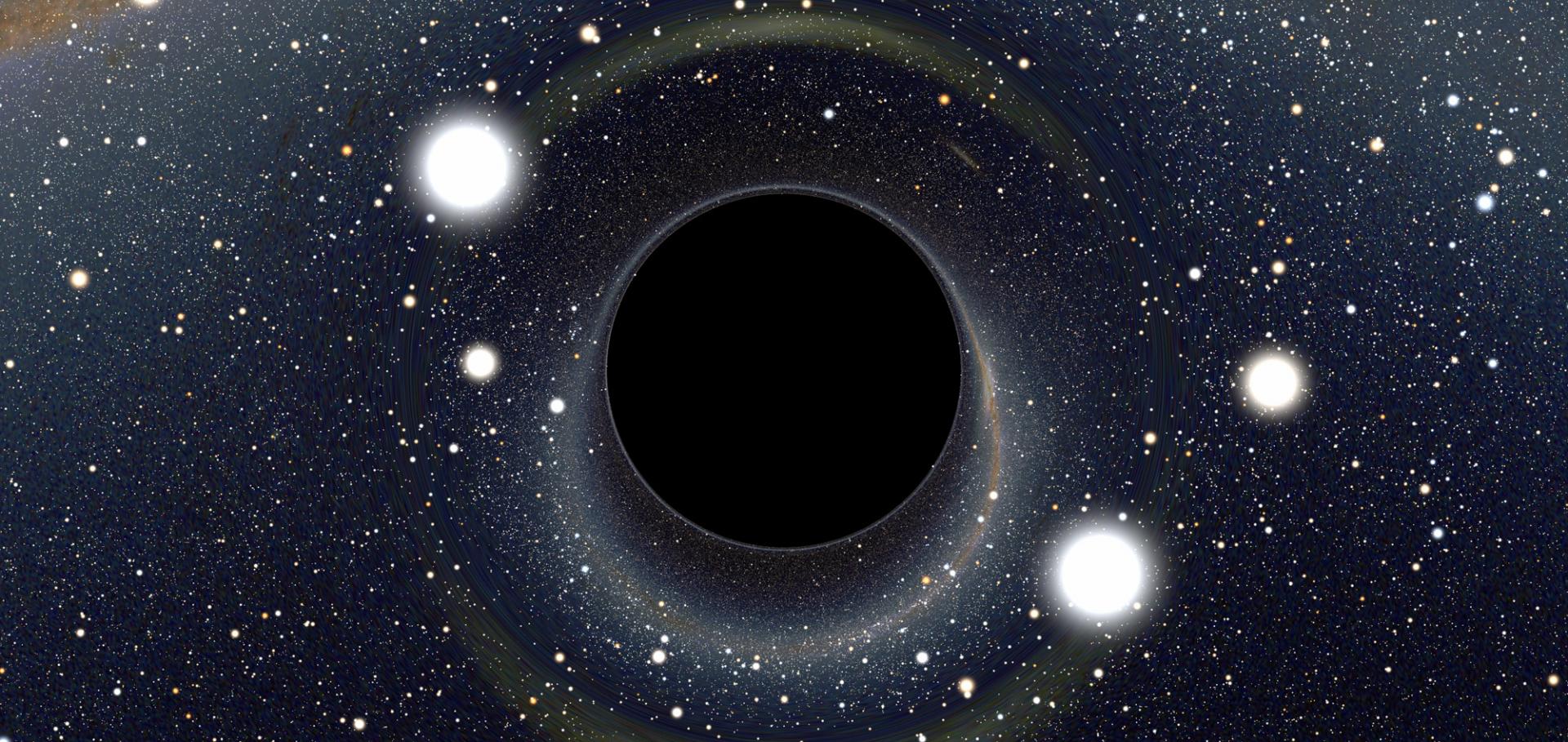
Black Hole

Lensing of space time around a black hole. At Oxford we study black holes observationally and theoretically on all size and time scales - it is some of our core work.

Credit: ALAIN RIAZUELO, IAP/UPMC/CNRS. CLICK HERE TO VIEW MORE IMAGES.

Dr Chiara Spiniello

Visitor

Research theme

  • Astronomy and astrophysics

Sub department

  • Astrophysics

Research groups

  • Galaxy formation and evolution
  • Hintze Centre for Astrophysical Surveys
  • Rubin-LSST
chiara.spiniello@physics.ox.ac.uk
Telephone: 0865 273309
Denys Wilkinson Building, room 562
Chiara's Website
  • About
  • Research
  • Teaching
  • Prizes, awards and recognition
  • Publications
The INvestigating Stellar Population In RElics

an ESO Observational Large Program (ID: 1104.B-0370, PI: C. Spiniello) with the X-Shooter spectrograph at the ESO Very Large Telescope targeting "Relic Galaxies", the ancient fossil of the early Universe

INSPIRE

INSPIRE: INvestigating Stellar Population In RElics VIII. Emission lines and UV colours in ultra-compact massive galaxies

Monthly Notices of the Royal Astronomical Society Oxford University Press (OUP) (2025) staf514

Authors:

Chiara Spiniello, Mario Radovich, Anna Ferré-Mateu, Roberto De Propris, Magda Arnaboldi, Francesco La Barbera, Johanna Hartke, Giuseppe D’Ago, Crescenzo Tortora, Davide Bevacqua, Michalina Maksymowicz-Maciata, John Mills, Nicola R Napolitano, Claudia Pulsoni, Paolo Saracco, Diana Scognamiglio
More details from the publisher
More details

Looking into the faintEst WIth MUSE (LEWIS): Exploring the nature of ultra-diffuse galaxies in the Hydra I cluster

Astronomy & Astrophysics EDP Sciences 695 (2025) a91

Authors:

J Hartke, E Iodice, M Gullieuszik, M Mirabile, C Buttitta, G Doll, G D’Ago, CC de la Casa, KM Hess, R Kotulla, B Poggianti, M Arnaboldi, M Cantiello, EM Corsini, J Falcón-Barroso, DA Forbes, M Hilker, S Mieske, M Rejkuba, M Spavone, C Spiniello
More details from the publisher

Looking into the faintEst WIth MUSE (LEWIS): Exploring the nature of ultra-diffuse galaxies in the Hydra-I cluster

Astronomy & Astrophysics EDP Sciences 694 (2025) a276

Authors:

Chiara Buttitta, Enrichetta Iodice, Goran Doll, Johanna Hartke, Michael Hilker, Duncan A Forbes, Enrico M Corsini, Luca Rossi, Magda Arnaboldi, Michele Cantiello, Giuseppe D’Ago, Jesus Falcón-Barroso, Marco Gullieuszik, Antonio La Marca, Steffen Mieske, Marco Mirabile, Maurizio Paolillo, Marina Rejkuba, Marilena Spavone, Chiara Spiniello, Marc Sarzi
More details from the publisher
More details

Strong gravitational lensing: Structure and evolution of galaxies

Chapter in Reference Module in Materials Science and Materials Engineering, Elsevier (2025)

Authors:

Aprajita Verma, Chiara Spiniello

Abstract:

Strong gravitational lensing has emerged as one of the most versatile tools to explore a range of open questions in astrophysics and cosmology. In this chapter, we focus on the significant contribution of strong lensing in the fields of galaxy structure and evolution. This includes the distribution of luminous and dark matter in galaxies, dark matter substructure, the initial mass function in intermediate redshift massive galaxies and the nature of high redshift galaxies. The impact of this probe has been significant, despite the rarity of known gravitational lens systems. In the imminent era of wide-area sensitive sky surveys, that will reveal 105 strong lensing systems, the full potential of strongly lensed galaxies as an essential and versatile probe of the nature of galaxies will be realized.
More details from the publisher

Strong Lensing by Galaxies

Space Science Reviews Springer 220:8 (2024) 87

Authors:

AJ Shajib, G Vernardos, TE Collett, V Motta, D Sluse, LLR Williams, P Saha, S Birrer, C Spiniello, T Treu

Abstract:

Strong gravitational lensing at the galaxy scale is a valuable tool for various applications in astrophysics and cosmology. Some of the primary uses of galaxy-scale lensing are to study elliptical galaxies’ mass structure and evolution, constrain the stellar initial mass function, and measure cosmological parameters. Since the discovery of the first galaxy-scale lens in the 1980s, this field has made significant advancements in data quality and modeling techniques. In this review, we describe the most common methods for modeling lensing observables, especially imaging data, as they are the most accessible and informative source of lensing observables. We then summarize the primary findings from the literature on the astrophysical and cosmological applications of galaxy-scale lenses. We also discuss the current limitations of the data and methodologies and provide an outlook on the expected improvements in both areas in the near future.
More details from the publisher
Details from ORA
More details
More details

Pagination

  • First page First
  • Previous page Prev
  • …
  • Page 2
  • Page 3
  • Page 4
  • Page 5
  • Current page 6
  • Page 7
  • Page 8
  • Page 9
  • Page 10
  • …
  • Next page Next
  • Last page Last

Footer Menu

  • Contact us
  • Giving to the Dept of Physics
  • Work with us
  • Media

User account menu

  • Log in

Follow us

FIND US

Clarendon Laboratory,

Parks Road,

Oxford,

OX1 3PU

CONTACT US

Tel: +44(0)1865272200

University of Oxfrod logo Department Of Physics text logo
IOP Juno Champion logo Athena Swan Silver Award logo

© University of Oxford - Department of Physics

Cookies | Privacy policy | Accessibility statement

Built by: Versantus

  • Home
  • Research
  • Study
  • Engage
  • Our people
  • News & Comment
  • Events
  • Our facilities & services
  • About us
  • Giving to Physics
  • Current students
  • Staff intranet