Home
Department Of Physics text logo
  • Research
    • Our research
    • Our research groups
    • Our research in action
    • Research funding support
    • Summer internships for undergraduates
  • Study
    • Undergraduates
    • Postgraduates
  • Engage
    • For alumni
    • For business
    • For schools
    • For the public
  • Support
Menu
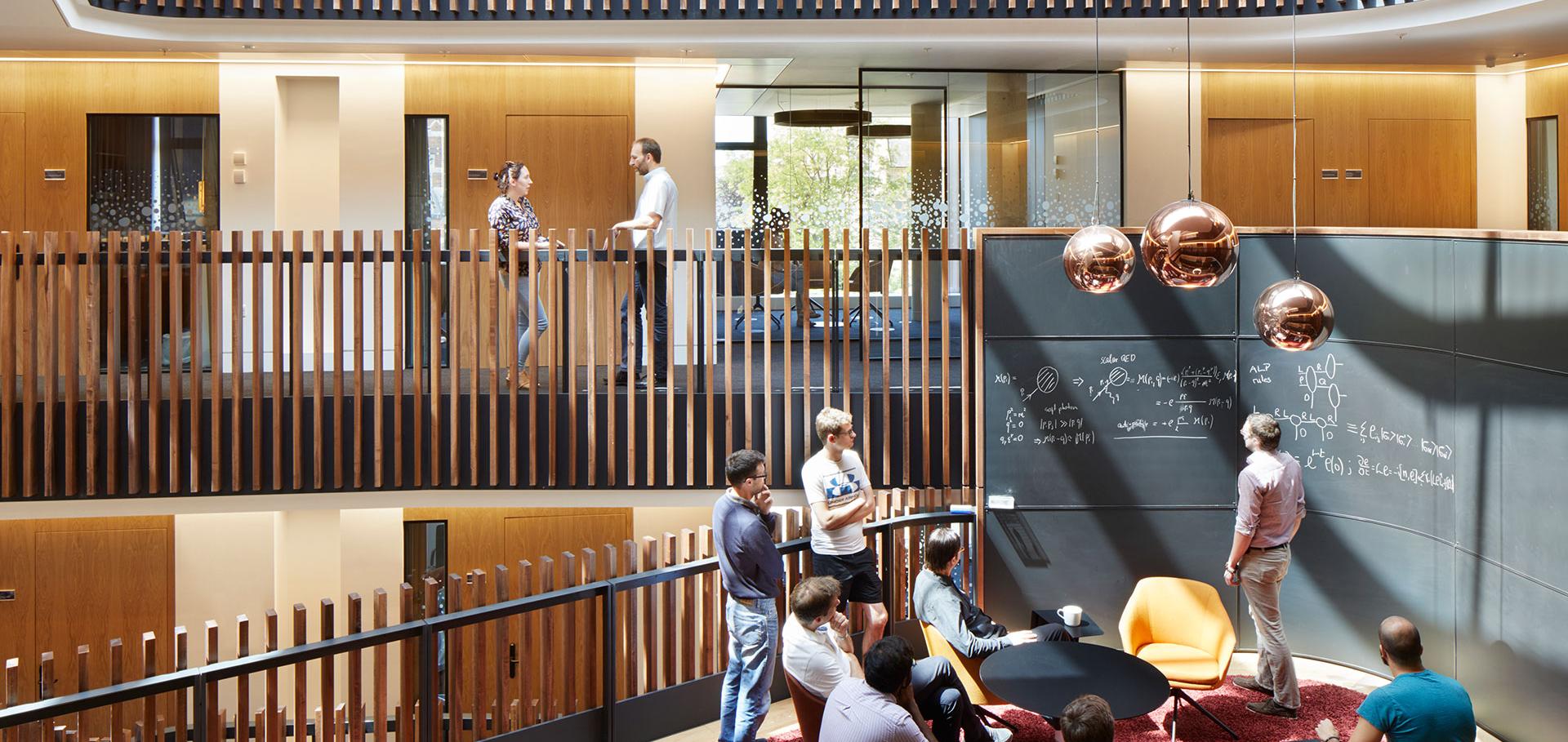
Theoretical physicists working at a blackboard collaboration pod in the Beecroft building.
Credit: Jack Hobhouse

Caroline Terquem

Professor of Physics

Research theme

  • Astronomy and astrophysics
  • Exoplanets and planetary physics
  • Plasma physics

Sub department

  • Rudolf Peierls Centre for Theoretical Physics

Research groups

  • Exoplanets and Stellar Physics
  • Geophysical and Astrophysical Fluid Dynamics
  • Planet formation and dynamics
  • Theoretical astrophysics and plasma physics at RPC
Caroline.Terquem@physics.ox.ac.uk
Telephone: 01865 (2)73983
Rudolf Peierls Centre for Theoretical Physics, room 50.11
  • About
  • Teaching
  • Graduate Matters
  • Publications

Migration and the formation of systems of hot super-earths and neptunes

Astrophysical Journal 654:2 I (2007) 1110-1120

Authors:

C Terquem, JCB Papaloizou
More details from the publisher
Details from ArXiV

Migration and the formation of systems of hot super-Earths and Neptunes

(2006)

Authors:

Caroline Terquem, John CB Papaloizou
More details from the publisher

Planet formation and migration

Reports on Progress in Physics 69:1 (2006) 119-180

Authors:

JCB Papaloizou, C Terquem

Abstract:

We review the observations of extrasolar planets, ongoing developments in theories of planet formation, orbital migration and the evolution of multiplanet systems. © 2006 IOP Publishing Ltd.
More details from the publisher
More details
Details from ArXiV

Numerical simulations of type i planetary migration in non-turbulent magnetized discs

Monthly Notices of the Royal Astronomical Society 363:3 (2005) 943-953

Authors:

S Fromang, C Terquem, RP Nelson

Abstract:

Using 2D magnetohydrodynamic (MHD) numerical simulations performed with two different finite-difference Eulerian codes, we analyse the effect that a toroidal magnetic field has on low-mass planet migration in non-turbulent protoplanetary discs. The presence of the magnetic field modifies the waves that can propagate in the disc. In agreement with a recent linear analysis, we find that two magnetic resonances develop on both sides of the planet orbit, which contribute to a significant global torque. In order to measure the torque exerted by the disc on the planet, we perform simulations in which the latter is either fixed on a circular orbit or allowed to migrate. For a 5-M⊕ planet, when the ratio β between the square of the sound speed and that of the Alfven speed at the location of the planet is equal to 2, we find inward migration when the magnetic field Bφ is uniform in the disc, reduced migration when Bφ decreases as r-1 and outward migration when Bφ decreases as r-2. These results are in agreement with predictions from the linear analysis. Taken as a whole, our results confirm that even a subthermal stable field can stop inward migration of an earth-like planet. © 2005 RAS.
More details from the publisher
More details
Details from ArXiV

Planet formation and migration

(2005)

Authors:

John CB Papaloizou, Caroline Terquem
More details from the publisher

Pagination

  • First page First
  • Previous page Prev
  • …
  • Page 5
  • Page 6
  • Page 7
  • Page 8
  • Current page 9
  • Page 10
  • Page 11
  • Page 12
  • Page 13
  • …
  • Next page Next
  • Last page Last

Footer Menu

  • Contact us
  • Giving to the Dept of Physics
  • Work with us
  • Media

User account menu

  • Log in

Follow us

FIND US

Clarendon Laboratory,

Parks Road,

Oxford,

OX1 3PU

CONTACT US

Tel: +44(0)1865272200

University of Oxfrod logo Department Of Physics text logo
IOP Juno Champion logo Athena Swan Silver Award logo

© University of Oxford - Department of Physics

Cookies | Privacy policy | Accessibility statement

Built by: Versantus

  • Home
  • Research
  • Study
  • Engage
  • Our people
  • News & Comment
  • Events
  • Our facilities & services
  • About us
  • Giving to Physics
  • Current students
  • Staff intranet