Home
Department Of Physics text logo
  • Research
    • Our research
    • Our research groups
    • Our research in action
    • Research funding support
    • Summer internships for undergraduates
  • Study
    • Undergraduates
    • Postgraduates
  • Engage
    • For alumni
    • For business
    • For schools
    • For the public
  • Support
Menu
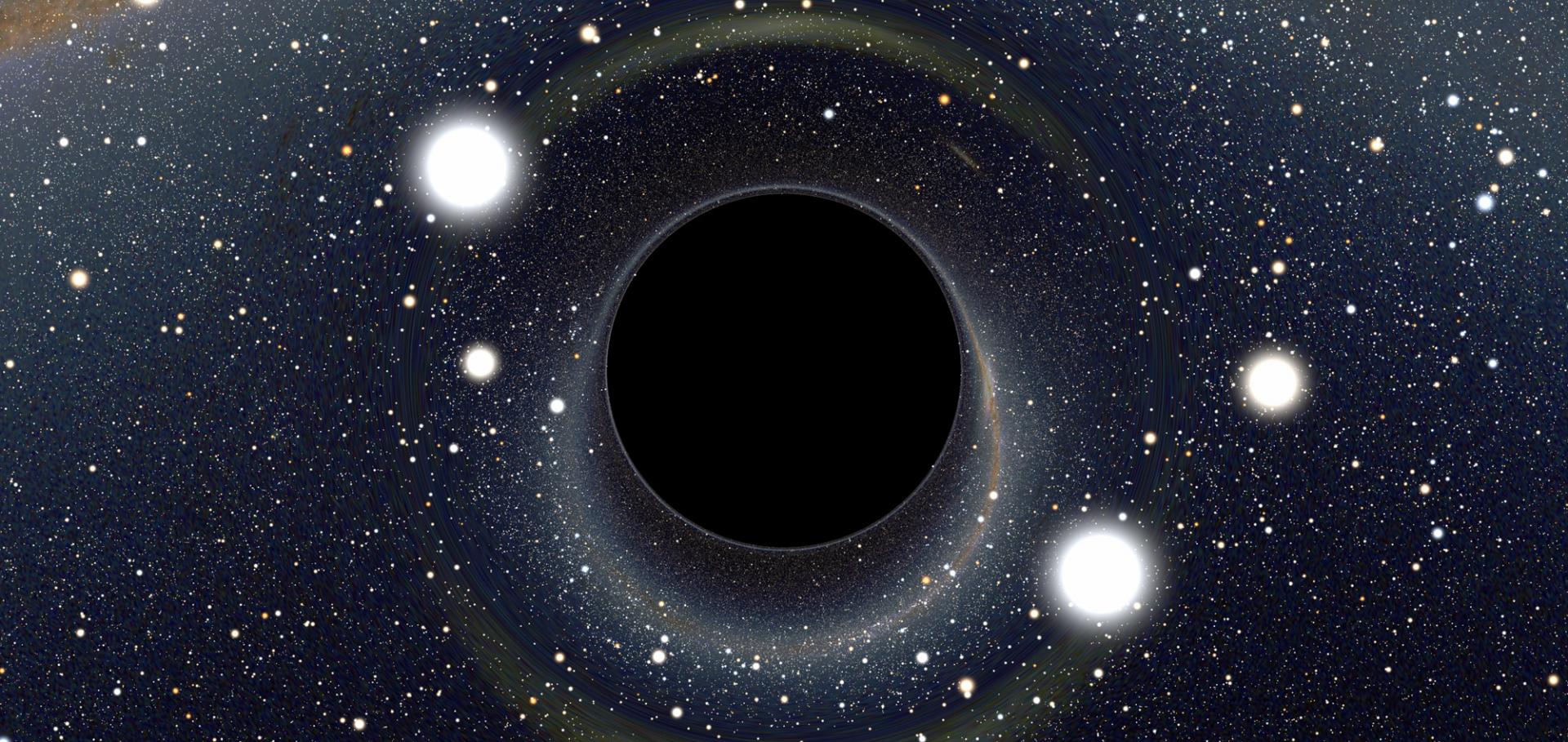
Black Hole

Lensing of space time around a black hole. At Oxford we study black holes observationally and theoretically on all size and time scales - it is some of our core work.

Credit: ALAIN RIAZUELO, IAP/UPMC/CNRS. CLICK HERE TO VIEW MORE IMAGES.

Dr Thomas Williams

Visitor

Research theme

  • Astronomy and astrophysics

Sub department

  • Astrophysics

Research groups

  • Galaxy formation and evolution
thomas.williams@physics.ox.ac.uk
Professional Website
  • About
  • Publications

A fundamental plane of black hole accretion at millimetre wavelengths

Monthly Notices of the Royal Astronomical Society: Letters Oxford University Press 528:1 (2023) L76-L82

Authors:

Ilaria Ruffa, Timothy A Davis, Jacob S Elford, Martin Bureau, Michele Cappellari, Jindra Gensior, Daryl Haggard, Satoru Iguchi, Federico Lelli, Fu-Heng Liang, Lijie Liu, Marc Sarzi, Thomas G Williams, Hengyue Zhang

Abstract:

We report the discovery of the ‘mm fundamental plane of black hole accretion’, which is a tight correlation between the nuclear 1 mm luminosity (Lν, mm), the intrinsic 2–10 keV X-ray luminosity (LX, 2–10) and the supermassive black hole (SMBH) mass (MBH) with an intrinsic scatter (σint) of 0.40 dex. The plane is found for a sample of 48 nearby galaxies, most of which are low-luminosity active galactic nuclei. Combining these sources with a sample of high-luminosity (quasar-like) nearby AGN, we show that the plane still holds. We also find that MBH correlates with Lν, mm at a highly significant level, although such correlation is less tight than the mm fundamental plane (σint = 0.51 dex). Crucially, we show that spectral energy distribution (SED) models for both advection-dominated accretion flows (ADAFs) and compact jets can explain the existence of these relations, which are not reproduced by the standard torus-thin accretion disc models usually associated to quasar-like AGN. The ADAF models reproduces the observed relations somewhat better than those for compact jets, although neither provides a perfect fit. Our findings thus suggest that radiatively inefficient accretion processes such as those in ADAFs or compact (and thus possibly young) jets may play a key role in both low- and high-luminosity AGN. This mm fundamental plane also offers a new, rapid method to (indirectly) estimate SMBH masses.

More details from the publisher
Details from ORA
More details

WISDOM project – XVIII. Molecular gas distributions and kinematics of three megamaser galaxies

Monthly Notices of the Royal Astronomical Society Oxford University Press 527:3 (2023) 9343-9358

Authors:

Fu-Heng Liang, Mark D Smith, Martin G Bureau, Feng Gao, Timothy A Davis, Michele Cappellari, Jacob S Elford, Jenny E Greene, Satoru Iguchi, Federico Lelli, Anan Lu, Ilaria Ruffa, Thomas G Williams, Hengyue Zhang

Abstract:

The co-evolution of galaxies and supermassive black holes (SMBHs) underpins our understanding of galaxy evolution, but different methods to measure SMBH masses have only infrequently been cross-checked. We attempt to identify targets to cross-check two of the most accurate methods, megamaser, and cold molecular gas dynamics. Three promising galaxies are selected from all those with existing megamaser SMBH mass measurements. We present Atacama Large Millimeter/sub-millimeter Array (ALMA) 12CO (2–1) and 230-GHz continuum observations with angular resolutions of ≈0"5. Every galaxy has an extended rotating molecular gas disc and 230-GHz continuum source(s), but all also have irregularities and/or non-axisymmetric features: NGC 1194 is highly inclined and has disturbed and lopsided central 12CO (2–1) emission; NGC 3393 has a nuclear disc with fairly regular but patchy 12CO (2–1) emission with little gas near the kinematic major axis, faint emission in the very centre, and two brighter structures reminiscent of a nuclear ring and/or spiral; NGC 5765B has a strong bar and very bright 12CO (2–1) emission concentrated along two bisymmetric offset dust lanes and two bisymmetric nuclear spiral arms. 12CO (2–1) and 12CO (3–2) observations with the James Clerk Maxwell Telescope are compared with the ALMA observations. Because of the disturbed gas kinematics and the impractically long integration times required for higher angular resolution observations, none of the three galaxies is suitable for a future SMBH mass measurement. None the less, increasing the number of molecular gas observations of megamaser galaxies is valuable, and the ubiquitous disturbances suggest a link between large-scale gas properties and the existence of megamasers.
More details from the publisher
Details from ORA
More details

Resolved low-J12CO excitation at 190 parsec resolution across NGC 2903 and NGC 3627

Monthly Notices of the Royal Astronomical Society Oxford University Press (OUP) 526:4 (2023) 6347-6363

Authors:

JS den Brok, AK Leroy, A Usero, E Schinnerer, E Rosolowsky, EW Koch, M Querejeta, D Liu, F Bigiel, AT Barnes, M Chevance, D Colombo, DA Dale, SCO Glover, MJ Jimenez-Donaire, Y-H Teng, TG Williams
More details from the publisher
More details

The WISDOM of power spectra: how the galactic gravitational potential impacts a galaxy’s central gas reservoir in simulations and observations

Monthly Notices of the Royal Astronomical Society Oxford University Press 526:4 (2023) 5590-5611

Authors:

Jindra Gensior, Timothy A Davis, Martin Bureau, JM Diederik Kruijssen, Michele Cappellari, Ilaria Ruffa, Thomas G Williams

Abstract:

Observations indicate that the central gas discs are smoother in early-type galaxies than their late-type counterparts, while recent simulations predict that the dynamical suppression of star formation in spheroid-dominated galaxies is preceded by the suppression of fragmentation of their interstellar media. The mass surface density power spectrum is a powerful tool to constrain the degree of structure within a gas reservoir. Specifically here, we focus on the power spectrum slope and aim to constrain whether the shear induced by a dominant spheroidal potential can induce sufficient turbulence to suppress fragmentation, resulting in the smooth central gas discs observed. We compute surface density power spectra for the nuclear gas reservoirs of fourteen simulated isolated galaxies and twelve galaxies observed as part of the mm-Wave Interferometric Survey of Dark Object Masses (WISDOM) project. Both simulated and observed galaxies range from disc-dominated galaxies to spheroids, with central stellar mass surface densities, a measure of bulge dominance, varying by more than an order of magnitude. For the simulations, the power spectra steepen with increasing central stellar mass surface density, thereby clearly linking the suppression of fragmentation to the shear-driven turbulence induced by the spheroid. The WISDOM observations show a different (but potentially consistent) picture: while there is no correlation between the power spectrum slopes and the central stellar mass surface densities, the slopes scatter around a value of 2.6. This is similar to the behaviour of the slopes of the simulated galaxies with high central stellar mass surface densities, and could indicate that high shear eventually drives incompressible turbulence.
More details from the publisher
Details from ORA
More details

Quantifying the energy balance between the turbulent ionised gas and young stars

Astronomy & Astrophysics EDP Sciences 678 (2023) a153

Authors:

Oleg V Egorov, Kathryn Kreckel, Simon CO Glover, Brent Groves, Francesco Belfiore, Eric Emsellem, Ralf S Klessen, Adam K Leroy, Sharon E Meidt, Sumit K Sarbadhicary, Eva Schinnerer, Elizabeth J Watkins, Brad C Whitmore, Ashley T Barnes, Enrico Congiu, Daniel A Dale, Kathryn Grasha, Kirsten L Larson, Janice C Lee, J Eduardo Méndez-Delgado, David A Thilker, Thomas G Williams
More details from the publisher
More details

Pagination

  • First page First
  • Previous page Prev
  • …
  • Page 13
  • Page 14
  • Page 15
  • Page 16
  • Current page 17
  • Page 18
  • Page 19
  • Page 20
  • Page 21
  • …
  • Next page Next
  • Last page Last

Footer Menu

  • Contact us
  • Giving to the Dept of Physics
  • Work with us
  • Media

User account menu

  • Log in

Follow us

FIND US

Clarendon Laboratory,

Parks Road,

Oxford,

OX1 3PU

CONTACT US

Tel: +44(0)1865272200

University of Oxfrod logo Department Of Physics text logo
IOP Juno Champion logo Athena Swan Silver Award logo

© University of Oxford - Department of Physics

Cookies | Privacy policy | Accessibility statement

Built by: Versantus

  • Home
  • Research
  • Study
  • Engage
  • Our people
  • News & Comment
  • Events
  • Our facilities & services
  • About us
  • Giving to Physics
  • Current students
  • Staff intranet