

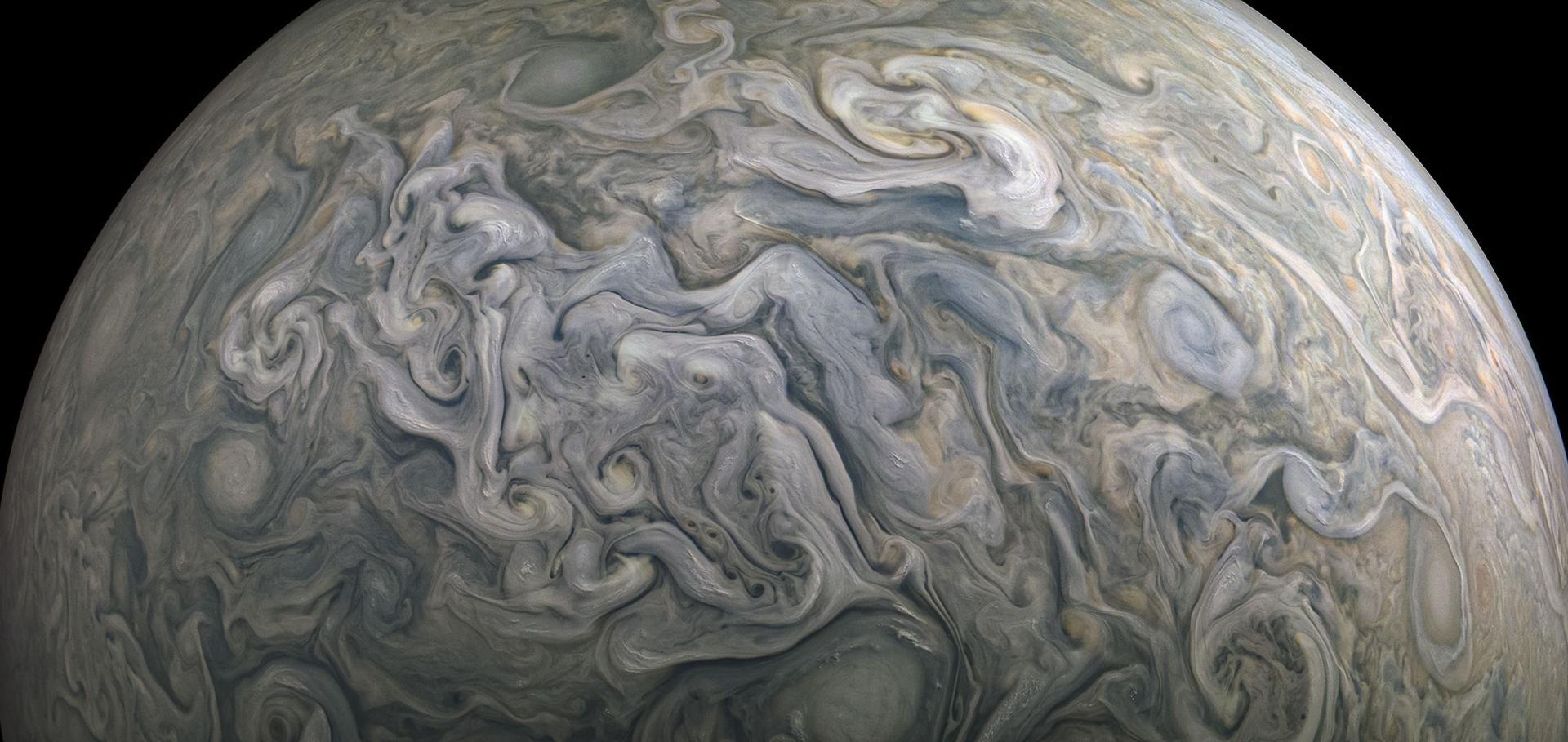

Global climate modeling of Saturn's atmosphere. Part III: Global statistical picture of zonostrophic turbulence in high-resolution 3D-turbulent simulations
ArXiv 2001.02473 (2020)
Abstract:
We conduct an in-depth analysis of statistical flow properties calculated from the reference high-resolution Saturn simulation obtained by global climate modelling in Part II. In the steady state of this reference simulation, strongly energetic, zonally dominated, large-scale structures emerge, which scale with the Rhines scale. Spectral analysis reveals a strong anisotropy in the kinetic energy spectra, consistent with the zonostrophic turbulent flow regime. By computing spectral energy and enstrophy fluxes we confirm the existence of a double cascade scenario related to 2D-turbulent theory. To diagnose the relevant 3D dynamical mechanisms in Saturn's turbulent atmosphere, we run a set of four simulations using an idealized version of our Global Climate Model devoid of radiative transfer, with a well-defined Taylor-Green forcing and over several rotation rates (4, 1, 0.5, and 0.25 times Saturn's rotation rate). This allows us to identify dynamics in three distinctive inertial ranges: (1) a ``residual-dominated'' range, in which non-axisymmetric structures dominate with a -5/3 spectral slope; (2) a ``zonostrophic inertial'' range, dominated by axisymmetric jets and characterized by the pile-up of strong zonal modes with a steeper, nearly -3, spectral slope; and (3) a ``large-scale'' range, beyond Rhines' typical length scale, in which the reference Saturn simulation and our idealized simulations differ. In the latter range, the dynamics is dominated by long-lived zonal modes 2 and 3 when a Saturn-like seasonal forcing is considered (reference simulation), and a steep energetic decrease with the idealized Taylor-Green forcing. Finally, instantaneous spectral fluxes show the coexistence of upscale and downscale enstrophy/energy transfers at large scales, specific to the regime of zonostrophic turbulence in a 3D atmosphere.Shadowing the rotating annulus. Part II: Gradient descent in the perfect model scenario
(2019)
Abstract:
Shadowing trajectories are model trajectories consistent with a sequence of observations of a system, given a distribution of observational noise. The existence of such trajectories is a desirable property of any forecast model. Gradient descent of indeterminism is a well-established technique for finding shadowing trajectories in low-dimensional analytical systems. Here we apply it to the thermally-driven rotating annulus, a laboratory experiment intermediate in model complexity and physical idealisation between analytical systems and global, comprehensive atmospheric models. We work in the perfect model scenario using the MORALS model to generate a sequence of noisy observations in a chaotic flow regime. We demonstrate that the gradient descent technique recovers a pseudo-orbit of model states significantly closer to a model trajectory than the initial sequence. Gradient-free descent is used, where the adjoint model is set to $\lambda$I in the absence of a full adjoint model. The indeterminism of the pseudo-orbit falls by two orders of magnitude during the descent, but we find that the distance between the pseudo-orbit and the initial, true, model trajectory reaches a minimum and then diverges from truth. We attribute this to the use of the $\lambda$-adjoint, which is well suited to noise reduction but not to finely-tuned convergence towards a model trajectory. We find that $\lambda=0.25$ gives optimal results, and that candidate model trajectories begun from this pseudo-orbit shadow the observations for up to 80 s, about the length of the longest timescale of the system, and similar to expected shadowing times based on the distance between the pseudo-orbit and the truth. There is great potential for using this method with real laboratory data.Shadowing the rotating annulus. Part I: Measuring candidate trajectory shadowing times
ArXiv 1909.04488 (2019)
Abstract:
An intuitively necessary requirement of models used to provide forecasts of a system's future is the existence of shadowing trajectories that are consistent with past observations of the system: given a system-model pair, do model trajectories exist that stay reasonably close to a sequence of observations of the system? Techniques for finding such trajectories are well-understood in low-dimensional systems, but there is significant interest in their application to high-dimensional weather and climate models. We build on work by Smith et al. [2010, Phys. Lett. A, 374, 2618-2623] and develop a method for measuring the time that individual "candidate" trajectories of high-dimensional models shadow observations, using a model of the thermally-driven rotating annulus in the perfect model scenario. Models of the annulus are intermediate in complexity between low-dimensional systems and global atmospheric models. We demonstrate our method by measuring shadowing times against artificially-generated observations for candidate trajectories beginning a fixed distance from truth in one of the annulus' chaotic flow regimes. The distribution of candidate shadowing times we calculated using our method corresponds closely to (1) the range of times over which the trajectories visually diverge from the observations and (2) the divergence time using a simple metric based on the distance between model trajectory and observations. An empirical relationship between the expected candidate shadowing times and the initial distance from truth confirms that the method behaves reasonably as parameters are varied.Simulating Jupiter’s weather layer. Part I: Jet spin-up in a dry atmosphere
Icarus Elsevier 326 (2018) 225-252
Abstract:
We investigate the dynamics of Jupiter's upper troposphere and lower stratosphere using a General Circulation Model that includes two-stream radiation and optional heating from below. Based on the MITgcm dynamical core, this is a new generation of the Oxford Jupiter model [Zuchowski, L.C. et al., 2009. Plan. Space Sci., 57, 1525--1537, doi:10.1016/j.pss.2009.05.008]. We simulate Jupiter's atmosphere at up to 0.7 degree horizontal resolution with 33 vertical levels down to a pressure of 18 bar, in configurations with and without a 5.7 W/m2 interior heat flux. Simulations ran for 130000-150000 days to allow the deep atmosphere to come into radiative equilibrium. Baroclinic instability generates alternating, eddy-driven, midlatitude jets in both cases. With interior heating the zonal jets migrate towards the equator and become barotropically unstable. This generates Rossby waves that radiate away from the equator, depositing westerly momentum there via eddy angular momentum flux convergence and spinning up a super-rotating 20 m/s equatorial jet throughout the troposphere. There are 30-35 zonal jets with latitudinal separation comparable with the real planet, and there is strong eddy activity throughout. Without interior heating the jets do not migrate and a divergent eddy angular momentum flux at the equator spins up a broad, 50 m/s sub-rotating equatorial jet with weak eddy activity at low latitudes.Simulating Jupiter's weather layer. Part II: Passive ammonia and water cycles
Icarus Elsevier 326 (2018) 253-268