Home
Department Of Physics text logo
  • Research
    • Our research
    • Our research groups
    • Our research in action
    • Research funding support
    • Summer internships for undergraduates
  • Study
    • Undergraduates
    • Postgraduates
  • Engage
    • For alumni
    • For business
    • For schools
    • For the public
  • Support
Menu
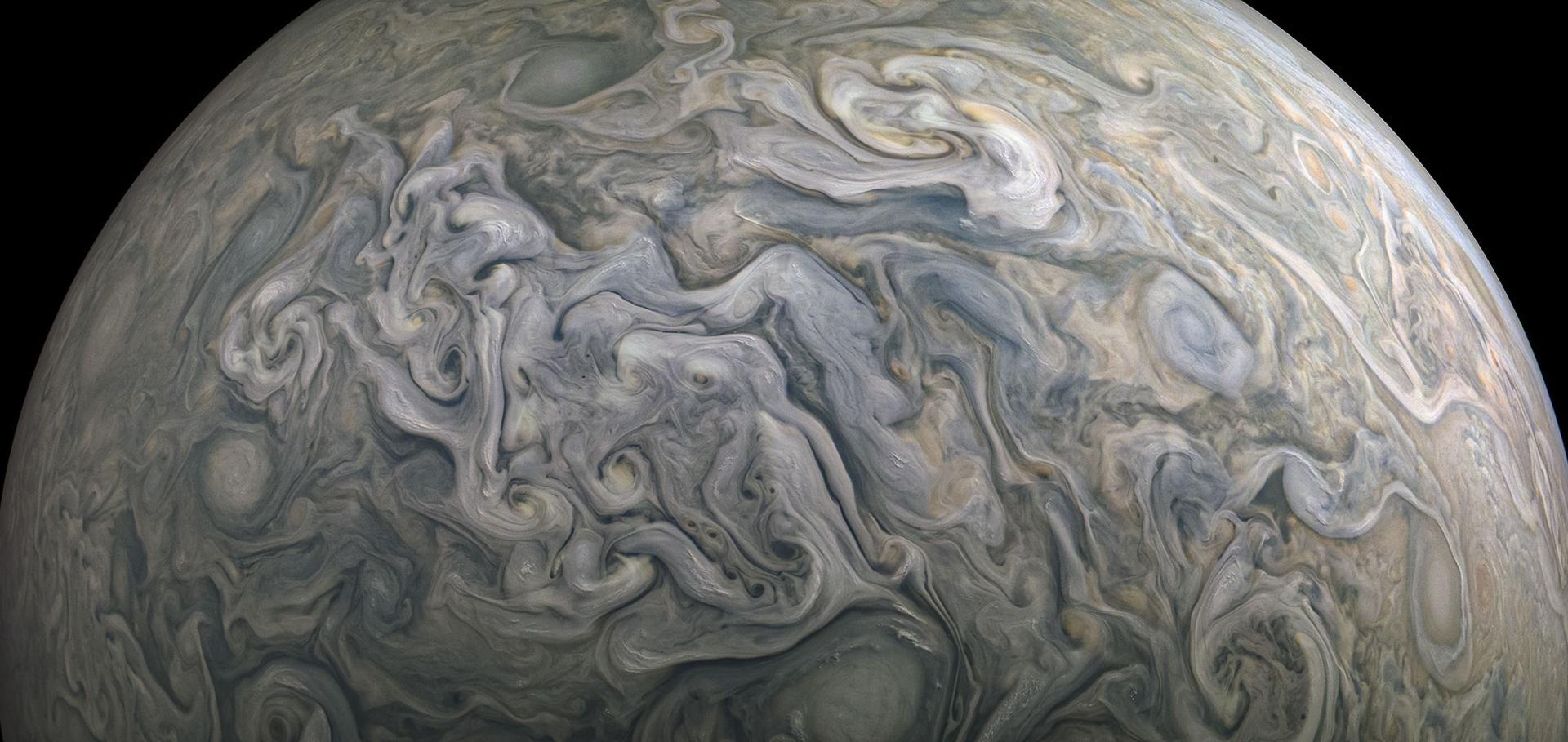
Juno Jupiter image

Roland Young

Visitor

Sub department

  • Atmospheric, Oceanic and Planetary Physics
roland.young@abdn.ac.uk
  • About
  • Publications

An experimental study of multiple zonal jet formation in rotating, thermally driven convective flows on a topographic beta-plane

Physics of Fluids American Institute of Physics 27:8 (2015) 085111

Authors:

Peter Read, TNL Jacoby, PHT Rogberg, RD Wordsworth, YH Yamazaki, K Miki-Yamazaki, Roland Young, J Sommeria, H Didelle, S Viboud

Abstract:

A series of rotating, thermal convection experiments were carried out on the Coriolis platform in Grenoble, France, to investigate the formation and energetics of systems of zonal jets through nonlinear eddy/wave-zonal flow interactions on a topographic ß-plane. The latterwas produced by a combination of a rigid, conically sloping bottom and the rotational deformation of the free upper surface. Convection was driven by a system of electrical heaters laid under the (thermally conducting) sloping bottom and led to the production of intense, convective vortices. These were observed to grow in size as each experiment proceeded and led to the development of weak but clear azimuthal jet-like flows, with a radial scale that varied according to the rotation speed of the platform. Detailed analyses reveal that the kinetic energy-weighted radial wavenumber of the zonal jets, kJ y, scales quite closely either with the Rhines wavenumber as kJ y ≃ 2(βT/2urms)1/2, where urms is the rms total or eddy velocity and βT is the vorticity gradient produced by the sloping topography, or the anisotropy wavenumber as kJ y ≃ 1.25(β3T ε{lunate})1/5, where ε{lunate} is the upscale turbulent energy transfer rate. Jets are primarily produced by the direct quasi-linear action of horizontal Reynolds stresses produced by trains of topographic Rossby waves. The nonlinear production rate of zonal kinetic energy is found to be strongly unsteady, however, with fluctuations of order 10-100 times the amplitude of the mean production rate for all cases considered. The time scale of such fluctuations is found to scale consistently with either an inertial time scale, Τp ~ 1.√urms βT, or the Ekman spin-down time scale. Kinetic energy spectra show some evidence for a k-5/3 inertial subrange in the isotropic component, suggestive of a classical Kolmogorov-Batchelor-Kraichnan upscale energy cascade and a steeper spectrum in the zonal mean flow, though not as steep as k-5, as anticipated for fully zonostrophic flow. This is consistent with a classification of all of these flows as marginally zonostrophic, as expected for values of the zonostrophy parameter Rβ ≃ 1.6-1.7, though a number of properties related to flow anisotropy were found to vary significantly and systematically within this range.
More details from the publisher
Details from ORA
More details

The thermally-driven rotating annulus: horizontal velocities in regular and weakly chaotic flow regimes

University of Oxford (2015)

Authors:

Wolf-Gerrit Früh, David Smith, Stephan H Risch

Abstract:

The dataset is documented in readme.pdf. The data files are in uncompressed .tar format. This dataset contains 11 1/2 hours of horizontal velocity measurements from four experiments using AOPP's 'small annulus' thermally-driven rotating annulus laboratory experiment. The experiments cover regular (2S, 3AV) and weakly chaotic (3SV) flow regimes. The apparatus consists of two concentric right circular cylinders with height 14.0cm and radii 2.5cm and 8.0cm, with a 17% glycerol / 83% water mixture (by volume) between them. The outer cylinder is heated and the inner cylinder cooled relative to the working fluid, with a temperature difference of approximately 4K, and the apparatus rotates about the co-incident axis of the two cylinders at rates between 0.75 and 3.1 rad/s. This setup mimics the main effects acting on a planetary atmosphere: gravity, rotation, and a heating gradient between low and high latitudes.
More details from the publisher
Details from ORA

General Circulation of Planetary Atmospheres: Insights from Rotating Annulus and Related Experiments

Chapter in Modeling Atmospheric and Oceanic Flows: Insights from Laboratory Experiments and Numerical Simulations, John Wiley & Sons Ltd. (2015) 1

Authors:

PL Read, EP Perez, IM Moroz, RMB Young

Abstract:

This chapter focuses on the "classical" thermally driven, rotating annulus system. It reviews the current state of understanding of the rich and diverse range of flow regimes that may be exhibited in thermal annulus experiments from the viewpoint of experimental observation, numerical simulation, and fundamental theory. This includes interpretation of various empirical experimental observations in relation to both linear and weakly nonlinear baroclinic instability theory. The chapter then examines how heat is transported within the baroclinic annulus across the full range of control parameters, associated with both the boundary layer circulation and baroclinically unstable eddies. It considers the overall role of annulus experiments in the laboratory in continuing to advance understanding of the global circulation of planetary atmospheres and oceans, reviewing the current state of research on delineating circulation regimes obtained in large-scale circulation models in direct comparison with the sequences of flow regimes and transitions in the laboratory.
More details from the publisher
Details from ORA

The Lorenz energy cycle in simulated rotating annulus flows

Physics of Fluids American Institute of Physics (AIP) 26:5 (2014) 056602

Abstract:

Lorenz energy cycles are presented for a series of simulated differentially heated rotating annulus flows, in the axisymmetric, steady, amplitude vacillating, and structurally vacillating flow regimes. The simulation allows contributions to the energy diagnostics to be identified in parts of the fluid that cannot be measured in experiments. These energy diagnostics are compared with laboratory experiments studying amplitude vacillation, and agree well with experimental time series of kinetic and potential energy, as well as conversions between them. Two of the three major energy transfer paradigms of the Lorenz energy cycle are identified—a Hadley-cell overturning circulation, and baroclinic instability. The third, barotropic instability, was never dominant, but increased in strength as rotation rate increased. For structurally vacillating flow, which matches the Earth's thermal Rossby number well, the ratio between energy conversions associated with baroclinic and barotropic instabilities was similar to the measured ratio in the Earth's mid-latitudes.
More details from the publisher
More details

Cassini observations reveal a regime of zonostrophic macroturbulence on Jupiter

Icarus 229 (2014) 295-320

Authors:

B Galperin, RMB Young, S Sukoriansky, N Dikovskaya, PL Read, AJ Lancaster, D Armstrong

Abstract:

In December 2000, the Cassini fly-by near Jupiter delivered high-resolution images of Jupiter's clouds over the entire planet in a band between 50°N and 50°S. Three daily-averaged two-dimensional velocity snapshots extracted from these images are used to perform spectral analysis of jovian atmospheric macroturbulence. A similar analysis is also performed on alternative data documented by Choi and Showman (Choi, D., Showman, A. [2011]. Icarus 216, 597-609), based on a different method of image processing. The inter-comparison of the products of both analyses ensures a better constraint of the spectral estimates. Both analyses reveal strong anisotropy of the kinetic energy spectrum. The zonal spectrum is very steep and most of the kinetic energy resides in slowly evolving, alternating zonal (west-east) jets, while the non-zonal, or residual spectrum obeys the Kolmogorov-Kraichnan law specific to two-dimensional turbulence in the range of the inverse energy cascade. The spectral data is used to estimate the inverse cascade rate {small element of} and the zonostrophy index Rβ for the first time. Although both datasets yield somewhat different values of {small element of}, it is estimated to be in the range 0.5-1.0×10⁻⁵m2s-3. The ensuing values of Rβ≳5 belong well in the range of zonostrophic turbulence whose threshold corresponds to Rβ≃2.5. We infer that the large-scale circulation is maintained by an anisotropic inverse energy cascade. The removal of the Great Red Spot from both datasets has no significant effect upon either the spectra or the inverse cascade rate. The spectral data are used to compute the rate of the energy exchange, W, between the non-zonal structures and the large-scale zonal flow. It is found that instantaneous values of W may exceed {small element of} by an order of magnitude. Previous numerical simulations with a barotropic model suggest that W and {small element of} attain comparable values only after averaging of W over a sufficiently long time. Near-instantaneous values of W that have been routinely used to infer the rate of the kinetic energy supply to Jupiter's zonal flow may therefore significantly overestimate {small element of}. This disparity between W and {small element of} may resolve the long-standing conundrum of an unrealistically high rate of energy transfer to the zonal flow. The meridional diffusivity Kφ in the regime of zonostrophic turbulence is given by an expression that depends on {small element of}. The value of Kφ estimated from the spectra is compared against data from the dispersion of stratospheric gases and debris resulting from the Shoemaker-Levy 9 comet and Wesley asteroid impacts in 1994 and 2009 respectively. Not only is Kφ found to be consistent with estimates for both impacts, but the eddy diffusivity found from observations appears to be scale-independent. This behaviour could be a consequence of the interaction between anisotropic turbulence and Rossby waves specific to the regime of zonostrophic macroturbulence. © 2013 Elsevier Inc.
More details from the publisher
Details from ORA
More details

Pagination

  • First page First
  • Previous page Prev
  • Page 1
  • Page 2
  • Current page 3
  • Page 4
  • Page 5
  • Next page Next
  • Last page Last

Footer Menu

  • Contact us
  • Giving to the Dept of Physics
  • Work with us
  • Media

User account menu

  • Log in

Follow us

FIND US

Clarendon Laboratory,

Parks Road,

Oxford,

OX1 3PU

CONTACT US

Tel: +44(0)1865272200

University of Oxfrod logo Department Of Physics text logo
IOP Juno Champion logo Athena Swan Silver Award logo

© University of Oxford - Department of Physics

Cookies | Privacy policy | Accessibility statement

Built by: Versantus

  • Home
  • Research
  • Study
  • Engage
  • Our people
  • News & Comment
  • Events
  • Our facilities & services
  • About us
  • Giving to Physics
  • Current students
  • Staff intranet