

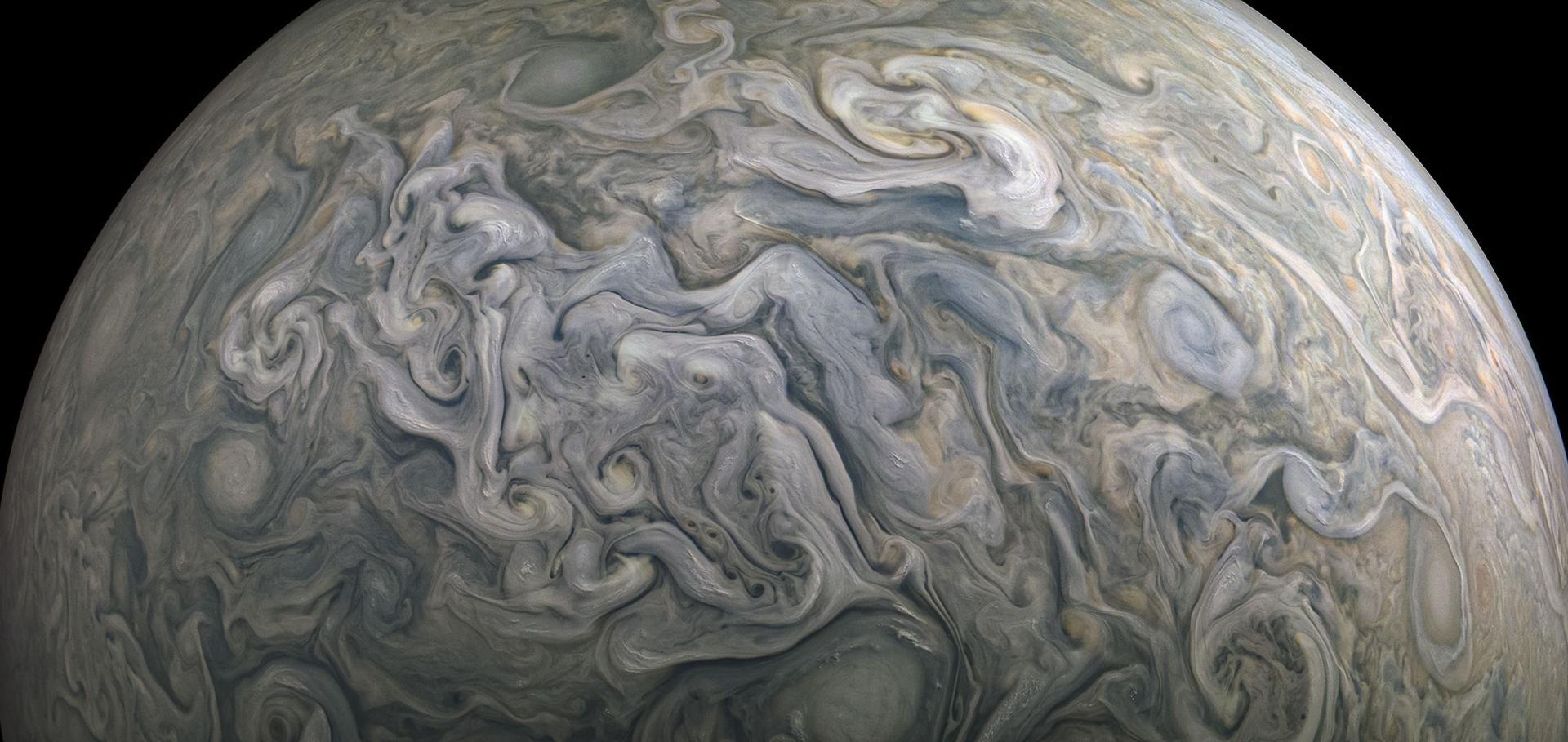

Comparative terrestrial atmospheric circulation regimes in simplified global circulation models: II. energy budgets and spectral transfers
Quarterly Journal of the Royal Meteorological Society Wiley 144:717 (2018) 2558-2576
Abstract:
The energetics of possible global atmospheric circulation patterns in an Earth-like atmosphere are explored using a simplified GCM based on the University of Hamburg’s Portable University Model for the Atmosphere (designated here as PUMA-S), forced by linear relaxation towards a prescribed temperature field and subject to Rayleigh surface drag and hyperdiffusive dissipation. Results from a series of simulations, obtained by varying planetary rotation rate Ω with an imposed equator-to-pole temperature difference, were analysed to determine the structure and magnitude of the heat transport and other contributions to the energy budget for the time-averaged, equilibrated flow. These show clear trends with rotation rate, with the most intense Lorenz energy cycle for an Earth-sized planet occurring with a rotation rate around half that of the present day Earth (i.e. Ω* = Ω/ΩE = 1/2, where ΩE is the rotation rate of the Earth). KE and APE spectra, EK(n) and EA(n) (where n is total spherical wavenumber), also show clear trends with rotation rate, with n^-3 enstrophy-dominated spectra around Ω* = 1 and steeper (~ n^-5) slopes in the zonal mean flow with little evidence for the n^-5/3 spectrum anticipated for an inverse KE cascade. Instead, both KE and APE spectra become almost flat at scales larger than the internal Rossby radius, Ld, and exhibit near-equipartition at high wavenumbers. At Ω* << 1, the spectrum becomes dominated by KE with EK(n) ~ (2 - 3)EA(n) at most wavenumbers and a slope that tends towards n^-5/3 across most of the spectrum. Spectral flux calculations show that enstrophy and APE are almost always cascaded downscale, regardless of rotation rate. KE cascades are more complicated, however, with downscale transfers across almost all wavenumbers, dominated by horizontally divergent modes, for Ω* ≲ 1/4. At higher rotation rates, transfers of KE become increasingly dominated by rotational (horizontally non-divergent) components with strong upscale transfers (dominated by eddy-zonal flow interactions) for scales larger than Ld and weaker downscale transfers for scales smaller than Ld.Comparative terrestrial atmospheric circulation regimes in simplified global circulation models. Part I: From cyclostrophic super‐rotation to geostrophic turbulence
Quarterly Journal of the Royal Meteorological Society Wiley 144:717 (2018) 2537-2557
Abstract:
The regimes of possible global atmospheric circulation patterns in an Earth‐like atmosphere are explored using a simplified Global Circulation Model (GCM) based on the University of Hamburg's Portable University Model for the Atmosphere (PUMA)—with simplified (linear) boundary‐layer friction, a Newtonian cooling scheme, and dry convective adjustment (designated here as PUMA‐S). A series of controlled experiments is conducted by varying planetary rotation rate and imposed equator‐to‐pole temperature difference. These defining parameters are combined further with each other into dimensionless forms to establish a parameter space in which the occurrences of different circulation regimes are mapped and classified. Clear, coherent trends are found when varying planetary rotation rate (thermal Rossby number) and frictional and thermal relaxation time‐scales. The sequence of circulation regimes as a function of parameters, such as the planetary rotation rate, strongly resembles that obtained in laboratory experiments on rotating, stratified flows, especially if a topographic β‐effect is included in those experiments to emulate the planetary vorticity gradients in an atmosphere induced by the spherical curvature of the planet. A regular baroclinic wave regime is also obtained at intermediate values of thermal Rossby number and its characteristics and dominant zonal wavenumber depend strongly on the strength of radiative and frictional damping. These regular waves exhibit some strong similarities to baroclinic storms observed on Mars under some conditions. Multiple jets are found at the highest rotation rates, when the Rossby deformation radius and other eddy‐related length‐scales are much smaller than the radius of the planet. These exhibit some similarity to the multiple zonal jets observed on gas giant planets. Jets form on a scale comparable to the most energetic eddies and the Rhines scale poleward of the supercritical latitude. The balance of heat transport varies strongly with Ω∗ between eddies and zonally symmetric flows, becoming weak with fast rotation.Regimes of axisymmetric flow and scaling laws in a rotating annulus with local convective forcing
Fluids MDPI 2:3 (2017) 41
Abstract:
We present a numerical study of axisymmetric flow in a rotating annulus in which local thermal forcing, via a heated annular ring on the outside of the base and a cooled circular disk in the centre of the top surface, drives convection. This new configuration is a variant of the classical thermally-driven annulus, where uniform heating and cooling are applied through the outer and inner sidewalls respectively. The annulus provides an analogue to a planetary circulation and the new configuration, with its more relaxed vertical thermal boundary conditions, is expected to better emulate vigorous convection in the tropics and polar regions as well as baroclinic instability in the mid-latitude baroclinic zone. Using the Met Office/Oxford Rotating Annulus Laboratory (MORALS) code, we have investigated a series of equilibrated, two dimensional axisymmetric flows across a large region of parameter space. These are characterized in terms of their velocity and temperature fields. When rotation is applied several distinct flow regimes may be identified for different rotation rates and strengths of differential heating. These regimes are defined as a function of the ratio of the horizontal Ekman layer thickness to the non-rotating thermal boundary layer thickness and are found to be similar to those identified in previous annulus experiments. Convection without rotation is also considered and the scaling of the heat transport with Rayleigh number is calculated. This is then compared with existing work on the classical annulus as well as horizontal and Rayleigh-Bénard convection. As with previous studies on both rotating and non-rotating convection the system’s behaviour is found to be aspect ratio dependent. This dependence is seen in the scaling of the non-rotating Nusselt number and in transitions between regimes in the rotating case although further investigation is required to fully explain these observations.Predictability of the thermally driven laboratory rotating annulus
Quarterly Journal of the Royal Meteorological Society Wiley 142:695 (2016) 911-927
Abstract:
© 2015 Royal Meteorological Society. We investigate the predictability of the thermally driven rotating annulus, a laboratory experiment used to study the dynamics of planetary atmospheres under controlled and reproducible conditions. Our approach is to apply the same principles used to predict the atmosphere in operational weather forecasting. We build a forecasting system for the annulus using the analysis correction method for data assimilation, the breeding method for ensemble generation, and the Met Office/Oxford Rotating Annulus Laboratory Simulation as the forecast model. The system forecasts the annulus in steady (2S), amplitude vacillating (3AV), and structurally vacillating (3SV) flow regimes, verifying the forecasts against laboratory data. The results show that a range of flow regimes from this experiment can be accurately predicted. Forecasts in the steady wave flow regime perform well, and are predictable until the end of the available data. Forecasts in the amplitude and structural vacillation flow regimes lose quality and skill by a combination of wave drift and wavenumber transition. Amplitude vacillation is predictable up to several hundred seconds ahead, and structural vacillation is predictable for a few hundred seconds. The wavenumber transitions are partly explained by hysteresis in the rotating annulus experiment and model.A Lorenz/Boer energy budget for the atmosphere of Mars from a "reanalysis" of spacecraft observations
Geophysical Research Letters American Geophysical Union 42:20 (2015) 8320-8327