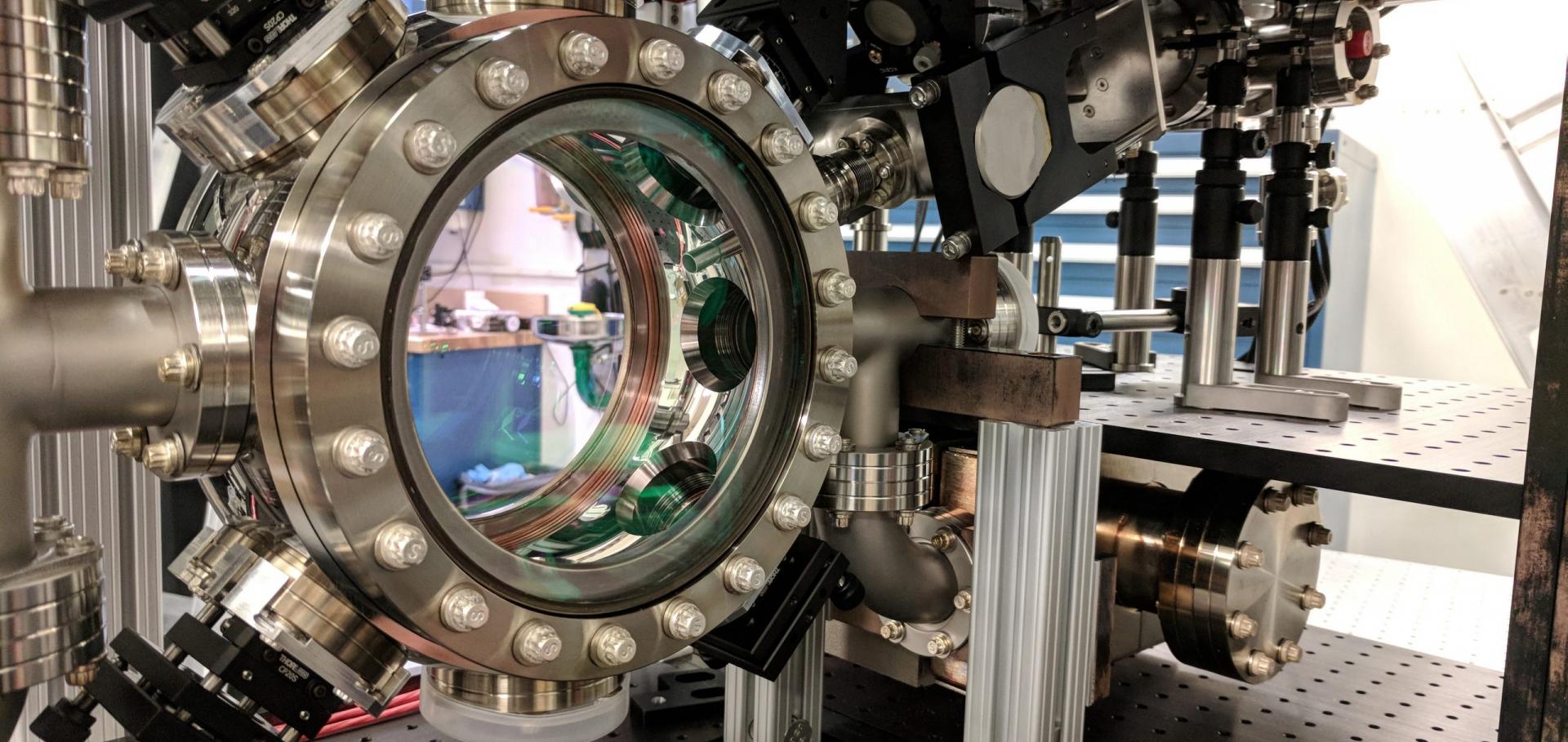
Applying machine learning optimization methods to the production of a quantum gas

Machine Learning: Science and Technology

Authors:

Adam J Barker, Harry Style, Shinichi Sunami, Kathrin Luksch, David Garrick, Felix Hill, Elliot Bentine, Christopher J Foot

Abstract:

We apply three machine learning strategies to optimize the atomic cooling processes utilized in the production of a Bose-Einstein condensate (BEC). For the first time, we optimize both laser cooling and evaporative cooling mechanisms simultaneously. We present the results of an evolutionary optimization method (Differential Evolution), a method based on non-parametric inference (Gaussian Process regression) and a gradient-based function approximator (Artificial Neural Network). Online optimization is performed using no prior knowledge of the apparatus, and the learner succeeds in creating a BEC from completely randomized initial parameters. Optimizing these cooling processes results in a factor of four increase in BEC atom number compared to our manually-optimized parameters. This automated approach can maintain close-to-optimal performance in long-term operation. Furthermore, we show that machine learning techniques can be used to identify the main sources of instability within the apparatus.

Combined CDF and D0 Upper Limits on Standard Model Higgs Boson Production with up to 8.2 fb$^-1$ of Data

Authors:

T Aaltonen, others

Higgs self-coupling measurements using deep learning in the $b\bar{b}b\bar{b}$ final state

The Journal of High Energy Physics Springer Verlag (Germany)

Authors:

Jacob Amacker, William Balunas, Lydia Beresford, Daniela Bortoletto, James Frost, Cigdem Issever, Jesse Liu, James McKee, Alessandro Micheli, Santiago Paredes Saenz, Michael Spannowsky, Beojan Stanislaus

Abstract:

Measuring the Higgs trilinear self-coupling $\lambda_{hhh}$ is experimentally demanding but fundamental for understanding the shape of the Higgs potential. We present a comprehensive analysis strategy for the HL-LHC using di-Higgs events in the four $b$-quark channel ($hh \to 4b$), extending current methods in several directions. We perform deep learning to suppress the formidable multijet background with dedicated optimisation for BSM $\lambda_{hhh}$ scenarios. We compare the $\lambda_{hhh}$ constraining power of events using different multiplicities of large radius jets with a two-prong structure that reconstruct boosted $h \to bb$ decays. We show that current uncertainties in the SM top Yukawa coupling $y_t$ can modify $\lambda_{hhh}$ constraints by $\sim 20\%$. For SM $y_t$, we find prospects of $-0.8 < \lambda_{hhh} / \lambda_{hhh}^\text{SM} < 6.6$ at 68% CL under simplified assumptions for 3000~fb$^{-1}$ of HL-LHC data. Our results provide a careful assessment of di-Higgs identification and machine learning techniques for all-hadronic measurements of the Higgs self-coupling and sharpens the requirements for future improvement.

Inelastic collisions in radiofrequency-dressed mixtures of ultracold atoms

Authors:

Elliot Bentine, Adam J Barker, Kathrin Luksch, Shinichi Sunami, Tiffany L Harte, Ben Yuen, Christopher J Foot, Daniel J Owens, Jeremy M Hutson

Abstract:

Radiofrequency (RF)-dressed potentials are a promising technique for manipulating atomic mixtures, but so far little work has been undertaken to understand the collisions of atoms held within these traps. In this work, we dress a mixture of 85Rb and 87Rb with RF radiation, characterize the inelastic loss that occurs, and demonstrate species-selective manipulations. Our measurements show the loss is caused by two-body 87Rb+85Rb collisions, and we show the inelastic rate coefficient varies with detuning from the RF resonance. We explain our observations using quantum scattering calculations, which give reasonable agreement with the measurements. The calculations consider magnetic fields both perpendicular to the plane of RF polarization and tilted with respect to it. Our findings have important consequences for future experiments that dress mixtures with RF fields.

Quantum Sensors for the Hidden Sector (QSHS) - A Summary of Our First Year!

Authors:

Ian Bailey, Bhaswati Chakraborty, Gemma Chapman, Ed Daw, Ling Hao, Edward Hardy, Edward Laird, Peter Leek, John Gallop, Gianluca Gregori, John March-Russell, Phil Meeson, Clem Mostyn, Yuri Pashkin, Searbhan O Peatain, Mitch Perry, Michele Piscitelli, Edward Romans, Subir Sarkar, Ningqiang Song, Mahesh Soni, Paul Smith, Boon-Kok Tan, Stephen West, Stafford Withington