

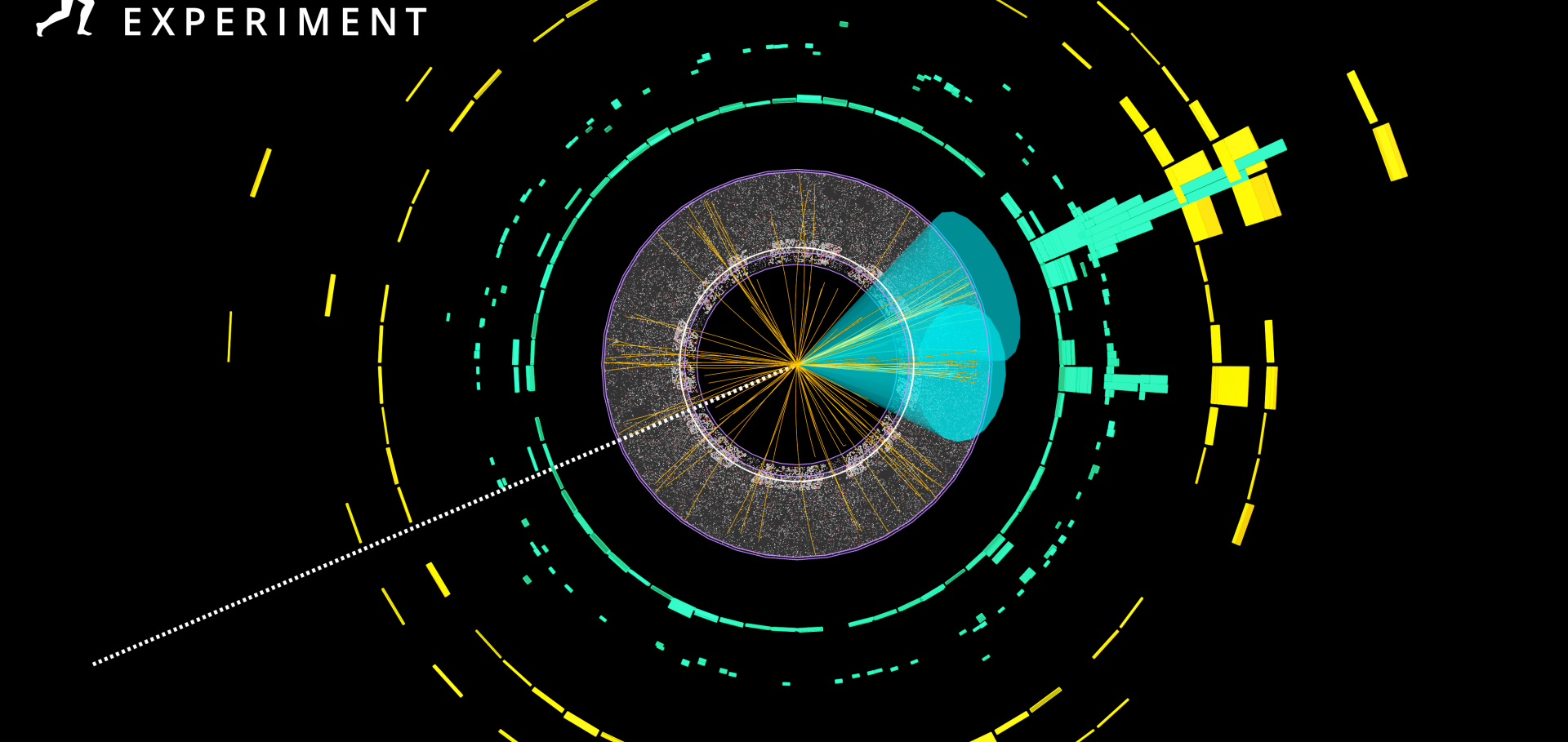
A search for $R$-parity violating supersymmetric decays of the top squark to a $b$-jet and a lepton in $\sqrt{s}$ = 13 TeV $pp$ collisions with the ATLAS detector
ArXiv 2406.18367 (2024)
Development of the radiation-hard MALTA CMOS sensor for tracking applications
Proceedings of Science 448 (2024)
Abstract:
The MALTA family of Depleted Monolithic Active Pixel Sensors (DMAPS) is produced using Tower 180 nm CMOS technology, specifically targeting radiation-hard applications in the HL-LHC and beyond. Several process modifications have resulted in radiation hardness up to 3 × 10¹⁵ 1 MeV neq/cm2 and time resolution below 2 ns, with uniform charge collection efficiency across the chip formed of 512 × 224 pixels with a size of 36.4 × 36.4 μm2. This is achieved when adopting high-resistivity Czochralski substrates with backside metallisation to obtain a good propagation of the bias voltage. This contribution will show the most recent results obtained on MALTA2 chip demonstrators, including signal efficiency, noise occupancy and time resolution, at different levels of irradiation as well as the performance of the MALTA telescope permanently installed at the SPS at CERN and used in the test beam campaign in 2021-2023.The ATLAS trigger system for LHC Run 3 and trigger performance in 2022
Journal of Instrumentation IOP Publishing 19:06 (2024) P06029
Abstract:
The ATLAS trigger system is a crucial component of the ATLAS experiment at the LHC. It is responsible for selecting events in line with the ATLAS physics programme. This paper presents an overview of the changes to the trigger and data acquisition system during the second long shutdown of the LHC, and shows the performance of the trigger system and its components in the proton-proton collisions during the 2022 commissioning period as well as its expected performance in proton-proton and heavy-ion collisions for the remainder of the third LHC data-taking period (2022–2025).A Benchmarking of QCD Evolution at Approximate $N^3LO$
(2024)
Combination of searches for Higgs boson pair production in $pp$ collisions at $\sqrt{s}=13$ TeV with the ATLAS detector
ArXiv 2406.09971 (2024)