

Charge calibration of MALTA2, a radiation hard depleted monolithic active pixel sensor
ArXiv 2501.13562 (2025)
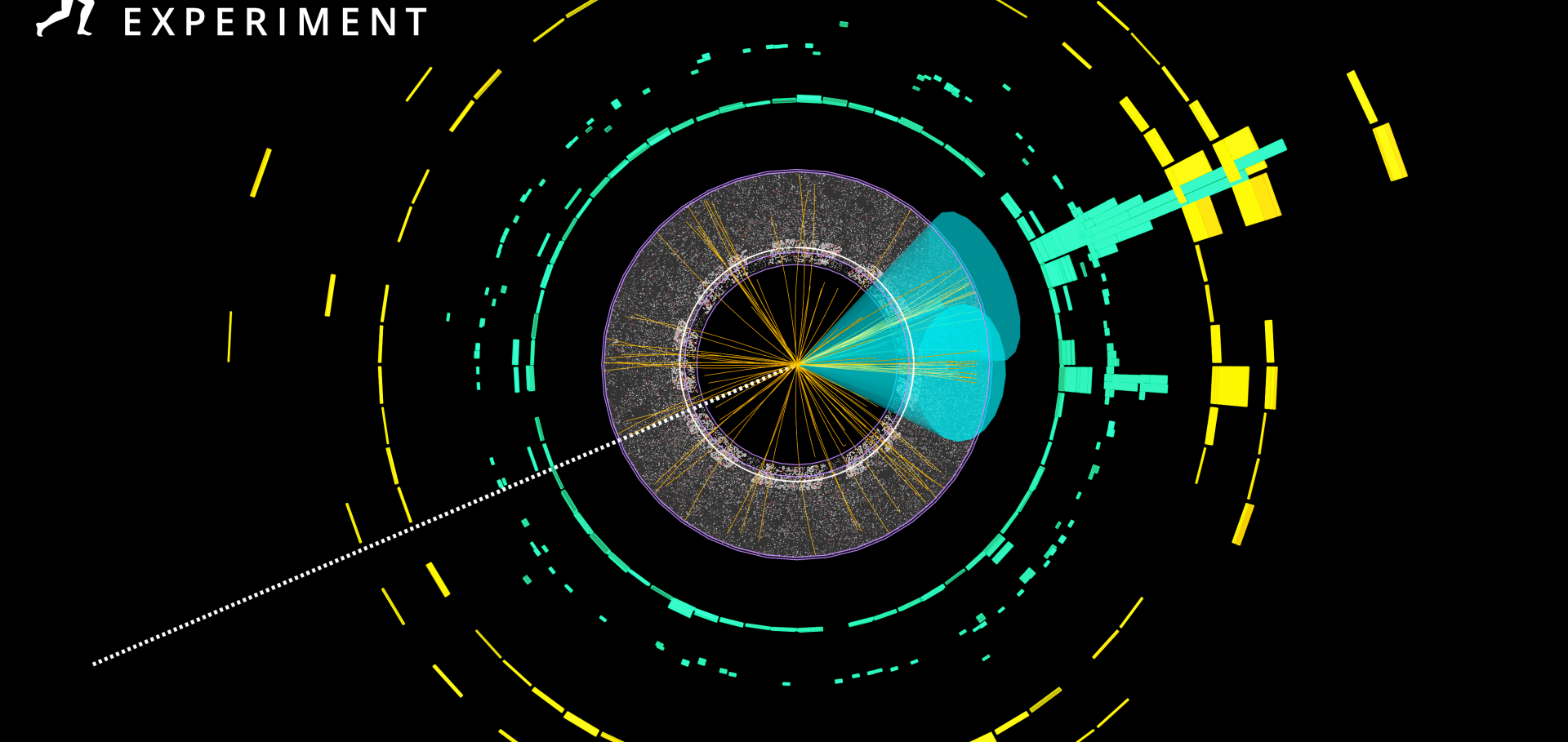
Search for boosted low-mass resonances decaying into hadrons produced in association with a photon in pp collisions at s = 13 TeV with the ATLAS detector
Journal of High Energy Physics Springer 2025:1 (2025) 99
Abstract:
Many extensions of the Standard Model, including those with dark matter particles, propose new mediator particles that decay into hadrons. This paper presents a search for such low mass narrow resonances decaying into hadrons using 140 fb−1 of proton-proton collision data recorded with the ATLAS detector at a centre-of-mass energy of 13 TeV. The resonances are searched for in the invariant mass spectrum of large-radius jets with two-pronged substructure that are recoiling against an energetic photon from initial state radiation, which is used as a trigger to circumvent limitations on the maximum data recording rate. This technique enables the search for boosted hadronically decaying resonances in the mass range 20–100 GeV hitherto unprobed by the ATLAS Collaboration. The observed data are found to agree with Standard Model predictions and 95% confidence level upper limits are set on the coupling of a hypothetical new spin-1 Z′ resonance with Standard Model quarks as a function of the assumed Z′-boson mass in the range between 20 and 200 GeV.Configuration, Performance, and Commissioning of the ATLAS $b$-jet Triggers for the 2022 and 2023 LHC data-taking periods
ArXiv 2501.1142 (2025)
Repeating Partial Tidal Encounters of Sun-like Stars Leading to Their Complete Disruption
The Astrophysical Journal American Astronomical Society 979:1 (2025) 40
Abstract:
Stars grazing supermassive black holes on bound orbits may produce periodic flares over many passages, known as repeating partial tidal disruption events (TDEs). Here, we present 3D hydrodynamic simulations of Sun-like stars over multiple tidal encounters. The star is significantly restructured and becomes less concentrated as a result of mass loss and tidal heating. The vulnerability to mass loss depends sensitively on the stellar density structure, and the strong correlation between the fractional mass loss ΔM/M* and the ratio of the central and average density ρc/ρ¯ , which was initially derived in disruption simulations of main-sequence stars, also applies for stars strongly reshaped by tides. Over multiple orbits, the star loses progressively more mass in each encounter and is doomed to a complete disruption. Throughout its lifetime, the star may produce numerous weak flares (depending on the initial impact parameter), followed by a couple of luminous flares whose brightness increases exponentially. Flux-limited surveys are heavily biased toward the brightest flares, which may appear similar to the flare produced by the same star undergoing a full disruption on its first tidal encounter. This places new challenges on constraining the intrinsic TDE rates, which need to take repeating TDEs into account. Other types of stars with different initial density structures (e.g., evolved stars with massive cores) follow distinct evolution tracks, which might explain the diversity of the long-term luminosity evolution seen in recently uncovered repeaters.Measurement of t t ¯ production in association with additional b -jets in the eμ final state in proton–proton collisions at s = 13 TeV with the ATLAS detector
Journal of High Energy Physics Springer 2025:1 (2025) 68