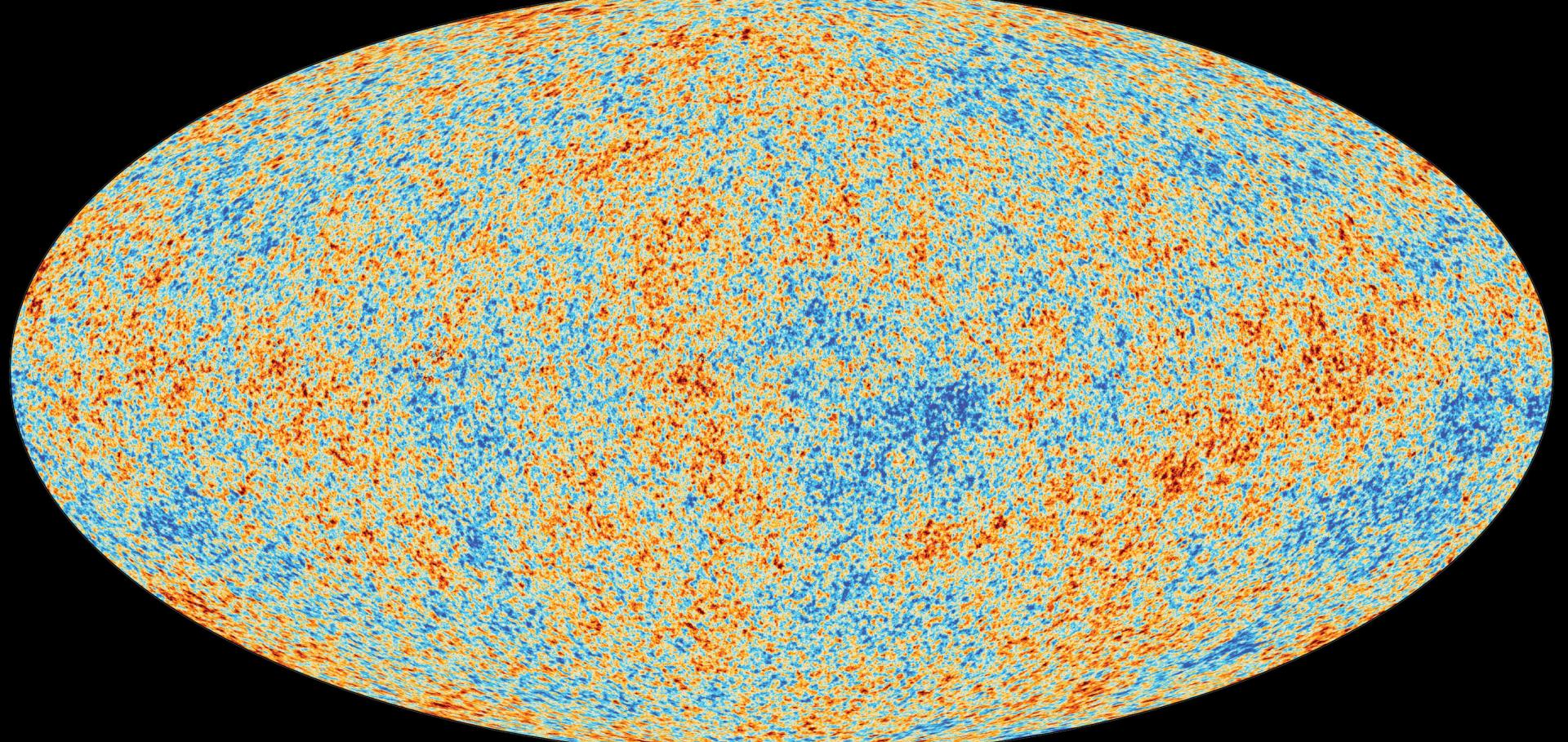
Cosmology from Maxima-1, Boomerang and COBE/DMR CMB Observations

ArXiv astro-ph/0007333 (2000)

Authors:

AH Jaffe, PAR Ade, A Balbi, JJ Bock, JR Bond, J Borrill, A Boscaleri, K Coble, BP Crill, P de Bernardis, P Farese, PG Ferreira, K Ganga, M Giacometti, S Hanany, E Hivon, VV Hristov, A Iacoangeli, AE Lange, AT Lee, L Martinis, S Masi, PD Mauskopf, A Melchiorri, T Montroy, CB Netterfield, S Oh, E Pascale, F Piacentini, D Pogosyan, S Prunet, B Rabii, S Rao, PL Richards, G Romeo, JE Ruhl, F Scaramuzzi, D Sforna, GF Smoot, R Stompor, CD Winant, JHP Wu

Abstract:

Recent results from BOOMERANG-98 and MAXIMA-1, taken together with COBE-DMR, provide consistent and high signal-to-noise measurements of the CMB power spectrum at spherical harmonic multipole bands over $2<\ell\lta800$. Analysis of the combined data yields 68% (95%) confidence limits on the total density, $\Omega_{\rm {tot}}\simeq 1.11 \pm 0.07 (^{+0.13}_{-0.12})$, the baryon density, $\Omega_b h^2\simeq 0.032^{+0.005}_{-0.004} (^{+0.009}_{-0.008})$, and the scalar spectral tilt, $n_s\simeq1.01^{+0.09}_{-0.07} (^{+0.17}_{-0.14})$. These data are consistent with inflationary initial conditions for structure formation. Taken together with other cosmological observations, they imply the existence of both non-baryonic dark matter and dark energy in the universe.

Asymmetric Beams in Cosmic Microwave Background Anisotropy Experiments

(2000)

Authors:

JHP Wu, A Balbi, J Borrill, PG Ferreira, S Hanany, AH Jaffe, AT Lee, S Oh, B Rabii, PL Richards, GF Smoot, R Stompor, CD Winant

Asymmetric Beams in Cosmic Microwave Background Anisotropy Experiments

ArXiv astro-ph/0007212 (2000)

Authors:

JHP Wu, A Balbi, J Borrill, PG Ferreira, S Hanany, AH Jaffe, AT Lee, S Oh, B Rabii, PL Richards, GF Smoot, R Stompor, CD Winant

Abstract:

We propose a new formalism to handle asymmetric beams in the data analysis of cosmic microwave background anisotropy experiments. For any beam shape, the formalism finds the optimal circularly symmetric equivalent and is thus easily adaptable to existing data analysis methods. We demonstrate certain key points by using a simulated highly elliptic beam, and the beams and data of the MAXIMA-1 experiment, where the asymmetry is mild. In particular, we show that in both cases the formalism does not bias the angular power spectrum estimates. We analyze the limitations of the formalism and find that it is well suited for most practical situations.

Constraints on Cosmological Parameters from MAXIMA-1

(2000)

Authors:

A Balbi, P Ade, J Bock, J Borrill, A Boscaleri, P de Bernardis, PG Ferreira, S Hanany, VV Hristov, AH Jaffe, AT Lee, S Oh, E Pascale, B Rabii, PL Richards, GF Smoot, R Stompor, CD Winant, JHP Wu

Constraints on Cosmological Parameters from MAXIMA-1

ArXiv astro-ph/0005124 (2000)

Authors:

A Balbi, P Ade, J Bock, J Borrill, A Boscaleri, P de Bernardis, PG Ferreira, S Hanany, VV Hristov, AH Jaffe, AT Lee, S Oh, E Pascale, B Rabii, PL Richards, GF Smoot, R Stompor, CD Winant, JHP Wu

Abstract:

We set new constraints on a seven-dimensional space of cosmological parameters within the class of inflationary adiabatic models. We use the angular power spectrum of the cosmic microwave background measured over a wide range of \ell in the first flight of the MAXIMA balloon-borne experiment (MAXIMA-1) and the low \ell results from COBE/DMR. We find constraints on the total energy density of the universe, \Omega=1.0^{+0.15}_{-0.30}, the physical density of baryons, \Omega_{b}h^2=0.03 +/- 0.01, the physical density of cold dark matter, \Omega_{cdm}h^2=0.2^{+0.2}_{-0.1}$, and the spectral index of primordial scalar fluctuations, n_s=1.08+/-0.1, all at the 95% confidence level. By combining our results with measurements of high-redshift supernovae we constrain the value of the cosmological constant and the fractional amount of pressureless matter in the universe to 0.45<\Omega_\Lambda<0.75 and 0.25<\Omega_{m}<0.50, at the 95% confidence level. Our results are consistent with a flat universe and the shape parameter deduced from large scale structure, and in marginal agreement with the baryon density from big bang nucleosynthesis.