

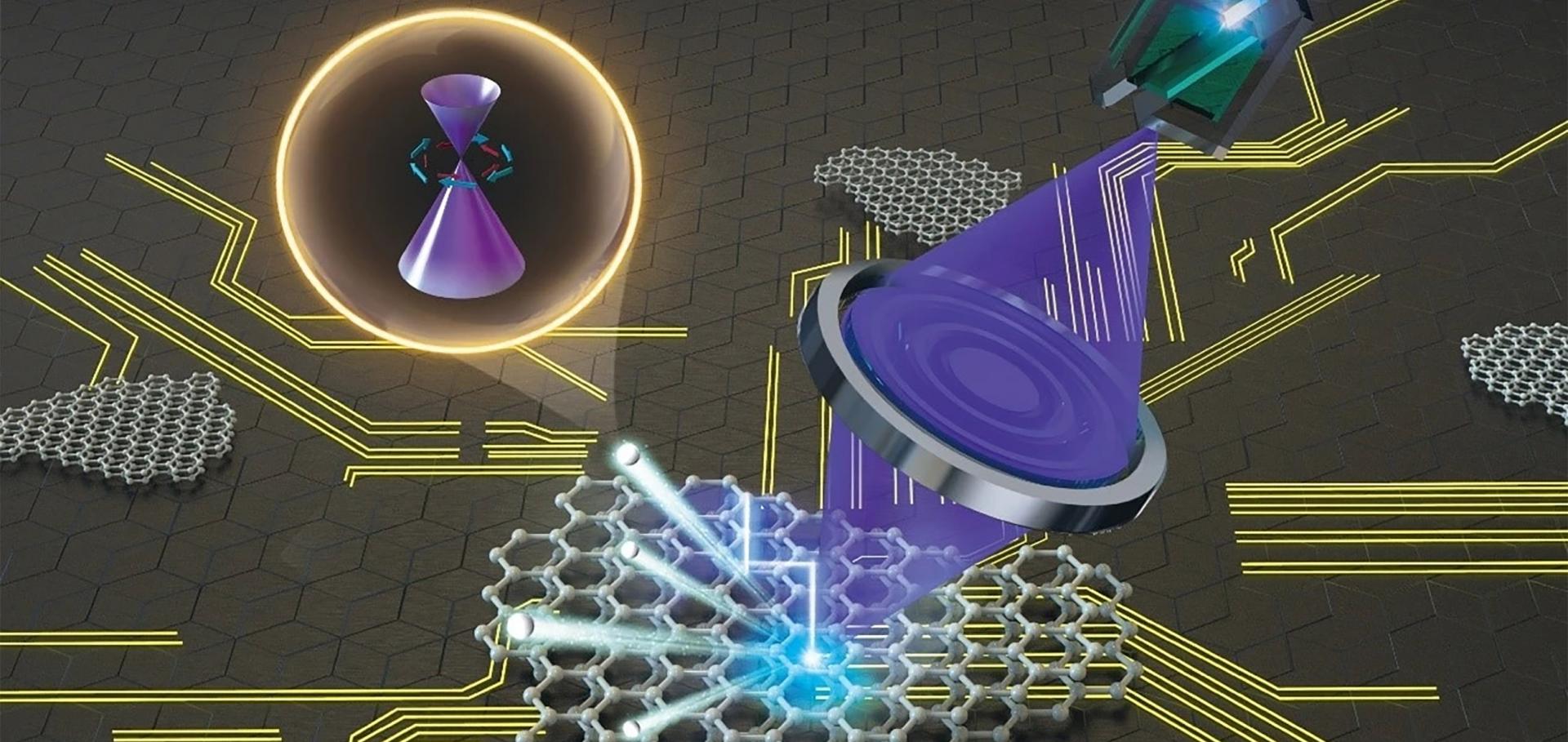
Pressure‐Induced Superconductivity and Topological Quantum Phase Transitions in the Topological Semimetal ZrTe2
Advanced Science Wiley 10:35 (2023) 2301332
Anomalous excitonic phase diagram in band-gap-tuned Ta2Ni(Se,S)5
Nature Communications Nature Research 14:1 (2023) 7512
Abstract:
During a band-gap-tuned semimetal-to-semiconductor transition, Coulomb attraction between electrons and holes can cause spontaneously formed excitons near the zero-band-gap point, or the Lifshitz transition point. This has become an important route to realize bulk excitonic insulators -- an insulating ground state distinct from single-particle band insulators. How this route manifests from weak to strong coupling is not clear. In this work, using angle-resolved photoemission spectroscopy (ARPES) and high-resolution synchrotron x-ray diffraction (XRD), we investigate the broken symmetry state across the semimetal-to-semiconductor transition in a leading bulk excitonic insulator candidate system Ta2Ni(Se,S)5. A broken symmetry phase is found to be continuously suppressed from the semimetal side to the semiconductor side, contradicting the anticipated maximal excitonic instability around the Lifshitz transition. Bolstered by first-principles and model calculations, we find strong interband electron-phonon coupling to play a crucial role in the enhanced symmetry breaking on the semimetal side of the phase diagram. Our results not only provide insight into the longstanding debate of the nature of intertwined orders in Ta2NiSe5, but also establish a basis for exploring band-gap-tuned structural and electronic instabilities in strongly coupled systems.Comment: 27 pages, 4 + 9 figureWafer-Scale Epitaxial Growth of the Thickness-Controllable Van Der Waals Ferromagnet CrTe2 for Reliable Magnetic Memory Applications
Advanced Functional Materials (2023)
Abstract:
To harness the intriguing properties of 2D van der Waals (vdW) ferromagnets (FMs) for versatile applications, the key challenge lies in the reliable material synthesis for scalable device production. Here, the epitaxial growth of single-crystalline 1T-CrTe2 thin films on 2-inch sapphire substrates are demonstrated. Benefiting from the uniform surface energy of the dangling bond-free Al2O3(0001) surface, the layer-by-layer vdW growth mode is observed right from the initial growth stage, which warrants precise control of the sample thickness beyond three monolayer and homogeneous surface morphology across the entire wafer. Moreover, the presence of the Coulomb interaction at the CrTe2/Al2O3 interface plays an important role in tailoring the anomalous Hall response, and the structural optimization of the CrTe2-based spin-orbit torque device leads to a substantial switching power reduction by 54%. The results may lay out a general framework for the design of energy-efficient spintronics based on configurable vdW FMs.Orbital-selective charge-density wave in TaTe4
npj Quantum Materials Springer Nature 8:1 (2023) 44
Twist-Induced Modification in the Electronic Structure of Bilayer WSe2
Nano Letters American Chemical Society (ACS) 23:15 (2023) 7008-7013