The atmospheric dynamics and habitability of temperate sub-Neptunes

Abstract:

Sub-Neptunes are a subset of exoplanets that lie between the Earth and Neptune in size, have no solar system analogue and yet are one of the most common types of exoplanet in the galaxy. Some sub-Neptunes receive a similar level of stellar flux as Earth, making their atmospheres potentially cool enough to contain liquid water. The aim of this thesis is to simulate the atmospheres of these temperate sub-Neptunes and develop theories describing their atmospheric dynamics and potential habitability. I use a general circulation model to simulate the atmospheres of a range of dry, temperate sub-Neptunes. I show that their atmospheres are governed by horizontal weak temperature gradients over a broad range of parameter space. Their circulation is dominated by high-latitude jets, but heat is transported from the dayside to the nightside by a residual overturning circulation. I derive a scaling theory to link the strength of this circulation to the instellation. Next, I calculate the inner edge of the habitable zone for sub-Neptunes with a water surface – “Hycean worlds”. Using a 1D radiative-convective model, I show that compositional gradients induced by the condensation of water inhibit convection in a hydrogendominated atmosphere. The resulting temperature structures heat the surface and lead to the inner edge of the habitable zone moving outwards compared to traditional calculations. Lastly, I develop a general circulation model for use in hydrogen-dominated atmospheres with a non-dilute water vapour component. I demonstrate the model’s ability to simulate a range of sub-Neptune atmospheres with different deep water contents reaching as high as 70% of the atmosphere by mass. Future work can build on this model to understand how latent heating and compositional gradients impact the observable features and habitability of sub-Neptune exoplanets.

The temporal brightening of Uranus’ northern polar hood from HST/WFC3 & HST/STIS observations

Authors:

Arjuna James, Patrick GJ Irwin, Jack Dobinson, Michael H Wong, Troy K Tsubota, Amy Simon, Leigh N Fletcher, Michael Thomas Roman, Nicholas Teanby, Daniel Toledo, Glenn S Orton

Third report on sub-millimetre spectra of Jupiter

Transitions in the cloud composition of hot Jupiters

The Astrophysical Journal American Astronomical Society

Authors:

Vivien Parmentier, Jonathan J Fortney, Adam P Showman, Caroline V Morley, Mark S Marley

Abstract:

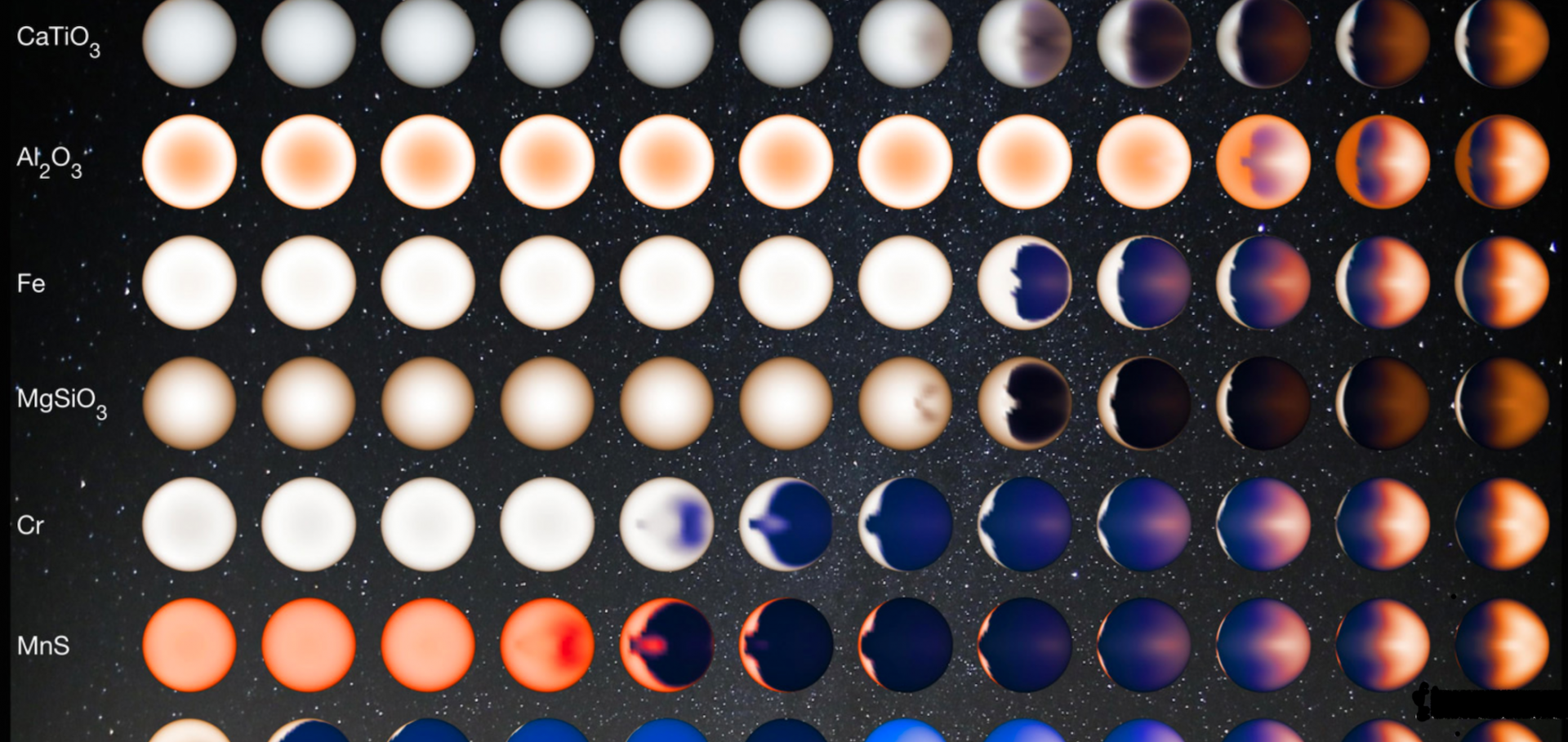
Over a large range of equilibrium temperatures, clouds shape the transmission spectrum of hot Jupiter atmospheres, yet their composition remains unknown. Recent observations show that the Kepler lightcurves of some hot Jupiters are asymmetric: for the hottest planets, the lightcurve peaks before secondary eclipse, whereas for planets cooler than $\sim1900\rm\,K$, it peaks after secondary eclipse. We use the thermal structure from 3D global circulation models to determine the expected cloud distribution and Kepler lightcurves of hot Jupiters. We demonstrate that the change from an optical lightcurve dominated by thermal emission to one dominated by scattering (reflection) naturally explains the observed trend from negative to positive offset. For the cool planets the presence of an asymmetry in the Kepler lightcurve is a telltale sign of the cloud composition, because each cloud species can produce an offset only over a narrow range of effective temperatures. By comparing our models and the observations, we show that the cloud composition of hot Jupiters likely varies with equilibrium temperature. We suggest that a transition occurs between silicate and manganese sulfide clouds at a temperature near $1600\rm\,K$, analogous to the L/T transition on brown dwarfs. The cold trapping of cloud species below the photosphere naturally produces such a transition and predicts similar transitions for other condensates, including TiO. We predict that most hot Jupiters should have cloudy nightsides, that partial cloudiness should be common at the limb and that the dayside hot spot should often be cloud-free.

Variation in Neptune's Mid-Infrared Emission from Ground Based Imaging

AAS Planetary Science Journal

Authors:

Michael T Roman, Leigh N Fletcher, Glenn S Orton, Naomi Rowe-Gurney, Julianne Moses, Thomas Greathouse, James Sinclair, Arrate Antunano, Patrick GJ Irwin, Yasumasa Kasaba, Takuya Fuhiyoshi, James Blake