Radial-velocity fitting challenge II. First results of the analysis of the data set
ASTRONOMY & ASTROPHYSICS 598 (2017) ARTN A133
Discovery of water at high spectral resolution in the atmosphere of 51 Peg b
(2017)
K2-99: a subgiant hosting a transiting warm Jupiter in an eccentric orbit and a long-period companion
Monthly Notices of the Royal Astronomical Society Oxford University Press (OUP) 464:3 (2017) 2708-2716
A consistent retrieval analysis of 10 hot Jupiters observed in transmission
Astrophysical Journal American Astronomical Society 834:1 (2017) 50
Abstract:
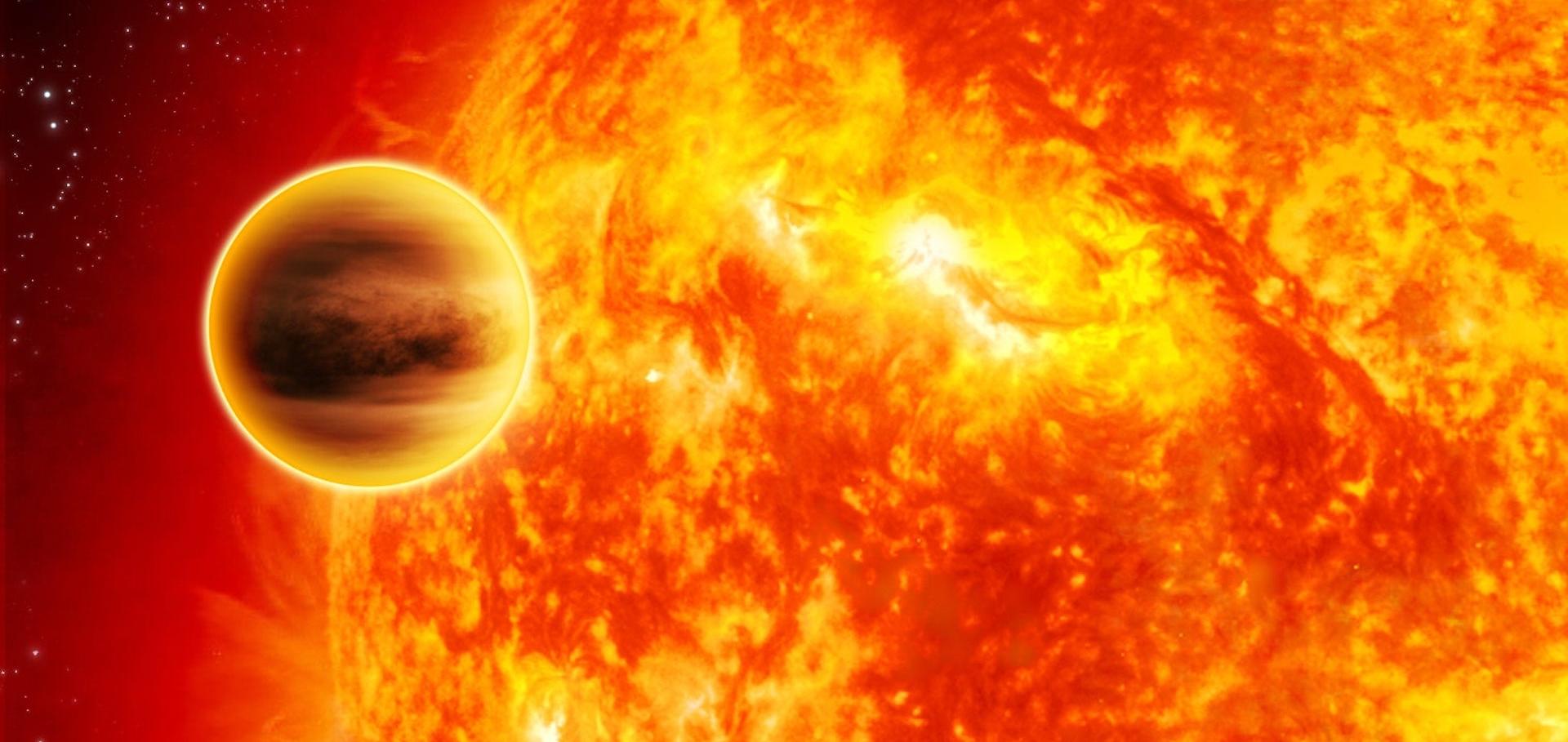
We present a consistent optimal estimation retrieval analysis of 10 hot Jupiter exoplanets, each with transmission spectral data spanning the visible to near-infrared wavelength range. Using the NEMESIS radiative transfer and retrieval tool, we calculate a range of possible atmospheric states for WASP-6b, WASP-12b, WASP-17b, WASP-19b, WASP-31b, WASP-39b, HD 189733b, HD 209458b, HAT-P-1b, and HAT-P-12b. We find that the spectra of all 10 planets are consistent with the presence of some atmospheric aerosol; WASP-6b, WASP-12b, WASP-17b, WASP-19b, HD 189733b, and HAT-P-12b are all fit best by Rayleigh scattering aerosols, whereas WASP-31b, WASP-39b and HD 209458b are better represented by a gray cloud model. HAT-P-1b has solutions that fall into both categories. WASP-6b, HAT-P-12b, HD 189733b, and WASP-12b must have aerosol extending to low atmospheric pressures (below 0.1 mbar). In general, planets with equilibrium temperatures between 1300 and 1700 K are best represented by deeper, gray cloud layers, whereas cooler or hotter planets are better fit using high Rayleigh scattering aerosol. We find little evidence for the presence of molecular absorbers other than H2O. Retrieval methods can provide a consistent picture across a range of hot Jupiter atmospheres with existing data, and will be a powerful tool for the interpretation of James Webb Space Telescope observations.A fast machine learning based algorithm for MKID readout power tuning
ISSTT 2017 - 28th International Symposium on Space Terahertz Technology 2017-March (2017)