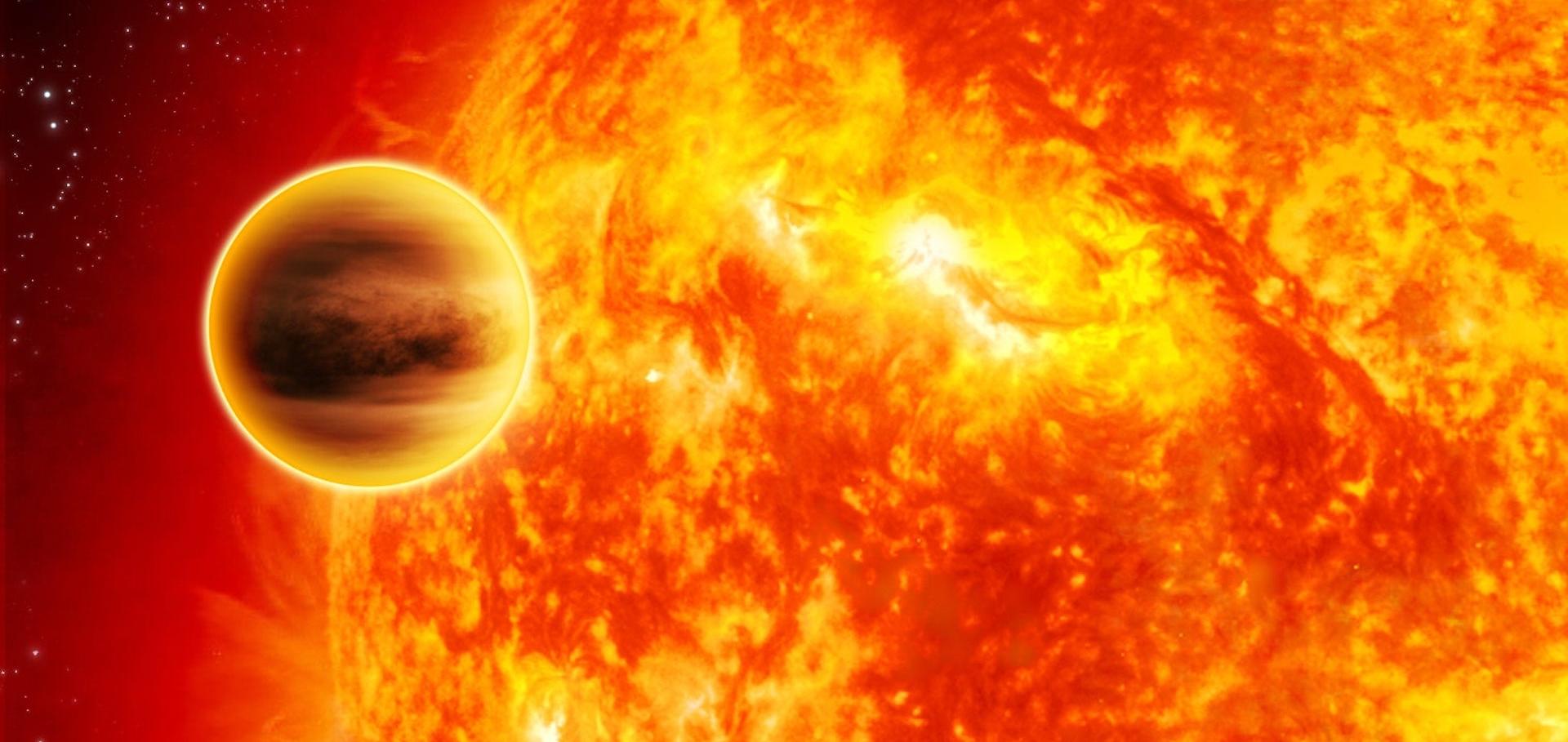
From Pretransit to Posteclipse: Investigating the Impact of 3D Temperature, Chemistry, and Dynamics on High-resolution Emission Spectra of the Ultrahot Jupiter WASP-76b
Abstract:
Hot Rocks Survey II. The thermal emission of TOI-1468 b reveals a bare hot rock
Abstract:
The aim of the Hot Rocks Survey programme is to determine whether exoplanets can retain secondary atmospheres in the presence of M dwarf hosts. In the sample of nine exoplanets in the programme, we aim to determine whether TOI-1468 b has a substantial atmosphere or is consistent with a low-albedo bare rock.
The James Webb Space Telescope provides an opportunity to characterise the thermal emission with MIRI at 15 μm. The occultation of TOI-1468 b was observed three times. We compared our observations to atmospheric models that include varying amounts of CO2 and H2O.
The observed occultation depths for the individual visits are 239±52 ppm, 341±53 ppm, and 357±52 ppm. A joint fit yields an occultation depth of 311±31 ppm. The thermal emission is mostly consistent with no atmosphere and a zero Bond albedo at a confidence level of 1.65σ, or a blackbody at a brightness temperature of 1024 ± 78 K. A pure CO2 or H2O atmosphere with a surface pressure above 1 bar is ruled out at higher than 3σ.
Surprisingly, the surface of TOI-1468 b is marginally hotter than expected. This indicates an additional source of energy on the planet. This source might originate from a temperature inversion or induction heating, or it might be an instrumental artefact. The results within the Hot Rocks Survey build on the legacy of studying the atmospheres of exoplanets around M dwarfs. The outcome of this survey will prove useful to the large-scale survey of M dwarfs that was recently approved by the STScI.
JWST NIRISS transmission spectroscopy of the super-Earth GJ 357b, a favourable target for atmospheric retention
Abstract:
We present a JWST Near Infrared Imager and Slitless Spectrograph/Single Object Slitless Spectroscopy transmission spectrum of the super-Earth GJ 357 b: the first atmospheric observation of this exoplanet. Despite missing the first 40 per cent of the transit due to using an out-of-date ephemeris, we still recover a transmission spectrum that does not display any clear signs of atmospheric features. We perform a search for Gaussian-shaped absorption features within the data but find that this analysis yields comparable fits to the observations as a flat line. We compare the transmission spectrum to a grid of atmosphere models and reject, to 3 confidence, atmospheres with metallicities solar (4 g mol−1) with clouds at pressures down to 0.01 bar. We analyse how the retention of a secondary atmosphere on GJ 357 b may be possible due to its higher escape velocity compared to an Earth-sized planet and the exceptional inactivity of its host star relative to other M2.5V stars. The star’s XUV luminosity decays below the threshold for rapid atmospheric escape early enough that the volcanic revival of an atmosphere of several bars of CO is plausible, though subject to considerable uncertainty. Finally, we model the feasibility of detecting an atmosphere on GJ 357 b with MIRI/LRS, MIRI photometry, and NIRSpec/G395H. We find that, with two eclipses, it would be possible to detect features indicative of an atmosphere or surface. Further to this, with three to four transits, it would be possible to detect a 1 bar nitrogen-rich atmosphere with 1000 ppm of CO.Supermassive black hole mass measurement in the spiral galaxy NGC 4736 using JWST/NIRSpec stellar kinematics
Abstract:
We present accurate mass measurements of the central supermassive black hole (SMBH) in NGC 4736 (M 94). We used the “gold-standard” stellar absorption features (CO band heads) at ∼2.3 μm, as opposed to gas emission lines, to trace the dynamics in the nuclear region, easily resolving the SMBH’s sphere of influence. The analysis uses observations made with the integral field unit of the Near-Infrared Spectrograph (NIRSpec) on the James Webb Space Telescope and a surface brightness profile derived from Hubble Space Telescope archival images. We used Jeans anisotropic models within a Bayesian framework, and comprehensive Markov chain Monte Carlo optimization, to determine the best-fit black hole mass, orbital anisotropy, mass-to-light ratio, and nucleus kinematical inclination. We obtained a SMBH mass MBH = (1.60 ± 0.16)×107 M⊙ (1σ random error), which is consistent with the MBH–σ and MBH–M⋆ relations. This is the first dynamical measurement of a MBH in NGC 4736 based on the stellar kinematics observed with NIRSpec. We thus settle a longstanding inconsistency between estimates based on nuclear emission-line tracers and the MBH–σ relation. Our analysis shows that NIRSpec can detect SMBHs with MBH, min ≈ 5 × 10⁶ M⊙ in galaxies within 5 Mpc and σ ≈ 100 km s−1.