

A Moderate Albedo from Reflecting Aerosols on the Dayside of WASP-80 b Revealed by JWST/NIRISS Eclipse Spectroscopy
Astronomical Journal American Astronomical Society 169:5 (2025) 277
Abstract:
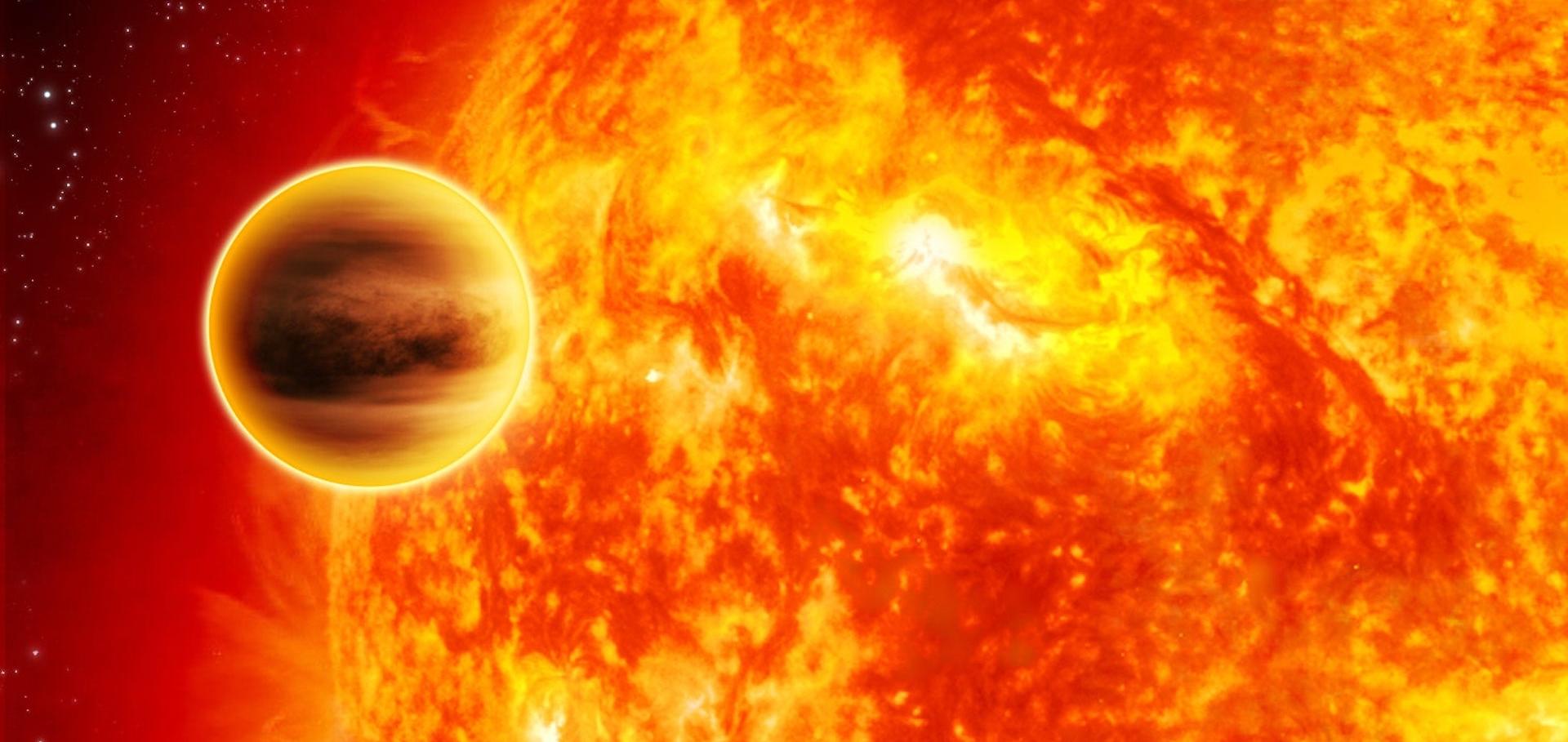
Secondary eclipse observations of exoplanets at near-infrared wavelengths enable the detection of thermal emission and reflected stellar light, providing insights into the thermal structure and aerosol composition of their atmospheres. These properties are intertwined as aerosols influence the energy budget of the planet. WASP-80 b is a warm gas giant with an equilibrium temperature of 825 K orbiting a bright late-K/early-M dwarf, and for which the presence of aerosols in its atmosphere has been suggested from previous Hubble Space Telescope and Spitzer observations. We present an eclipse spectrum of WASP-80 b obtained with JWST NIRISS/SOSS, spanning 0.68–2.83 μm, which includes the first eclipse measurements below 1.1 μm for this exoplanet, extending our ability to probe light reflected by its atmosphere. When a reflected light geometric albedo is included in the atmospheric retrieval, our eclipse spectrum is best explained by a reflected light contribution of ∼30 ppm at short wavelengths, although further observations are needed to statistically confirm this preference. We measure a dayside brightness temperature of TB=811−70+69 K and constrain the reflected light geometric albedo across the SOSS wavelength range to Ag=0.204−0.056+0.051 , allowing us to estimate a 1σ range for the Bond albedo of 0.148 ≲ AB ≲ 0.383. By comparing our spectrum with aerosol models, we find that manganese sulfide and silicate clouds are disfavored, while cloud species with weak-to-moderate near-infrared reflectance, along with soots or low formation-rate tholin hazes, are consistent with our eclipse spectrum.Are there Spectral Features in the MIRI/LRS Transmission Spectrum of K2-18b?
ArXiv 2504.15916 (2025)
The PLATO mission
Experimental Astronomy Springer 59:3 (2025) 26
Abstract:
PLATO (PLAnetary Transits and Oscillations of stars) is ESA’s M3 mission designed to detect and characterise extrasolar planets and perform asteroseismic monitoring of a large number of stars. PLATO will detect small planets (down to <2REarth) around bright stars (<11 mag), including terrestrial planets in the habitable zone of solar-like stars. With the complement of radial velocity observations from the ground, planets will be characterised for their radius, mass, and age with high accuracy (5%, 10%, 10% for an Earth-Sun combination respectively). PLATO will provide us with a large-scale catalogue of well-characterised small planets up to intermediate orbital periods, relevant for a meaningful comparison to planet formation theories and to better understand planet evolution. It will make possible comparative exoplanetology to place our Solar System planets in a broader context. In parallel, PLATO will study (host) stars using asteroseismology, allowing us to determine the stellar properties with high accuracy, substantially enhancing our knowledge of stellar structure and evolution. The payload instrument consists of 26 cameras with 12cm aperture each. For at least four years, the mission will perform high-precision photometric measurements. Here we review the science objectives, present PLATO‘s target samples and fields, provide an overview of expected core science performance as well as a description of the instrument and the mission profile towards the end of the serial production of the flight cameras. PLATO is scheduled for a launch date end 2026. This overview therefore provides a summary of the mission to the community in preparation of the upcoming operational phases.Low 4.5 μ m Dayside Emission Disfavors a Dark Bare-rock Scenario for the Hot Super-Earth TOI-431 b
Astronomical Journal American Astronomical Society 169:5 (2025) 239
Abstract:
The full range of conditions under which rocky planets can host atmospheres remains poorly understood, especially in the regime of close-in orbits around late-type stars. One way to assess the presence of atmospheres on rocky exoplanets is to measure their dayside emission as they are eclipsed by their host stars. Here, we present Spitzer observations of the 4.5 μm secondary eclipses of the rocky super-Earth TOI-431 b, whose mass and radius indicate an Earth-like bulk composition (3.07 ± 0.35 M⊕, 1.28 ± 0.04 R⊕). Exposed to more than 2000 times the irradiation of Earth, dayside temperatures of up to 2400 K are expected if the planet is a dark bare rock without a significant atmosphere. Intriguingly, despite the strong stellar insolation, we measure a secondary-eclipse depth of only 33 ± 22 ppm, which corresponds to a dayside brightness temperature of 1520−390+360 K. This notably low eclipse depth disagrees with the dark bare-rock scenario at the 2.5σ level, and suggests either that the planet is surrounded by an atmosphere or that it is a bare rock with a highly reflective surface. In the atmosphere scenario, the low dayside emission implies the efficient redistribution of heat to the nightside, or by molecular absorption in the 4–5 μm bandpass. In the bare-rock scenario, a surface composition made of a high-albedo mineral species such as ultramafic rock can lead to reduced thermal emission consistent with low eclipse depth measurement. Follow-up spectroscopic observations with the James Webb Space Telescope hold the key to constraining the nature of the planet.A JWST Panchromatic Thermal Emission Spectrum of the Warm Neptune Archetype GJ 436b
The Astrophysical Journal Letters American Astronomical Society 982:2 (2025) l39