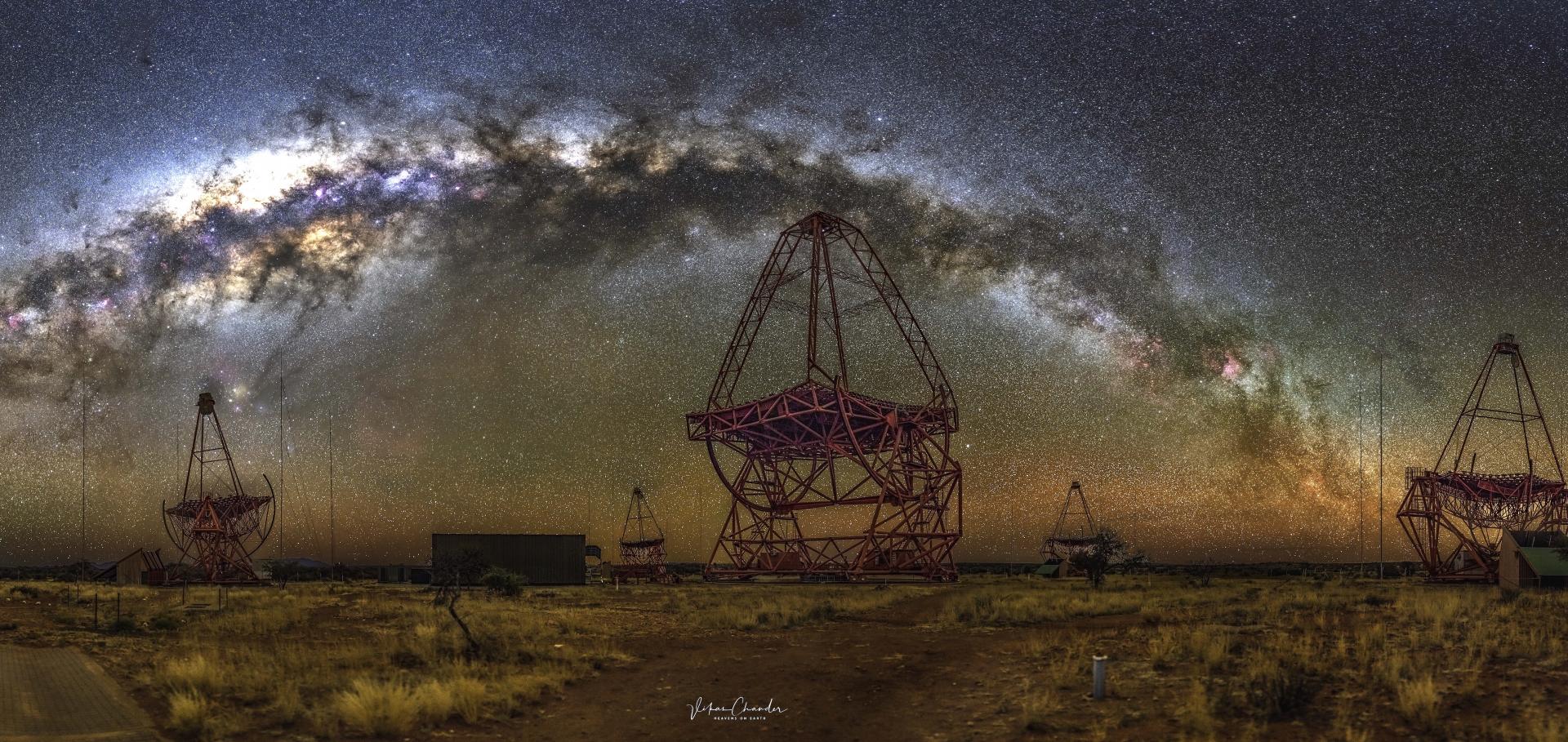
SALT and VLT spectroscopy of the VHE flat-spectrum radio quasar PKS 0903–57

Sissa Medialab Srl (2025) 033

Authors:

Eli Kasai, Paolo Goldoni, Catherine Boisson, Santiago Pita, Filippo D'Ammando, Walter Max-Moerbeck, Michael Backes, Garret Cotter

Kinematics show consistency between stellar mass and supermassive black hole parent population jet speeds

(2025)

Authors:

Clara Lilje, Rob Fender, James H Matthews

The Radio Flare and Multiwavelength Afterglow of the Short GRB 231117A: Energy Injection from a Violent Shell Collision

The Astrophysical Journal American Astronomical Society 994:1 (2025) 5-5

Authors:

GE Anderson, GP Lamb, BP Gompertz, L Rhodes, A Martin-Carrillo, AJ van der Horst, A Rowlinson, ME Bell, T-W Chen, HM Fausey, M Ferro, PJ Hancock, SR Oates, S Schulze, RLC Starling, S Yang, K Ackley, JP Anderson, A Andersson, JF Agüí Fernández, R Brivio, E Burns, KC Chambers, T de Boer, V D’Elia, M De Pasquale, A de Ugarte Postigo, Dimple, R Fender, MD Fulton, H Gao, JH Gillanders, DA Green, M Gromadzki, A Gulati, DH Hartmann, ME Huber, NJ Klingler, NPM Kuin, JK Leung, AJ Levan, C-C Lin, E Magnier, DB Malesani, P Minguez, KP Mooley, T Mukherjee, M Nicholl, PT O’Brien, G Pugliese, A Rossi, SD Ryder, B Sbarufatti, B Schneider, F Schüssler, SJ Smartt, KW Smith, S Srivastav, D Steeghs, NR Tanvir, CC Thoene, SD Vergani, RJ Wainscoat, Z-N Wang, RAMJ Wijers, D Williams-Baldwin, I Worssam, T Zafar

Abstract:

Abstract We present the early radio detection and multiwavelength modeling of the short gamma-ray burst (GRB) 231117A at redshift z = 0.257. The Australia Telescope Compact Array automatically triggered a 9 hr observation of GRB 231117A at 5.5 and 9 GHz following its detection by the Neil Gehrels Swift Observatory just 1.3 hr post-burst. Splitting this observation into 1 hr time bins, the early radio afterglow exhibited flaring, scintillating and plateau phases. The scintillation allowed us to place the earliest upper limit (<10 hr) on the size of a GRB blast wave to date, constraining it to <1 × 10 16 cm. Multiwavelength modeling of the full afterglow required a period of significant energy injection between ∼0.02 and 1 day. The energy injection was modeled as a violent collision of two shells: a reverse shock passing through the injection shell explains the early radio plateau, while an X-ray flare is consistent with a shock passing through the leading impulsive shell. Beyond 1 day, the blast wave evolves as a classic decelerating forward shock with an electron distribution index of p  = 1.66 ± 0.01. Our model also indicates a jet break at ∼2 days, and a half-opening angle of θ j = 16 . ° 6 ± 1 . ° 1 . Following the period of injection, the total energy is ζ  ∼ 18 times the initial impulsive energy, with a final collimation-corrected energy of E Kf  ∼ 5.7 × 10 49 erg. The minimum Lorentz factors this model requires are consistent with constraints from the early radio measurements of Γ > 35 to Γ > 5 between ∼0.1 and 1 day. These results demonstrate the importance of rapid and sensitive radio follow-up of GRBs for exploring their central engines and outflow behaviour.

Unprecedentedly bright X-ray flaring in Cygnus X-1 observed by INTEGRAL

Astronomy & Astrophysics EDP Sciences 703 (2025) A109-A109

Authors:

P Thalhammer, T Bouchet, J Rodriguez, F Cangemi, K Pottschmidt, DA Green, L Rhodes, C Ferrigno, MA Nowak, V Grinberg, T Siegert, P Laurent, I Kreykenbohm, M Perucho, J Tomsick, C Sánchez-Fernández, J Wilms

Abstract:

We study three extraordinarily bright X-ray flares originating from Cyg X-1 seen on July 10, 2023, detected with INTEGRAL. The flares had a duration on the order of only ten minutes each, and within seconds reached a 1–100 keV peak luminosity of 1.1 − 2.6 × 10 38  erg s −1 . The associated INTEGRAL/IBIS count rate was approximately ten times higher than usual for the hard state. To our knowledge, this is the first time that such strong flaring has been seen in Cyg X-1, despite the more than 21 years of INTEGRAL monitoring – with almost ∼20 Ms of exposure – and the similarly deep monitoring with RXTE/PCA from 1997 to 2012. The flares were seen in all three X-ray and γ -ray instruments of INTEGRAL. Radio monitoring by the AMI Large Array with observations 6 h before and 40 h after the X-ray flares did not detect a corresponding increase in radio flux. The shape of the X-ray spectrum shows only marginal change during the flares, i.e., photon index and cut-off energy are largely preserved. The overall flaring behavior points toward a sudden and brief release of energy either due to the ejection of material in an unstable jet or due to the interaction of the jet with the ambient clumpy stellar wind.

A multi-wavelength view of the outflowing short-period X-ray binary UW CrB

Monthly Notices of the Royal Astronomical Society Oxford University Press (OUP) (2025) staf1790

Authors:

S Fijma, N Degenaar, N Castro Segura, TJ Maccarone, C Knigge, M Armas Padilla, D Mata Sánchez, T Muñoz-Darias, JV Hernández Santisteban, L Rhodes, J Bright, J van den Eijnden, DA Green

Abstract:

Abstract Previous work detected transient ultraviolet outflow features for the short-period (Porb ≈ 111 min), low-mass X-ray binary (LMXB) UW CrB, suggesting the presence of a disc wind in the system. However, because of the transient nature of the outflow features, and the limited amount of data available, the features were challenging to interpret. To follow up on this work, we present a comprehensive multi-wavelength campaign on UW CrB. We observe complex phenomenology and find several features that could be naturally interpreted as being associated with a persistent disc wind. Moreover, we identify a blue-shifted absorption in the Hβ line during one of the epochs, which might be the signature of such an outflow. We present an X-ray to radio campaign of the source, discuss our results in the context of accretion disc wind outflows, present a ‘toy model’ interpretation of the outflow scattering the X-ray emission into our line of sight, and explore the implications for binary evolution models. If correct, our preferred scenario of a persistent disc wind suggests that mass transfer for LMXBs can be non-conservative down to short orbital periods, and thereby opens an important parameter space for angular momentum loss in compact binaries.