

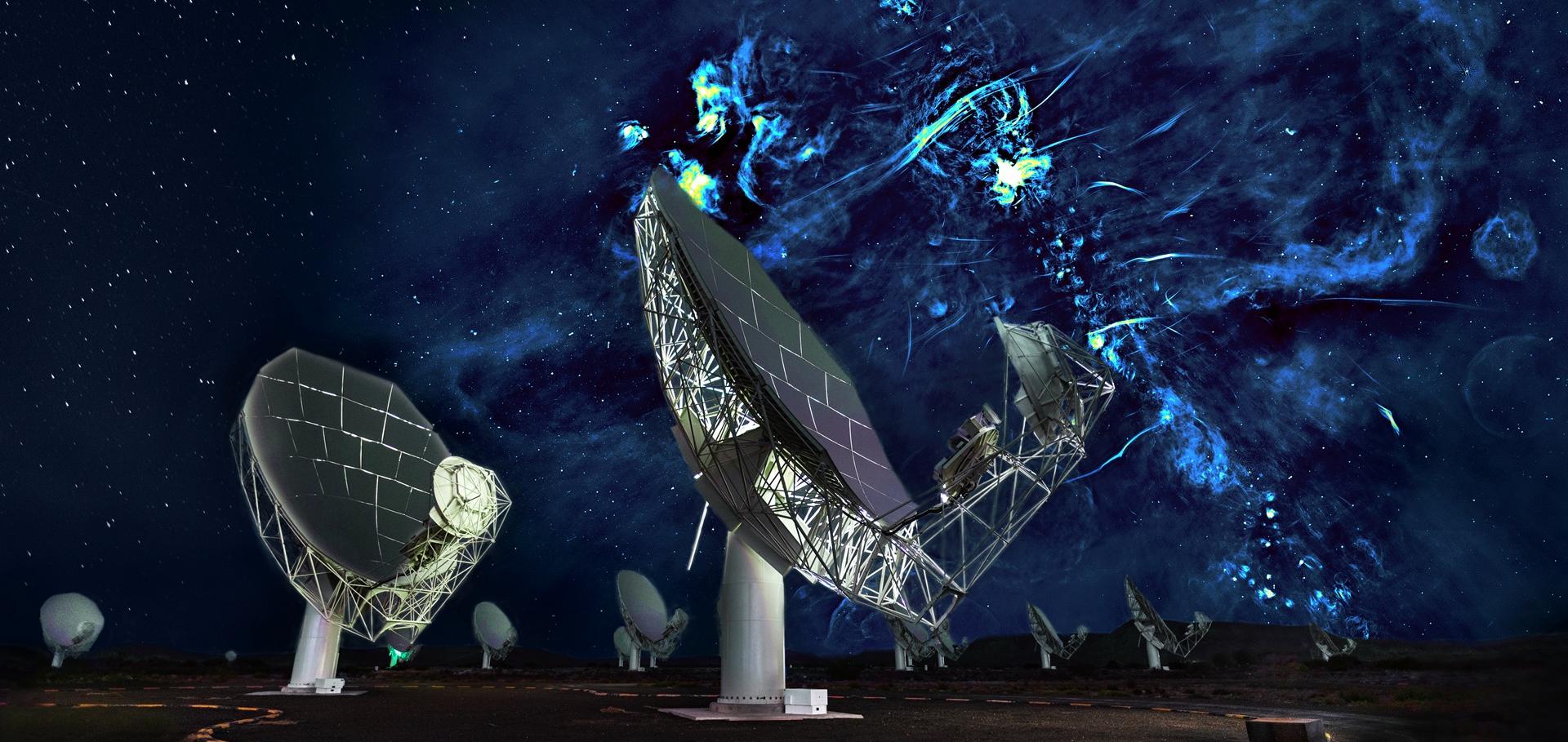
The discovery of a z=0.7092 OH megamaser with the MIGHTEE survey
Monthly Notices of the Royal Astronomical Society Oxford University Press 529:4 (2023) 3484-3494
Abstract:
We present the discovery of the most distant OH megamaser to be observed in the main lines, using data from the MeerKAT International Giga-Hertz Tiered Extragalactic Exploration (MIGHTEE) survey. At a newly measured redshift of 𝑧 = 0.7092, the system has strong emission in both the 1665 MHz (𝐿 ≈ 2500 L⊙) and 1667 MHz (𝐿 ≈ 4.5×10⁴ L⊙) transitions, with both narrow and broad components. We interpret the broad line as a high-velocity-dispersion component of the 1667 MHz transition, with velocity 𝑣 ∼ 330 km s−1 with respect to the systemic velocity. The host galaxy has a stellar mass of 𝑀★ = 2.95 × 10¹⁰ M⊙ and a star-formation rate of SFR = 371 M⊙ yr−1 , placing it ∼ 1.5 dex above the main sequence for star-forming galaxies at this redshift, and can be classified as an ultra-luminous infrared galaxy. Alongside the optical imaging data, which exhibits evidence for a tidal tail, this suggests that the OH megamaser arises from a system that is currently undergoing a merger, which is stimulating star formation and providing the necessary conditions for pumping the OH molecule to saturation. The OHM is likely to be lensed, with a magnification factor of ∼ 2.5, and perhaps more if the maser emitting region is compact and suitably offset relative to the centroid of its host galaxy’s optical light. This discovery demonstrates that spectral line mapping with the new generation of radio interferometers may provide important information on the cosmic merger history of galaxies.The discovery of a z=0.7092 OH megamaser with the MIGHTEE survey
(2023)
Filling the radio transients gap
Astronomy & Geophysics Oxford University Press (OUP) 64:6 (2023) 6.24-6.30
The dense and non-homogeneous circumstellar medium revealed in radio wavelengths around the Type Ib SN 2019oys
(2023)
Bayesian Imaging for Radio Interferometry with Score-Based Priors
ArXiv 2311.18012 (2023)