

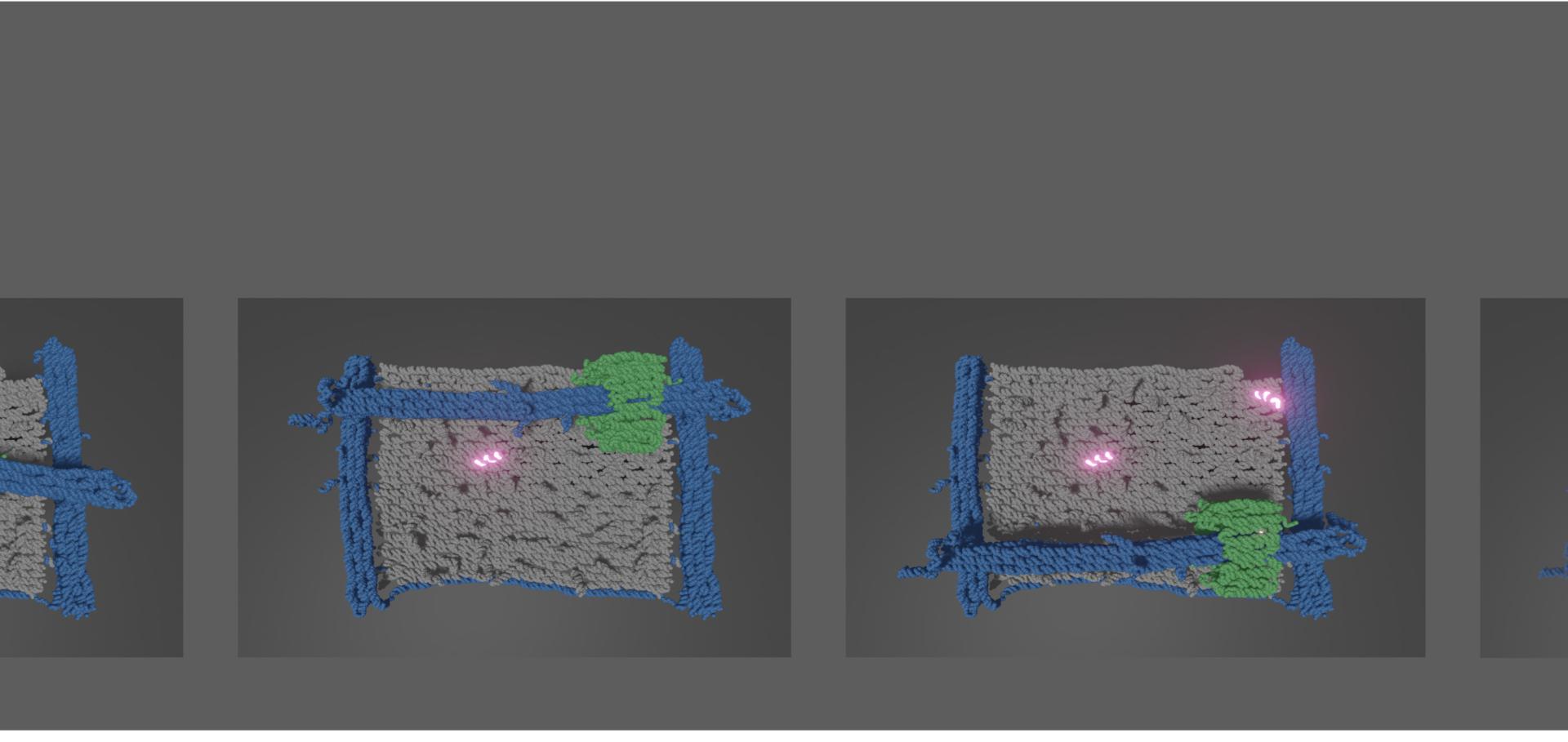
Direct observation of stepwise movement of a synthetic molecular transporter.
Nat Nanotechnol 6:3 (2011) 166-169
Abstract:
Controlled motion at the nanoscale can be achieved by using Watson-Crick base-pairing to direct the assembly and operation of a molecular transport system consisting of a track, a motor and fuel, all made from DNA. Here, we assemble a 100-nm-long DNA track on a two-dimensional scaffold, and show that a DNA motor loaded at one end of the track moves autonomously and at a constant average speed along the full length of the track, a journey comprising 16 consecutive steps for the motor. Real-time atomic force microscopy allows direct observation of individual steps of a single motor, revealing mechanistic details of its operation. This precisely controlled, long-range transport could lead to the development of systems that could be programmed and routed by instructions encoded in the nucleotide sequences of the track and motor. Such systems might be used to create molecular assembly lines modelled on the ribosome.Remote toehold: A mechanism for flexible control of DNA hybridization kinetics
Journal of the American Chemical Society 133:7 (2011) 2177-2182
Abstract:
Hybridization of DNA strands can be used to build molecular devices, and control of the kinetics of DNA hybridization is a crucial element in the design and construction of functional and autonomous devices. Toehold-mediated strand displacement has proved to be a powerful mechanism that allows programmable control of DNA hybridization. So far, attempts to control hybridization kinetics have mainly focused on the length and binding strength of toehold sequences. Here we show that insertion of a spacer between the toehold and displacement domains provides additional control: modulation of the nature and length of the spacer can be used to control strand-displacement rates over at least 3 orders of magnitude. We apply this mechanism to operate displacement reactions in potentially useful kinetic regimes: the kinetic proofreading and concentration-robust regimes. © 2011 American Chemical Society.Remote toehold: a mechanism for flexible control of DNA hybridization kinetics.
J Am Chem Soc 133:7 (2011) 2177-2182
Abstract:
Hybridization of DNA strands can be used to build molecular devices, and control of the kinetics of DNA hybridization is a crucial element in the design and construction of functional and autonomous devices. Toehold-mediated strand displacement has proved to be a powerful mechanism that allows programmable control of DNA hybridization. So far, attempts to control hybridization kinetics have mainly focused on the length and binding strength of toehold sequences. Here we show that insertion of a spacer between the toehold and displacement domains provides additional control: modulation of the nature and length of the spacer can be used to control strand-displacement rates over at least 3 orders of magnitude. We apply this mechanism to operate displacement reactions in potentially useful kinetic regimes: the kinetic proofreading and concentration-robust regimes.DNA-templated protein arrays for single-molecule imaging.
Nano Lett 11:2 (2011) 657-660
Abstract:
Single-particle electron cryomicroscopy permits structural characterization of noncrystalline protein samples, but throughput is limited by problems associated with sample preparation and image processing. Three-dimensional density maps are reconstructed from high resolution but noisy images of individual molecules. We show that self-assembled DNA nanoaffinity templates can create dense, nonoverlapping arrays of protein molecules, greatly facilitating data collection. We demonstrate this technique using a G-protein-coupled membrane receptor, a soluble G-protein, and a signaling complex of both molecules.A cascade of DNA strand displacements using toehold-mediated exchange
7th Annual Conference on Foundations of Nanoscience: Self-Assembled Architectures and Devices, FNANO 2010 (2010) 55