A family of steady, translating vortex pairs with distributed vorticity

Journal of Fluid Mechanics Cambridge University Press (CUP) 99:1 (1980) 129-144

2 AND 3 DIMENSIONAL INSTABILITIES OF A SPATIALLY PERIODIC SHEAR-LAYER

BULLETIN OF THE AMERICAN PHYSICAL SOCIETY 25:9 (1980) 1085-1085

Authors:

RT PIERREHUMBERT, SE WIDNALL

Assimilation of both column- and layer-integrated dust opacity observations in the Martian atmosphere

Authors:

Peter L Read, Tao Ruan, Roland MB Young, Stephen Lewis, Luca Montabone, Alexandru Valeanu

Baroclinic and barotropic instabilities in planetary atmospheres - energetics, equilibration and adjustment

Authors:

Peter Read, Neil Lewis, Daniel Kennedy, Hélène Scolan, Fachreddin Tabataba-Vakili, Yixiong Wang, Susie Wright, Roland Young

Beyond runaway: initiation of the post-runaway greenhouse state on rocky exoplanets

Astrophysical Journal IOP Publishing

Authors:

Ryan Boukrouche, Tim Lichtenberg, Raymond Pierrehumbert

Abstract:

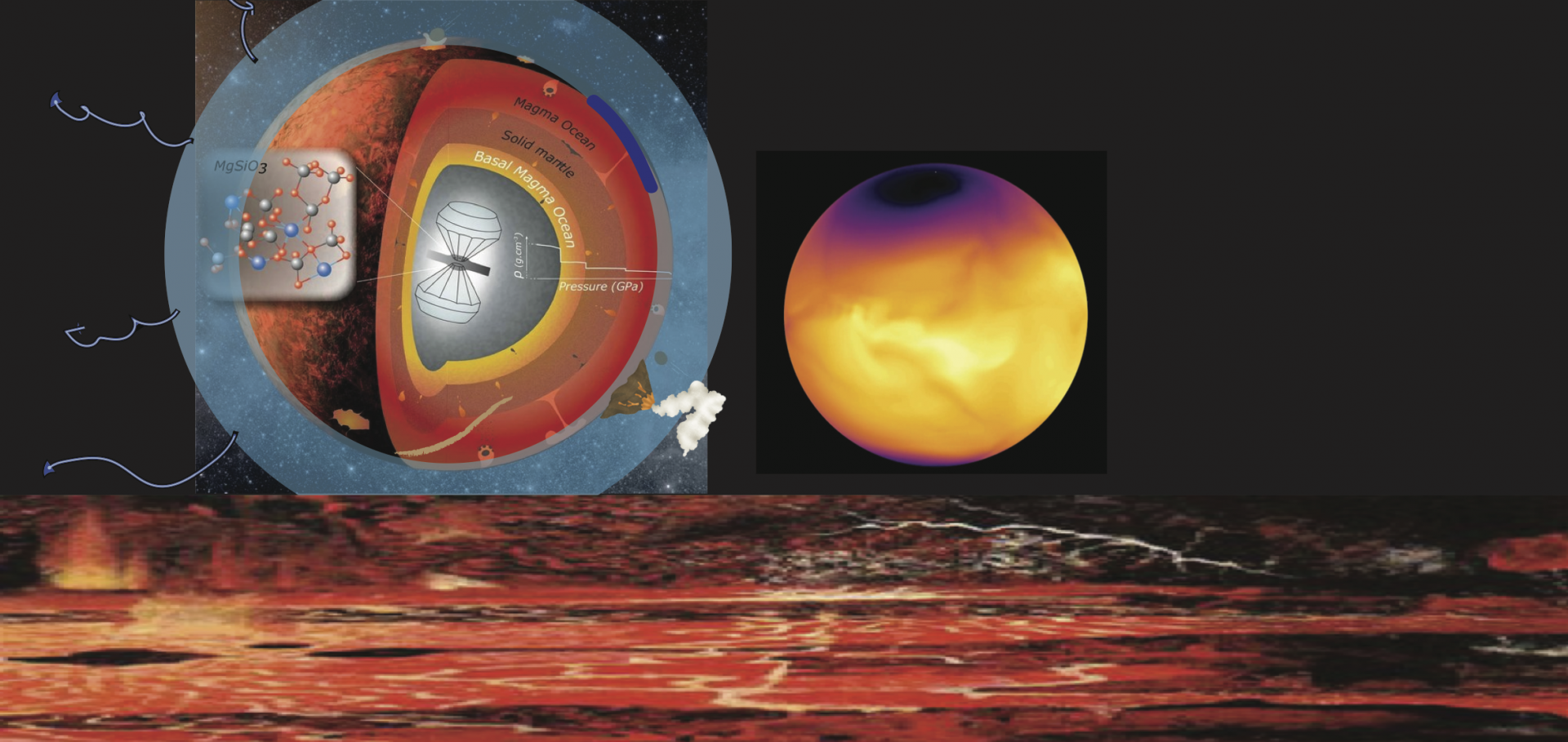
The runaway greenhouse represents the ultimate climate catastrophe for rocky, Earth-like worlds: when the incoming stellar flux cannot be balanced by radiation to space, the oceans evaporate and exacerbate heating, turning the planet into a hot wasteland with a steam atmosphere overlying a possibly molten magma surface. The equilibrium state beyond the runaway greenhouse instellation limit depends on the radiative properties of the atmosphere and its temperature structure. Here, we use 1-D radiative-convective models of steam atmospheres to explore the transition from the tropospheric radiation limit to the post-runaway climate state. To facilitate eventual simulations with 3-D global circulation models, a computationally efficient band-grey model is developed, which is capable of reproducing the key features of the more comprehensive calculations. We analyze two factors which determine the equilibrated surface temperature of post-runaway planets. The infrared cooling of the planet is strongly enhanced by the penetration of the dry adiabat into the optically thin upper regions of the atmosphere. In addition, thermal emission of both shortwave and near-IR fluxes from the hot lower atmospheric layers, which can radiate through window regions of the spectrum, is quantified. Astronomical surveys of rocky exoplanets in the runaway greenhouse state may discriminate these features using multi-wavelength observations.