Ice-shelf damming in the glacial Arctic Ocean: dynamical regimes of a basin-covering kilometre thick ice shelf

Authors:

Johan Nilsson, Martin Jakobsson, Chris Borstad, Nina Kirchner, Göran Björk, Raymond T Pierrehumbert, Christian Stranne

QUAGMIRE v1.3: a quasi-geostrophic model for investigating rotating fluids experiments

Authors:

PD Williams, TWN Haine, PL Read, SR Lewis, YH Yamazaki

The atmospheric dynamics and habitability of temperate sub-Neptunes

Abstract:

Sub-Neptunes are a subset of exoplanets that lie between the Earth and Neptune in size, have no solar system analogue and yet are one of the most common types of exoplanet in the galaxy. Some sub-Neptunes receive a similar level of stellar flux as Earth, making their atmospheres potentially cool enough to contain liquid water. The aim of this thesis is to simulate the atmospheres of these temperate sub-Neptunes and develop theories describing their atmospheric dynamics and potential habitability. I use a general circulation model to simulate the atmospheres of a range of dry, temperate sub-Neptunes. I show that their atmospheres are governed by horizontal weak temperature gradients over a broad range of parameter space. Their circulation is dominated by high-latitude jets, but heat is transported from the dayside to the nightside by a residual overturning circulation. I derive a scaling theory to link the strength of this circulation to the instellation. Next, I calculate the inner edge of the habitable zone for sub-Neptunes with a water surface – “Hycean worlds”. Using a 1D radiative-convective model, I show that compositional gradients induced by the condensation of water inhibit convection in a hydrogendominated atmosphere. The resulting temperature structures heat the surface and lead to the inner edge of the habitable zone moving outwards compared to traditional calculations. Lastly, I develop a general circulation model for use in hydrogen-dominated atmospheres with a non-dilute water vapour component. I demonstrate the model’s ability to simulate a range of sub-Neptune atmospheres with different deep water contents reaching as high as 70% of the atmosphere by mass. Future work can build on this model to understand how latent heating and compositional gradients impact the observable features and habitability of sub-Neptune exoplanets.

Toward More Realistic Simulation and Prediction of Dust Storms on Mars

Authors:

Claire E Newman, Tanguy Bertrand, Joseph Battalio, Mackenzie Day, Manuel de la Torre Juarez, Meredith K Elrod, Francesca Esposito, Lori K Fenton, Claus Gebhardt, Steven J Greybush, Scott D Guzewich, Melinda A Kahre, Henrik Kahanpää, Özgür Karatekin, Brian Jackson, Mathieu Lapotre, Christopher Lee, Stephen R Lewis, Ralph D Lorenz, Germán Martínez Martínez, Javier Martin-Torres, Michael A Mischna, Luca Montabone, Lynn Neakrase, Alexey Pankine, Jorge Pla-Garcia, Peter L Read, Isaac B Smith, Michael D Smith, Alejandro Soto, Aymeric Spiga, Christy Swann, Leslie Tamppari, Orkun Temel, Daniel Viúdez Moreiras, Danika Wellington, Paulina Wolkenberg, Gerhard Wurm, María-Paz Zorzano

What happened to rocky planets?

Abstract:

A satisfactory model describing why Earth, Venus, and Mars, differ so substantially is yet to be described; centuries of planetary science have yielded insightful - but incomplete - explanations. Meanwhile, observations of planets beyond the Solar System are revealing novel environments which raise challenges to our existing theories.

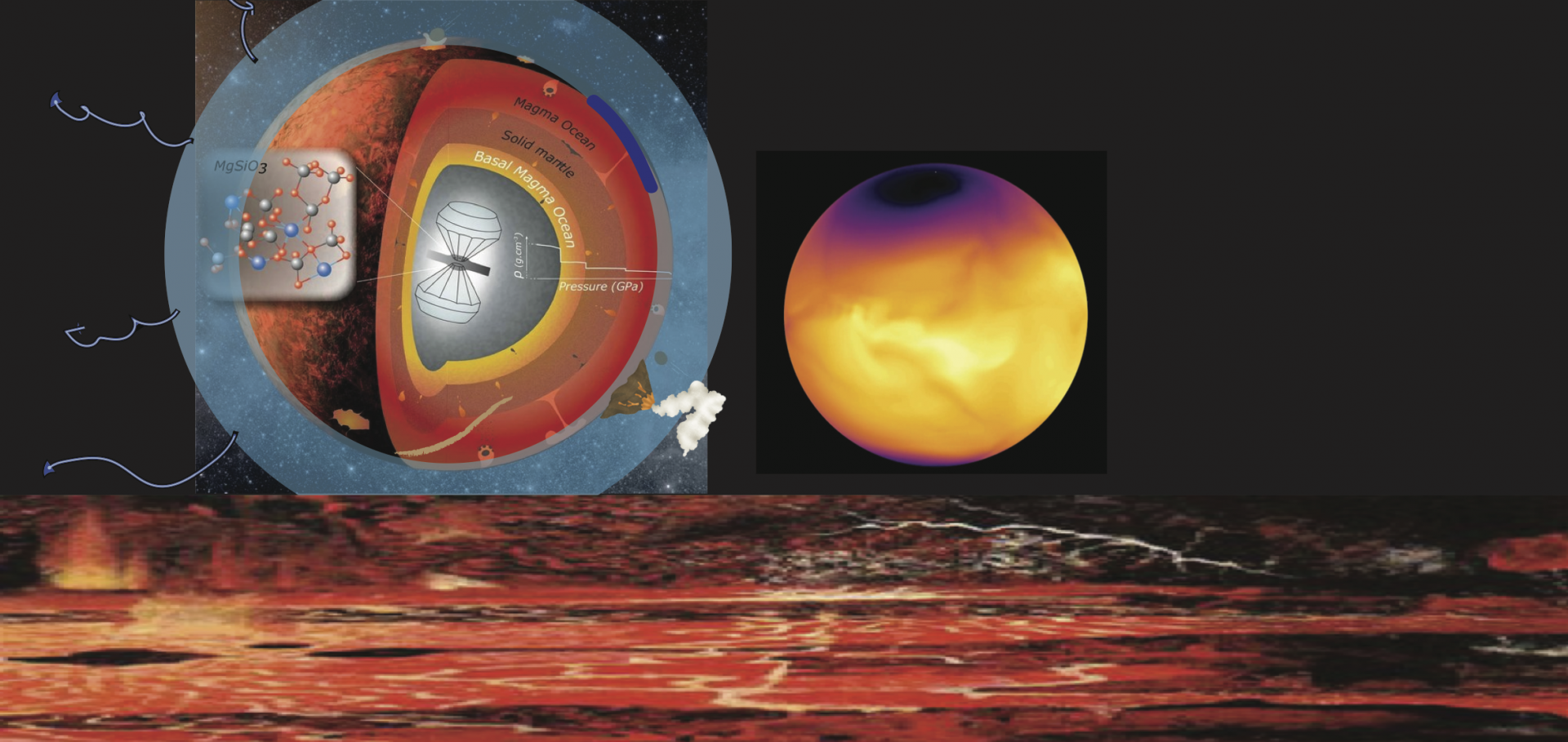
Multiple lines of evidence suggest the presence of 'magma oceans' early in rocky planets' lifetimes. During these important natal periods, planet-scale feedbacks emerge via exchange of energy and material between mantles and atmospheres. Some magma oceans are sustained indefinitely; others solidify, providing initial conditions for solid-body geodynamics, secondary atmospheres, and the potential for habitability. Both scenarios are observable on exoplanets today.

I present a numerical framework for modelling planetary evolution over deep time, capturing the physics of mantle dynamics, tides, volatile partitioning, atmospheric chemistry, convection, radiative transfer, and escape. Applying this holistic model resolves the history of rocky (exo)planets from their birth to the present.

Diverse atmospheres are formed in equilibrium with deep magma oceans: from H2- to CO2-dominated compositions, beyond previously-adopted simplified mixtures. Corresponding radiative properties can sustain magma oceans for billions of years. Atmospheric temperature structure, tied to the efficacy of energy transport, regulates planet-scale evolution - including that of the deep interior. Tidal feedbacks, from interior-atmospheric coupling, further regulate magma ocean longevity. My simulations show that global physical-chemical interactions set exoplanets' observables, making a connection between measurable atmospheric properties and otherwise hidden processes. Evolution tracks of L 98-59 d (a case study) are consistent with recent JWST & TESS observations: L 98-59 d formed volatile-rich, with a substantial atmosphere and a reducing interior - a scenario inaccessible to simplified models, pointing to a continuum of atmospheric evolution scenarios.

Space missions, ground-based telescopes, and lab experiments are expanding the horizon of planetary science. The interdisciplinary modelling framework developed here provides a connection between these missions and experiments - yielding a comprehensive picture of the geological, chemical, physical, and climatic evolution of rocky planets in the Solar System and beyond.