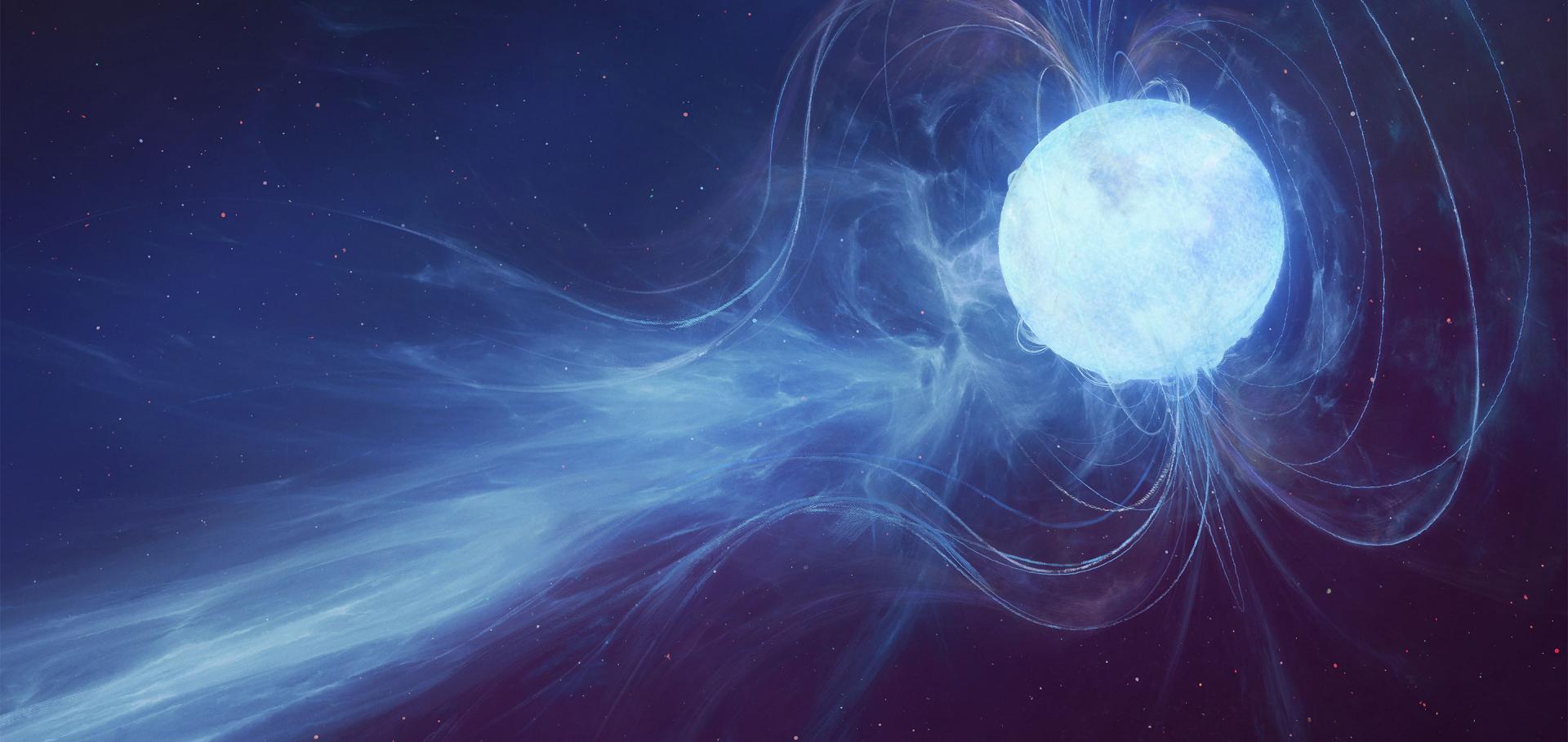
The Black Hole Candidate Swift J1728.9–3613 and the Supernova Remnant G351.9–0.9

The Astrophysical Journal American Astronomical Society 947:1 (2023) 38

Authors:

Mayura Balakrishnan, Paul A Draghis, Jon M Miller, Joe Bright, Robert Fender, Mason Ng, Edward Cackett, Andrew Fabian, Kip Kuntz, James CA Miller-Jones, Daniel Proga, Paul S Ray, John Raymond, Mark Reynolds, Abderahmen Zoghbi

Time-dependent visibility modelling of a relativistic jet in the X-ray binary MAXI J1803-298

Monthly Notices of the Royal Astronomical Society Oxford University Press 522:1 (2023) 70-89

Authors:

Cm Wood, Jca Miller-Jones, A Bahramian, Sj Tingay, Td Russell, Aj Tetarenko, D Altamirano, T Belloni, F Carotenuto, C Ceccobello, S Corbel, M Espinasse, Rp Fender, E Körding, S Migliari, Dm Russell, Cl Sarazin, Gr Sivakoff, R Soria, V Tudose

Abstract:

ABSTRACT
Tracking the motions of transient jets launched by low-mass X-ray binaries (LMXBs) is critical for determining the moment of jet ejection, and identifying any corresponding signatures in the accretion flow. However, these jets are often highly variable and can travel across the resolution element of an image within a single observation, violating a fundamental assumption of aperture synthesis. We present a novel approach in which we directly fit a single time-dependent model to the full set of interferometer visibilities, where we explicitly parametrize the motion and flux density variability of the emission components, to minimize the number of free parameters in the fit, while leveraging information from the full observation. This technique allows us to detect and characterize faint, fast-moving sources, for which the standard time binning technique is inadequate. We validate our technique with synthetic observations, before applying it to three Very Long Baseline Array (VLBA) observations of the black hole candidate LMXB MAXI J1803−298 during its 2021 outburst. We measured the proper motion of a discrete jet component to be 1.37 ± 0.14 mas h−1, and thus we infer an ejection date of MJD 59348.0+0.05-0.06,which occurs just after the peak of a radio flare observed by the Australia Telescope Compact Array (ATCA) and the Atacama Large Millimeter/Sub-Millimeter Array (ALMA), while MAXI J1803−298 was in the intermediate state. Further development of these new VLBI analysis techniques will lead to more precise measurements of jet ejection dates, which, combined with dense, simultaneous multiwavelength monitoring, will allow for clearer identification of jet ejection signatures in the accretion flow.

H.E.S.S. follow-up observations of GRB 221009A

Astrophysical Journal Letters American Astronomical Society 946 (2023) L27

Authors:

F Aharonian, Fa Benkhali, J Aschersleben, G Cotter

Abstract:

GRB 221009A is the brightest gamma-ray burst (GRB) ever detected. To probe the very-high-energy (VHE; >100 GeV) emission, the High Energy Stereoscopic System (H.E.S.S.) began observations 53 hr after the triggering event, when the brightness of the moonlight no longer precluded observations. We derive differential and integral upper limits using H.E.S.S. data from the third, fourth, and ninth nights after the initial GRB detection, after applying atmospheric corrections. The combined observations yield an integral energy flux upper limit of Φ UL 95 % = 9.7 × 10 − 12 erg cm − 2 s − 1 above E thr = 650 GeV. The constraints derived from the H.E.S.S. observations complement the available multiwavelength data. The radio to X-ray data are consistent with synchrotron emission from a single electron population, with the peak in the spectral energy distribution occurring above the X-ray band. Compared to the VHE-bright GRB 190829A, the upper limits for GRB 221009A imply a smaller gamma-ray to X-ray flux ratio in the afterglow. Even in the absence of a detection, the H.E.S.S. upper limits thus contribute to the multiwavelength picture of GRB 221009A, effectively ruling out an IC-dominated scenario.

The Optical Light Curve of GRB 221009A: The Afterglow and the Emerging Supernova

The Astrophysical Journal Letters American Astronomical Society 946:1 (2023) L22-L22

Authors:

MD Fulton, SJ Smartt, L Rhodes, ME Huber, VA Villar, T Moore, S Srivastav, ASB Schultz, KC Chambers, L Izzo, J Hjorth, T-W Chen, M Nicholl, RJ Foley, A Rest, KW Smith, DR Young, SA Sim, J Bright, Y Zenati, T de Boer, J Bulger, J Fairlamb, H Gao, C-C Lin, T Lowe, EA Magnier, IA Smith, R Wainscoat, DA Coulter, DO Jones, CD Kilpatrick, P McGill, E Ramirez-Ruiz, K-S Lee, G Narayan, V Ramakrishnan, R Ridden-Harper, A Singh, Q Wang, AKH Kong, C-C Ngeow, Y-C Pan, S Yang, KW Davis, AL Piro, C Rojas-Bravo, J Sommer, SK Yadavalli

Abstract:

Abstract We present extensive optical photometry of the afterglow of GRB 221009A. Our data cover 0.9–59.9 days from the time of Swift and Fermi gamma-ray burst (GRB) detections. Photometry in rizy -band filters was collected primarily with Pan-STARRS and supplemented by multiple 1–4 m imaging facilities. We analyzed the Swift X-ray data of the afterglow and found a single decline rate power law f ( t ) ∝ t −1.556±0.002 best describes the light curve. In addition to the high foreground Milky Way dust extinction along this line of sight, the data favor additional extinction to consistently model the optical to X-ray flux with optically thin synchrotron emission. We fit the X-ray-derived power law to the optical light curve and find good agreement with the measured data up to 5−6 days. Thereafter we find a flux excess in the riy bands that peaks in the observer frame at ∼20 days. This excess shares similar light-curve profiles to the Type Ic broad-lined supernovae SN 2016jca and SN 2017iuk once corrected for the GRB redshift of z = 0.151 and arbitrarily scaled. This may be representative of an SN emerging from the declining afterglow. We measure rest-frame absolute peak AB magnitudes of M g = −19.8 ± 0.6 and M r = − 19.4 ± 0.3 and M z = −20.1 ± 0.3. If this is an SN component, then Bayesian modeling of the excess flux would imply explosion parameters of M ej = 7.1 − 1.7 + 2.4 M ⊙ , M Ni = 1.0 − 0.4 + 0.6 M ⊙ , and v ej = 33,900 − 5700 + 5900 km s −1 , for the ejecta mass, nickel mass, and ejecta velocity respectively, inferring an explosion energy of E kin ≃ 2.6–9.0 × 10 52 erg.

Time-dependent visibility modelling of a relativistic jet in the X-ray binary MAXI J1803-298

(2023)

Authors:

CM Wood, JCA Miller-Jones, A Bahramian, SJ Tingay, TD Russell, AJ Tetarenko, D Altamirano, T Belloni, F Carotenuto, C Ceccobello, S Corbel, M Espinasse, RP Fender, E Körding, S Migliari, DM Russell, CL Sarazin, GR Sivakoff, R Soria, V Tudose