Comprehensive coverage of particle acceleration and kinetic feedback from the stellar mass black hole V404 Cygni

(2022)

Authors:

RP Fender, KP Mooley, SE Motta, JS Bright, DRA Williams, AP Rushton, RJ Beswick, JCA Miller-Jones, M Kimura, K Isogai, T Kato

A MeerKAT, e-MERLIN, HESS, and Swift search for persistent and transient emission associated with three localized FRBs

Monthly Notices of the Royal Astronomical Society Oxford University Press 515:1 (2022) 1365-1379

Authors:

Jo Chibueze, M Caleb, L Spitler, H Ashkar, F Schussler, Bw Stappers, C Venter, I Heywood, Ams Richards, Dra Williams, M Kramer, R Beswick, Mc Bezuidenhout, Rp Breton, Ln Driessen, F Jankowski, Ef Keane, M Malenta, M Mickaliger, V Morello, H Qiu, K Rajwade, S Sanidas, M Surnis, Tw Scragg, Crh Walker, N Wrigley, F Aharonian, F Ait Benkhali, Eo Anguener, M Backes, V Baghmanyan, V Barbosa Martins, R Batzofin, Y Becherini, D Berge, M Bottcher, C Boisson, J Bolmont, M de Bony de Lavergne, M Breuhaus, R Brose, F Brun, T Bulik, F Cangemi, S Caroff, S Casanova, J Catalano, M Cerruti, T Chand

Abstract:

We report on a search for persistent radio emission from the one-off fast radio burst (FRB) 20190714A, as well as from two repeating FRBs, 20190711A and 20171019A, using the MeerKAT radio telescope. For FRB 20171019A, we also conducted simultaneous observations with the High-Energy Stereoscopic System (H.E.S.S.) in very high-energy gamma rays and searched for signals in the ultraviolet, optical, and X-ray bands. For this FRB, we obtain a UV flux upper limit of 1.39 × 10⁻¹⁶ erg, cm-2, s-1Å-1, X-ray limit of ~6.6 × 10⁻¹⁴~erg, cm-2, s-1 and a limit on the very high energy gamma-ray flux Φ (E> 120, GeV) < 1.7× 10⁻¹², erg, cm-2, s-1. We obtain a radio upper limit of ∼15 μJy beam-1 for persistent emission at the locations of both FRBs 20190711A and 20171019A with MeerKAT. However, we detected an almost unresolved (ratio of integrated flux to peak flux is ∼1.7 beam) radio emission, where the synthesized beam size was ∼8 arcsec size with a peak brightness of ∼ 53, μJy beam-1 at MeerKAT and ∼ 86, μ Jy beam-1 at e-MERLIN, possibly associated with FRB 20190714A at z = 0.2365. This represents the first detection of persistent continuum radio emission potentially associated with a (as-yet) non-repeating FRB. If the association is confirmed, one of the strongest remaining distinction between repeaters and non-repeaters would no longer be applicable. A parallel search for repeat bursts from these FRBs revealed no new detections down to a fluence of 0.08 Jy ms for a 1 ms duration burst.

Energy partition between Alfvenic and compressive fluctuations in magnetorotational turbulence with near-azimuthal mean magnetic field

JOURNAL OF PLASMA PHYSICS 88:3 (2022) ARTN 905880311

Authors:

Y Kawazura, Aa Schekochihin, M Barnes, W Dorland, Sa Balbus

Abstract:

The theory of magnetohydrodynamic (MHD) turbulence predicts that Alfvénic and slow-mode-like compressive fluctuations are energetically decoupled at small scales in the inertial range. The partition of energy between these fluctuations determines the nature of dissipation, which, in many astrophysical systems, happens on scales where plasma is collisionless. However, when the magnetorotational instability (MRI) drives the turbulence, it is difficult to resolve numerically the scale at which both types of fluctuations start to be decoupled because the MRI energy injection occurs in a broad range of wavenumbers, and both types of fluctuations are usually expected to be coupled even at relatively small scales. In this study, we focus on collisional MRI turbulence threaded by a near-azimuthal mean magnetic field, which is naturally produced by the differential rotation of a disc. We show that, in such a case, the decoupling scales are reachable using a reduced MHD model that includes differential-rotation effects. In our reduced MHD model, the Alfvénic and compressive fluctuations are coupled only through the linear terms that are proportional to the angular velocity of the accretion disc. We numerically solve for the turbulence in this model and show that the Alfvénic and compressive fluctuations are decoupled at the small scales of our simulations as the nonlinear energy transfer dominates the linear coupling below the MRI-injection scale. In the decoupling scales, the energy flux of compressive fluctuations contained in the small scales is almost double that of Alfvénic fluctuations. Finally, we discuss the application of this result to prescriptions of ion-to-electron heating ratio in hot accretion flows.

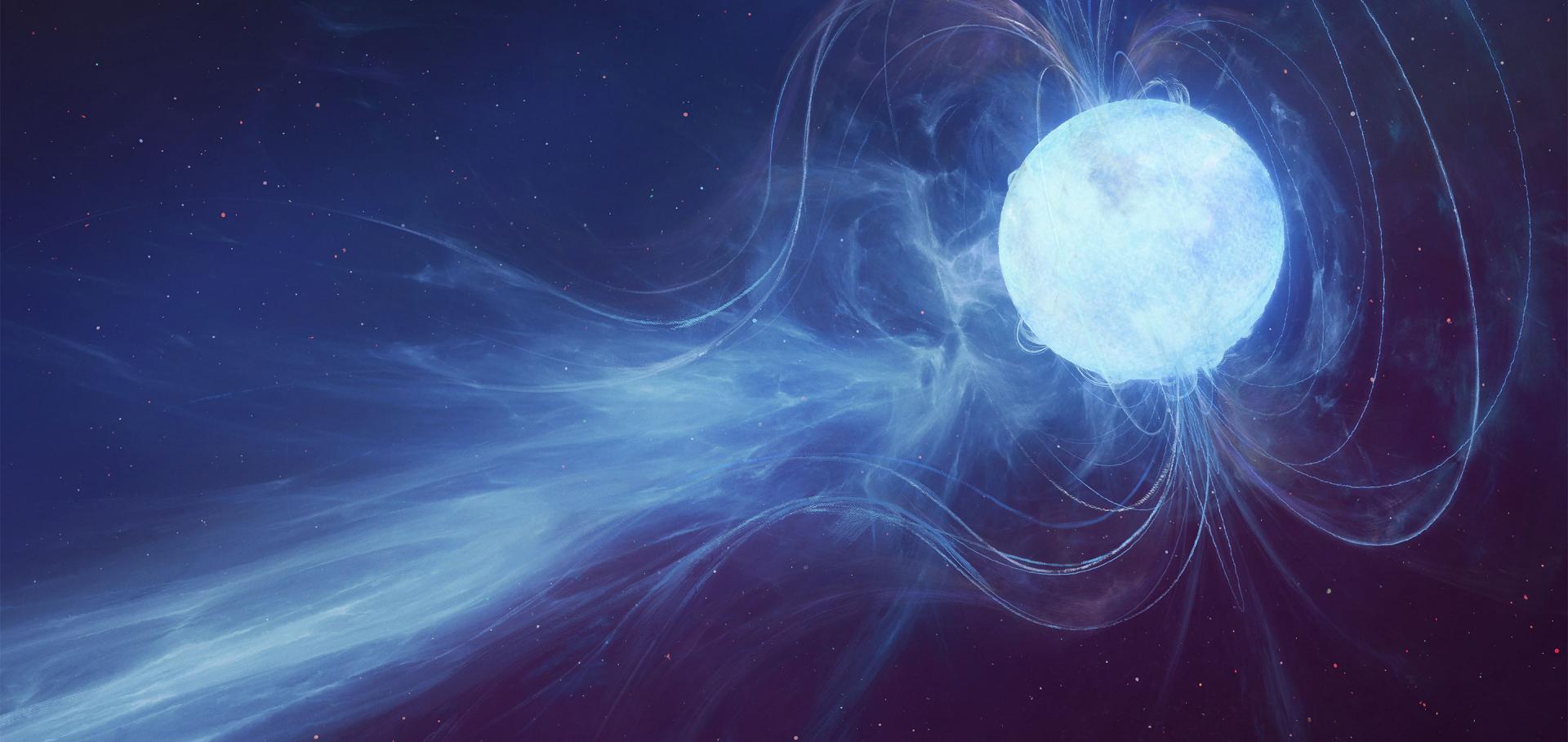
Discovery of a radio emitting neutron star with an ultra-long spin period of 76 seconds

(2022)

Authors:

Manisha Caleb, Ian Heywood, Kaustubh Rajwade, Mateusz Malenta, Benjamin Stappers, Ewan Barr, Weiwei Chen, Vincent Morello, Sotiris Sanidas, Jakob van den Eijnden, Michael Kramer, David Buckley, Jaco Brink, Sara Elisa Motta, Patrick Woudt, Patrick Weltevrede, Fabian Jankowski, Mayuresh Surnis, Sarah Buchner, Mechiel Christiaan Bezuidenhout, Laura Nicole Driessen, Rob Fender

A Multiwavelength Study of GRS 1716-249 in Outburst: Constraints on Its System Parameters

The Astrophysical Journal American Astronomical Society 932:1 (2022) 38

Authors:

Payaswini Saikia, David M Russell, MC Baglio, DM Bramich, Piergiorgio Casella, Maria Diaz Trigo, Poshak Gandhi, Jiachen Jiang, Thomas Maccarone, Roberto Soria, Hind Al Noori, Aisha Al Yazeedi, Kevin Alabarta, Tomaso Belloni, Marion Cadolle Bel, Chiara Ceccobello, Stéphane Corbel, Rob Fender, Elena Gallo, Jeroen Homan, Karri Koljonen, Fraser Lewis, Sera B Markoff, James CA Miller-Jones, Jerome Rodriguez, Thomas D Russell, Tariq Shahbaz, Gregory R Sivakoff, Vincenzo Testa, Alexandra J Tetarenko