

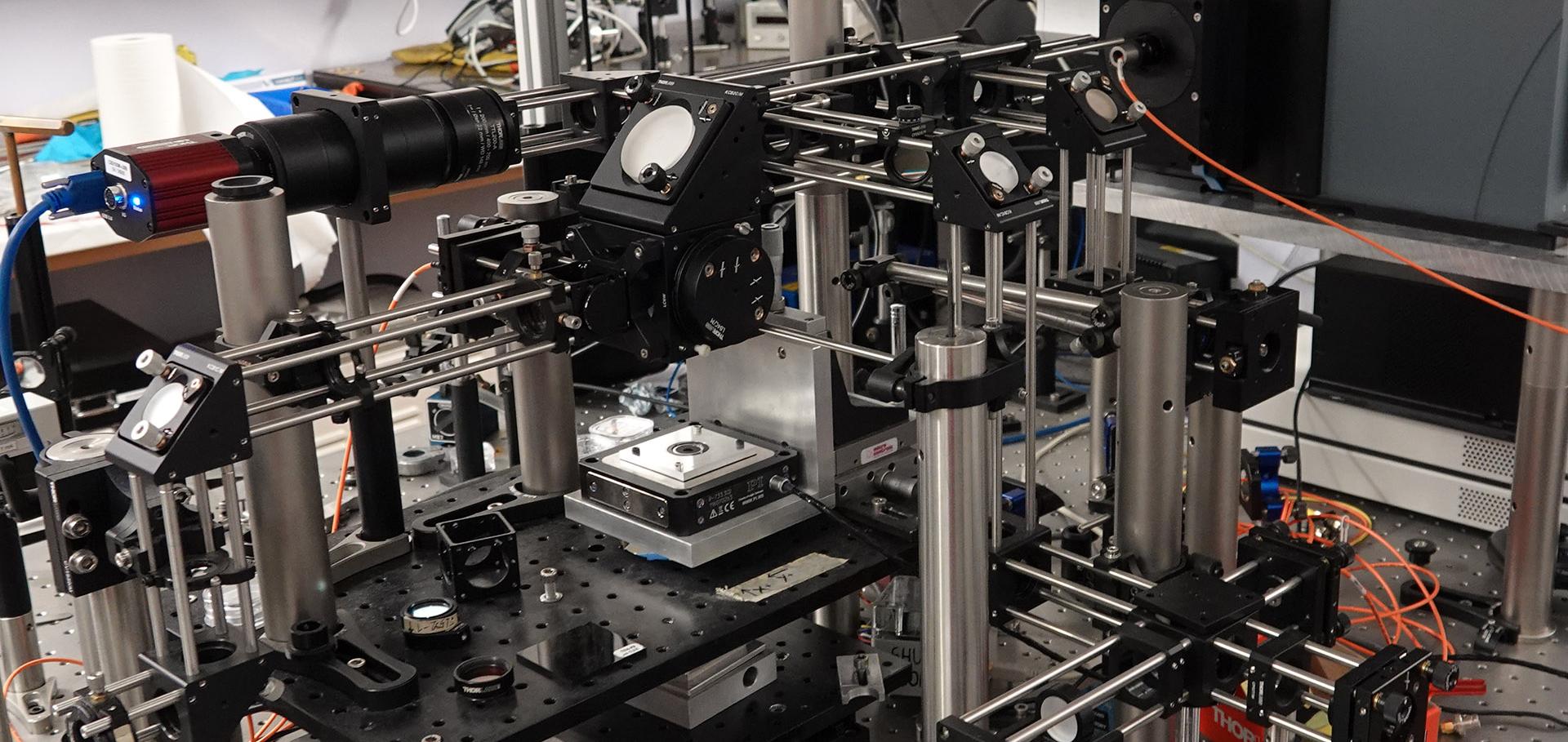
Time-resolved gain dynamics in InGaN MQWs using a Kerr gate
Physica E Low Dimensional Systems and Nanostructures 17:1-4 (2003) 255-257
Abstract:
The Kerr gate technique is used to time-resolve the gain in an InTime-resolved gain dynamics in InGaN MQWs using a Kerr gate
PHYSICA E 17:1-4 (2003) 255-257
Abstract:
The Kerr gate technique is used to time-resolve the gain in an In0.02Ga0.98N/In0.16Ga0.84N multiple quantum well sample. A new way of analyzing the data in such a variable stripe length method gain experiment is used to analyze the time-resolved spectra. The dynamics of the emission and gain are discussed. These measurements suggest that the photoexcited carriers must localize (possibly at indium-rich sites) before strong stimulated emission is seen. (C) 2002 Elsevier Science B.V. All rights reserved.Growth of InGaN quantum dots on GaN by MOVPE, employing a growth temperature nitrogen anneal
(2003) 2515-2519
Abstract:
We have studied the growth of InGaN epitaxial layers on GaN by MOVPE (metal-organic vapour phase epitaxy), and have discovered that nanostructures may be formed if a flat epilayer is annealed in molecular nitrogen immediately after growth. The size and density of the nanostructures are shown to be dependent on the growth/anneal temperature. We demonstrated the quantum dot nature of our nanostructures by performing spatially resolved photoluminescence on samples that had been capped with a layer of GaN, grown at the same temperature as the InGaN epilayer. This revealed narrow, delta-function-like lines in the luminescence spectrum with full width at half maximum (FWHM) limited by the resolution of the spectrometer at 4.2 K. Measurement of the FWHM as a function of temperature revealed significant broadening above 20 K. (C) 2003 WILEY-VCH Vertag GmbH & Co. KGaA, WeinheimInGaN quantum dots grown by metalorganic vapor phase epitaxy employing a post-growth nitrogen anneal
APPLIED PHYSICS LETTERS 83:4 (2003) 755-757
Dynamics and gain in highly-excited InGaN MQWs
Current Applied Physics 2:4 (2002) 321-326