

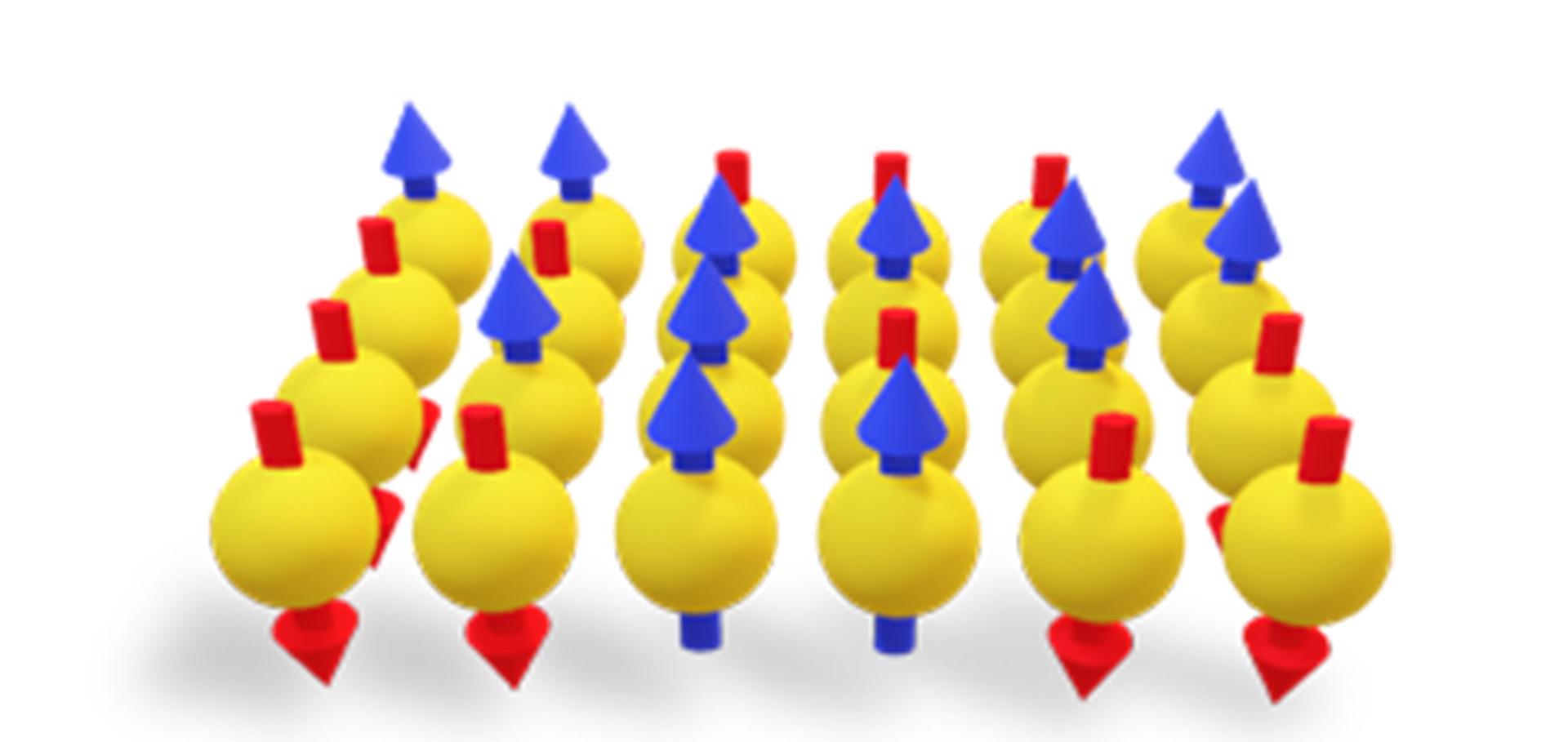
Bose-Hubbard lattice as a controllable environment for open quantum systems
Physical Review A American Physical Society 97:4 (2018) 040101(R)
Abstract:
We investigate the open dynamics of an atomic impurity embedded in a one-dimensional Bose-Hubbard lattice. We derive the reduced evolution equation for the impurity and show that the Bose-Hubbard lattice behaves as a tunable engineered environment allowing one to simulate both Markovian and non-Markovian dynamics in a controlled and experimentally realizable way. We demonstrate that the presence or absence of memory effects is a signature of the nature of the excitations induced by the impurity, being delocalized or localized in the two limiting cases of a superfluid and Mott insulator, respectively. Furthermore, our findings show how the excitations supported in the two phases can be characterized as information carriers.Coherent microwave-to-optical conversion via six-wave mixing in Rydberg atoms
Physical Review Letters American Physical Society 120:9 (2018) 093201
Abstract:
We present an experimental demonstration of converting a microwave field to an optical field via frequency mixing in a cloud of cold 87Rb atoms, where the microwave field strongly couples to an electric dipole transition between Rydberg states. We show that the conversion allows the phase information of the microwave field to be coherently transferred to the optical field. With the current energy level scheme and experimental geometry, we achieve a photon conversion efficiency of \sim 0.3\% at low microwave intensities and a broad conversion bandwidth of more than 4~MHz. Theoretical simulations agree well with the experimental data, and indicate that near-unit efficiency is possible in future experiments.Topological Spin Models in Rydberg Lattices
Chapter in Exploring the World with the Laser, Springer Nature (2018) 351-369
Exact matrix product decay modes of a boundary driven cellular automaton
Journal of Physics A: Mathematical and Theoretical 50:39 (2017)
Abstract:
© 2017 IOP Publishing Ltd. We study integrability properties of a reversible deterministic cellular automaton (Rule 54 of (Bobenko et al 1993 Commun. Math. Phys. 158 127)) and present a bulk algebraic relation and its inhomogeneous extension which allow for an explicit construction of Liouvillian decay modes for two distinct families of stochastic boundary driving. The spectrum of the many-body stochastic matrix defining the time propagation is found to separate into sets, which we call orbitals, and the eigenvalues in each orbital are found to obey a distinct set of Bethe-like equations. We construct the decay modes in the first orbital (containing the leading decay mode) in terms of an exact inhomogeneous matrix product ansatz, study the thermodynamic properties of the spectrum and the scaling of its gap, and provide a conjecture for the Bethe-like equations for all the orbitals and their degeneracy.The tensor network theory library
JOURNAL OF STATISTICAL MECHANICS-THEORY AND EXPERIMENT (2017) ARTN 093102